


Brian Niccol opened Starbucks’ 2026 Investor Day a way most corporate events never begin: with a coffee tasting.
Standing on stage at a venue on Manhattan’s West Side on January 29, 2026, the chairman and CEO invited master coffee developer Sergio Alvarez to join him. Together, they walked a room full of sell-side analysts and financial media through a tasting of 1971 Roast; a new dark roast named for the year Starbucks was founded.
Before a single slide appeared, the audience had cups in their hands. That wasn’t casual hospitality. That was a production decision – and it set the tone for an Investor Day designed to be experienced, not just watched.

The Stakes Behind Starbucks’ First Investor Day in Three Years
The stakes weren’t theoretical. This was Starbucks’ first Investor Day since 2023, its first under Niccol, and the highest-stakes communication moment in the company’s turnaround campaign. As of late January 2026, SBUX had declined roughly 13% over the trailing twelve months.
The “Back to Starbucks” initiative – Niccol’s signature strategy since arriving from Chipotle in September 2024 – had just delivered its first proof point: Q1 FY2026 earnings showed 4% U.S. same-store sales growth, the first positive traffic reading in eight quarters.
The event needed to accomplish two things simultaneously:
- Rebuild emotional conviction in the Starbucks brand
- Deliver a long-term financial model the Street could underwrite
It nailed the first. The second is where the seams showed.

The Investor Day Production Decisions That Shaped the Experience
Why the Coffee Tasting Was a Production Decision, Not Just Hospitality
Opening with a coffee tasting operated on multiple levels:
- Surface level: brand-appropriate hospitality
- Production level: an attention architecture strategy that broke the 8:00 AM slide-deck autopilot
- Narrative level: 1971 Roast references Starbucks’ founding year, anchoring a return-to-core turnaround in its literal origin story
The tasting required physical participation, activating sensory engagement that a keynote alone cannot. By the time Niccol began his formal remarks, the audience was already part of the brand experience, not just observing it.
Stage and Environment Design: Experience-as-Evidence
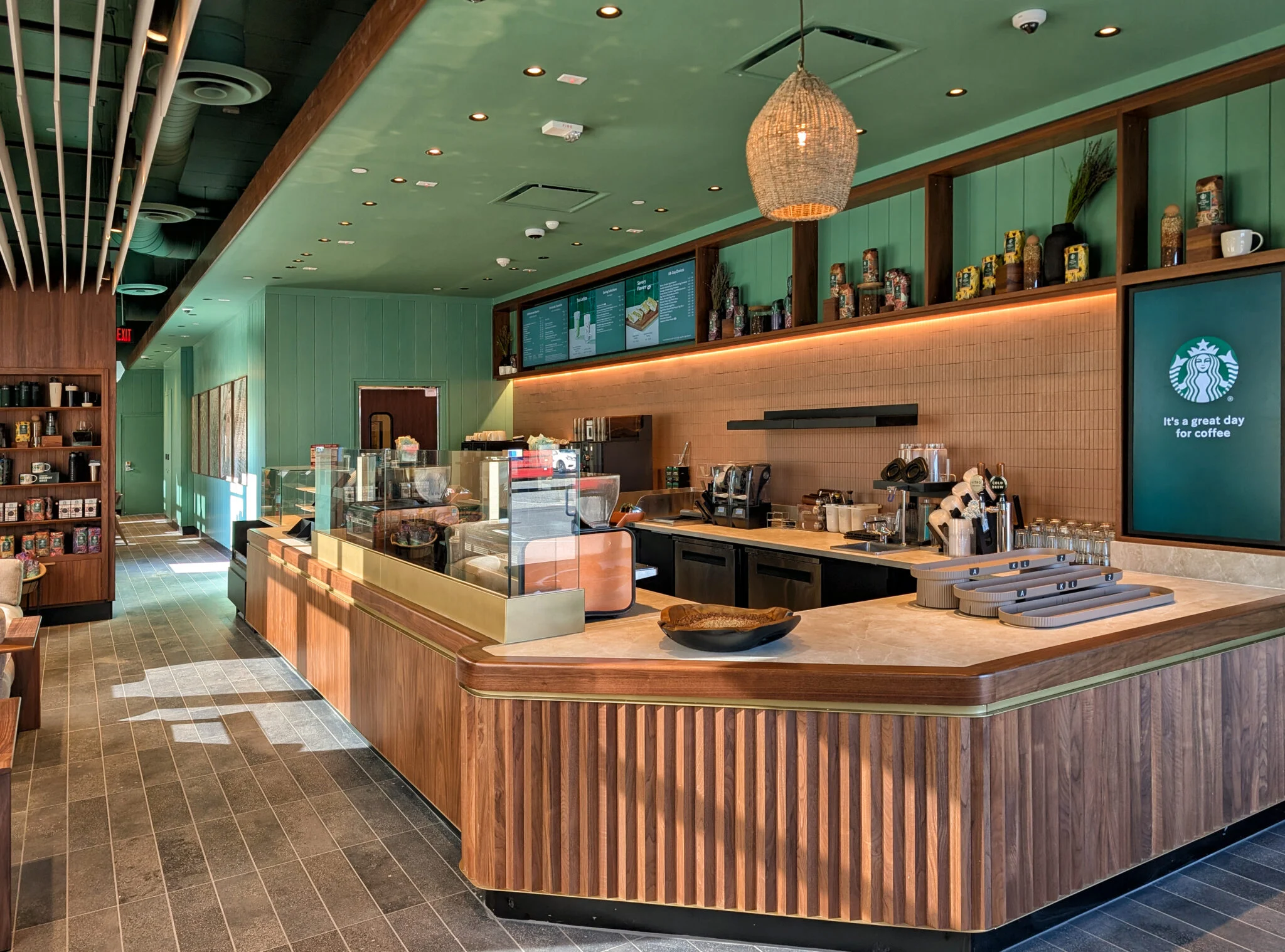
Starbucks made a production choice that few public companies attempt at this scale: they built the turnaround into the event space itself. Beyond the stage, the venue housed a floor model of Starbucks’ redesigned coffeehouse: leather seating, teak-colored display cabinets, warmer lighting, plants.
Analysts didn’t hear about the store renovation strategy through a slide. They walked through it. Upcoming menu items: a new matcha line, an ube beverage slated for spring – all available to taste. New espresso equipment and an AI-powered barista assistant were on display for hands-on interaction.
This is the experience-as-evidence production model.


When your turnaround story is about introducing and restoring a physical space (the coffeehouse), a considered, immersive experience in a controlled environment is more persuasive than any deck. The physical model gave analysts sensory proof that the capital investment in store renovations was producing something tangible, relevant, and compelling – not just a line item. That distinction matters.
The venue itself, on Manhattan’s West Side with a hybrid webcast, positioned the Investor Day as a destination event. After three years without one, the return to an in-person format signaled confidence.
The implication for any company investing in physical transformation is straightforward: if you’re spending significant capital to change what a customer experiences in your space, the most convincing production choice may be building that experience into the event itself.
How Starbucks Structured the “Back to Starbucks” Turnaround Narrative
The event ran approximately four hours, structured around five executive presentations with Niccol bookending the program. The speaker order followed a deliberate progression:
Tressie Lieberman, Global Chief Brand Officer, went first, establishing the emotional and cultural thesis before a single financial target appeared. The “Back to Starbucks” framing positioned the turnaround as a return to core identity – coffee, craft, connection – rather than a reinvention. That framing matters for analyst modeling: return-to-core stories anchor the growth thesis in proven economics. It’s a lower bar for conviction than an unproven pivot.
Mike Grams, Chief Operating Officer, followed with execution proof – operational improvements, staffing investments, the mechanics of how coffeehouses were actually changing on the ground.
Brady Brewer, CEO of Starbucks International, expanded the growth canvas: more than 2,000 net new international stores by 2028, a goal of reaching approximately 40,000 locations outside the U.S., and a China licensing partnership with Boyu Capital projecting international operating margins past 20%.
“The world wants more Starbucks,” Brewer told the room.
Cathy Smith, Chief Financial Officer, anchored the arc in the financial framework: 13.5–15% operating margin target by fiscal 2028, $3.35 to $4.00 earnings per share, and consolidated revenue growth of 5% or more.
The stakes weren’t theoretical. As of late January 2026, SBUX shares had declined approximately 13% over the trailing twelve months. Analysts were watching to see whether Niccol’s turnaround rhetoric would translate into a credible financial framework.
The event needed to accomplish two things simultaneously:
- Rebuild emotional conviction in the Starbucks brand
- Deliver a long-term financial model the Street could underwrite
Niccol returned to close, synthesizing four hours into a single thesis: “‘Back to Starbucks’ is the strategic currency of our turnaround.”
The Narrative Logic: Brand → Operations → International → Finance → CEO Synthesis
This approach is effective because each speaker builds on the previous, moving from “what we believe” to “what we’re doing” to “how big this gets” to “what the numbers say.” When executed well, this structure creates a compounding sense of inevitability, so financial targets feel like natural conclusions rather than aspirational claims.
By the time Smith presented margin targets, they landed as an expression of a brand strategy, an operational overhaul, and a growth opportunity that had been layered throughout the entire event.
Where it worked: The return-to-core framing, the evidence-first timing (positive earnings the day before), and the speaker sequencing created a narrative arc that was structurally sound.
Where it strained: The connective tissue between speakers could have done more to build momentum. The gap between “solid plan” and “this is a momentum story” is often a production and editorial challenge, not a strategy problem. The individual presentations delivered. The sum didn’t quite exceed the parts.
One underappreciated, key element: The timing. By scheduling the Investor Day one day after reporting the first positive U.S. same-store sales in two years, Starbucks let Niccol open with evidence instead of promises. Proof first, plan second. It’s one of the most effective sequencing techniques available to any company hosting an Investor Day.

How the Market Responded to Starbucks’ 2026 Investor Day
Despite strong production, the market response was flat.
- SBUX shares fell approximately 1.5% on January 29, reflecting both the prior evening’s earnings report and the Investor Day’s long-term targets. The stock continued sliding over subsequent sessions.
- Business Insider reporters who attended described the in-room vibe as “enthusiastic” and the plan as “reasonable, but not blockbuster.”
- TD Cowen analyst Andrew Charles raised his price target to $89 from $84 but maintained a Hold.
- By March, RBC Capital would downgrade Starbucks to Sector Perform, citing labor investments and growth expectations that had gotten ahead of the evidence.
Three specific gaps contributed to that disconnect.
1. The Guidance Gap
Starbucks targeted a 13.5-15% operating margin and $3.35-$4 EPS range by FY2028. The $3.35 to $4.00 EPS range spans nearly 20% of the midpoint.
In an event where every other signal – the tasting, the store model, Niccol’s conviction – pointed toward precision and control, that width introduced a completely different register. Deutsche Bank analyst Lauren Silberman called the range “too wide” during Q&A. Brian Jacobsen of Annex Wealth Management was more blunt: “Turning the ship around may be taking longer than originally hoped.”
The core problem? The experiential production built genuine conviction in the brand turnaround, but the financial framework didn’t match that confidence. When the room says “we’re back” and the guidance says “somewhere between here and there,” the audience has to choose which version to believe. The Street will always choose the conservative one.
For IR teams, this is the most directly actionable takeaway from the event. If your guidance range is genuinely uncertain, the presentation needs explicit bridging logic – walking analysts through the scenarios, the levers, and the specific conditions that determine where within the range the company lands. Transparency about the range is more credible than precision you can’t support. But the range alone, without that context, just reads as uncertainty.
2. The Cost Narrative Void
Post-event coverage and subsequent analyst actions consistently flagged the same concerns:
- Labor costs from staffing investments
- Store renovation expenses estimated at roughly $100,000 per location
- The pace of margin recovery
None of this was a surprise. These were the predictable questions any informed analyst would raise about a turnaround predicated on spending more to earn more. The event addressed those concerns – within Smith’s broader financial framework. But there’s a meaningful difference between addressing a concern and confronting it.
Addressing it means the data exists somewhere in the deck. Confronting it means building a dedicated moment with its own narrative structure, its own evidence, its own emphasis that tells the room: we know this is a question you have, and here is exactly how we’re thinking about it.
For example, the walkthrough of Starbucks’ loyalty program revamp included a specific, clear, relevant data point: if half of Starbucks’ loyalty members buy one additional time per year, it adds $150 million in annual revenue.
That single sentence converted a brand initiative into something an analyst could put in a spreadsheet. The cost narrative needed (but didn’t quite get) the same treatment.
The Hybrid Experience Gap
Starbucks ran this as a hybrid event with a live webcast. However, the experiential elements that made the in-person event distinctive – the tasting, the store model, the product previews – were precisely the elements that couldn’t translate through a stream.
This matters because the webcast audience is typically the larger audience – and often the one most directly trading the stock. If the live experience builds conviction through immersive details while the webcast delivers standard presentations, those two audiences leave with fundamentally different experiences and levels of belief.
The production solution here is editorial, not technological. Handheld camera work following analysts through the experiential space. Close-up footage of product interactions. Cinematic moments of storytelling. Reaction shots that capture what the room actually feels like. Narrated segments that translate live moments into visual story. Given that the entire thesis of this event was about the power of physical experience, ensuring every audience – not just the on onsite – received that message was critical.
What This Means for IR Teams
Regardless of any outcome, Starbucks approached this event asking the right question: what does it take to make an analyst really feel the revitalizing power of a turnaround, not just hear about it?
Starbucks’ 2026 Investor Day represents a genuine evolution in how consumer brands approach investor communications. The experiential format; building the brand experience into the event space, opening with sensory engagement, integrating product and technology demonstrations alongside formal presentations – is a model that will influence how companies think about these events going forward.
Starbucks proved you can immerse analysts in a brand story and generate real enthusiasm. But it also highlights a challenge that any IR team navigating a turnaround will face. The stock’s subsequent decline proved that enthusiasm without financial precision isn’t enough for the institutional audience. The most effective Investor Days will increasingly live at this intersection – experiential enough to build belief, financially precise enough to convert it. Where every immersive moment makes the financial story more specific – not more ambitious..
And to be clear, that’s not a Starbucks problem. The outcome of every Investor Day production lives at this intersection. Companies that master both will achieve the most valuable outcome in corporate communications: complete ownership of the narrative.
What IR Teams Can Learn from Starbucks’ Investor Day Production
1. Lead with Evidence, Not Promises
Starbucks timed their Investor Day one day after reporting the first positive U.S. same-store sales growth in two years. This allowed Niccol to open with proof (“4% same-store sales growth demonstrates the momentum we have”) rather than projections.
This evidence-first sequencing is immediately replicable for any company timing their Investor Day relative to a positive earnings cycle. If you have proof, let it precede the plan.
2. Design Your Opening to Break Audience Patterns
The coffee tasting reset audience expectations in the first five minutes. Most Investor Days open with forward-looking disclaimers and a CEO keynote. Starbucks opened with a sensory experience that was brand-aligned and participatory.
The question for IR teams: what’s the equivalent of a coffee tasting for your brand? What production choice in the first five minutes forces your audience out of autopilot and into active engagement?
3. Build Experiential Proof for Physical Transformation Claims
When your turnaround story involves a physical experience (a store redesign, a product improvement, a service model change), showing is exponentially more convincing than telling. Starbucks’ floor model of the redesigned coffeehouse gave analysts tactile evidence.
The investment in building that environment inside the event space is a production cost that pays back in conviction. For any company investing in physical transformation, consider building the proof into the event.
4. Close the Gap Between Guidance and Narrative Confidence
When your experiential production says “we’re confident,” your financial guidance must match that confidence. Wide EPS ranges undermine the precision of everything else.
If a range is genuinely uncertain, the production should include explicit bridging logic that walks analysts through the scenarios. Not to eliminate uncertainty, but to demonstrate that leadership understands the range as clearly as the Street does.
5. Anticipate the Ask – Plan a Dedicated “How We Pay for This” Moment
Every turnaround involves investment. Every analyst audience will ask “at what cost?”
If the answer is embedded in a broader financial overview, it’ll get lost. Dedicate a segment, with its own narrative structure and its own data, to directly address:
- The cost of the turnaround
- The specific savings levers
- The timeline to margin recovery
Pre-empt the narrative the Street will write if you don’t.
6. Solve the Hybrid Investor Day Production Gap
If your Investor Day includes experiential or immersive elements, your webcast production must translate them. In most hybrid events, the remote audience is the larger audience.
Build a broadcast strategy specifically for the elements that can’t be physically shared:
- Reaction shots and narrated walkthroughs
- Close-up B-roll of products and interactions
- Post-segment recaps that capture what the room experienced
The remote audience should feel the room, not just watch the stage.
Frequently Asked Questions
Starbucks held its 2026 Investor Day on January 29 in Manhattan. It was the company’s first in three years and the first under CEO Brian Niccol. The event featured a five-speaker presentation structure, an experiential floor model of Starbucks’ redesigned coffeehouse, product tastings, technology demonstrations, and a financial framework targeting 13.5–15% operating margins and $3.35–$4.00 EPS by FY2028. SBUX shares fell approximately 1.5% on the day.
The immediate market reaction was tepid. SBUX declined approximately 1.5% on January 29 and continued falling over subsequent sessions. Analyst reactions were mixed: TD Cowen raised its price target but maintained a Hold, Deutsche Bank flagged the wide guidance range, and RBC Capital downgraded Starbucks to Sector Perform in March 2026. In-room reception, however, was described as “enthusiastic” by attending reporters.
“Back to Starbucks” is CEO Brian Niccol’s turnaround strategy focused on restoring the coffeehouse experience around three pillars: coffee, craft, and connection. Introduced after Niccol joined from Chipotle in September 2024, the strategy emphasizes store redesigns, improved staffing, menu simplification, and a renewed focus on in-store experience. Q1 FY2026 results showed its first proof point: 4% U.S. same-store sales growth.
Effective Investor Day production combines narrative architecture, experiential design, and financial precision. Key elements include evidence-first timing (reporting positive results before the event), experiential proof that supports strategic claims, clear speaker sequencing that builds a compounding narrative, dedicated cost-and-margin segments, and hybrid broadcast strategies that translate in-room experiences for remote audiences.
Check out more about our process, here.
The biggest challenge in hybrid Investor Day production is the asymmetry between in-room and webcast experiences. Companies should invest in dedicated broadcast storytelling for remote audiences: handheld camera work through experiential spaces, reaction shots, narrated B-roll packages, close-up product footage, and post-segment recaps. The goal is ensuring remote viewers feel the room, not just watch the stage./
Thinking about your next Investor Day?
Every analyst walks in with questions. The most effective events answer them before they’re asked, through narrative architecture, experiential production, and financial precision that earns the room’s conviction. Let’s start a conversation →
- “Starbucks seeks pre-pandemic profit margins at CEO Niccol’s first investor day” — Reuters, January 29, 2026
- “3 takeaways from Starbucks’ Investor Day” — Restaurant Dive, January 30, 2026
- “We went to Starbucks’ first investor day in 3 years” — Business Insider, February 1, 2026
- “Starbucks Investor Day Fails to Perk Up Stock — But Retail Traders Turn Extremely Bullish” — Stocktwits, January 31, 2026
- “Starbucks turnaround plan hits costly snags” — TheStreet, February 1, 2026
- “RBC downgrades Starbucks after strong 2026 start, says growth expectations are too high” — CNBC, March 18, 2026
