FOOH (fake out-of-home – CGI spectacle staged on real footage of real places) is a legitimate, high-performing format. But AI has collapsed the cost of entry just as disclosure rules for synthetic ad content have spiked – led by the states. The brands that win treat FOOH as a production discipline with proof, not a prank.
Nobody ever needed Maybelline’s giant mascara wand on the London train to be real. That’s the point of the format. The lashes sweeping the carriages, Jacquemus’s handbags driving through Paris, the impossible objects parked on real streets. Audiences got the joke almost immediately, and the punchline earned hundreds of millions of views.
This format has a name, FOOH – fake out-of-home advertising – and in our experience it’s the most misunderstood line item in the modern social budget. Teams either treat it as a cheat code with no rules, or refuse to touch it because “fake” sounds like a liability.
Both are wrong, and the reason is the same. FOOH doesn’t fail because it’s fake. It fails when the audience can’t tell whether it’s supposed to be – and the format’s earliest hits sat closer to that line than most people remember. The comment sections asking “is this real?” weren’t a bug in those campaigns. They were the point of the playbook. That trick worked once, when the format was new. Now, it’s the exact behavior the disclosure rules target.
FOOH advertising is CGI or AI-generated spectacle composited onto real footage of real places – social video a brand publishes, not media space it buys. It works when the illusion is confident enough that the audience is in on it. But it turns into a trust problem when viewers genuinely believe a physical installation exists.
That second scenario is no longer just a comms risk – states have begun requiring disclosure of AI-generated content in advertising, and existing truth-in-advertising rules already reach synthetic content that presents as real. The fix isn’t avoiding the format. It’s producing the content like a stunt: real foundation footage, deliberate craft, and a documented decision about how the audience finds out.
Our perspective: We shoot the real world for a living – the streets, facilities, and city plates underneath illusions like these – and we produce for brands whose work faces real scrutiny. So we come at FOOH from the ground up: the foundational content that supports the fantasy is our department.
Lose the acronym and it’s simple: an out-of-home ad that was never really out of home. A team shoots or licenses footage of a real location – a landmark, a transit line, a storefront – and composites an impossible brand object into it. The film ships to social, where it behaves nothing like a billboard and everything like scroll-stopping entertainment.
The economics explain the popularity of this format. A physical spectacular means leases, permits, fabrication, and one city. A FOOH film means a location plate and post-production, and it plays everywhere at once.
Then, generative AI collapsed the cost again. One artist can now rough out in days what once took a VFX team weeks – which is why feeds were full of floating products and CGI content, and why the format’s early novelty advantage is gone. When everyone can fake a branded moment, the faking isn’t the idea anymore.
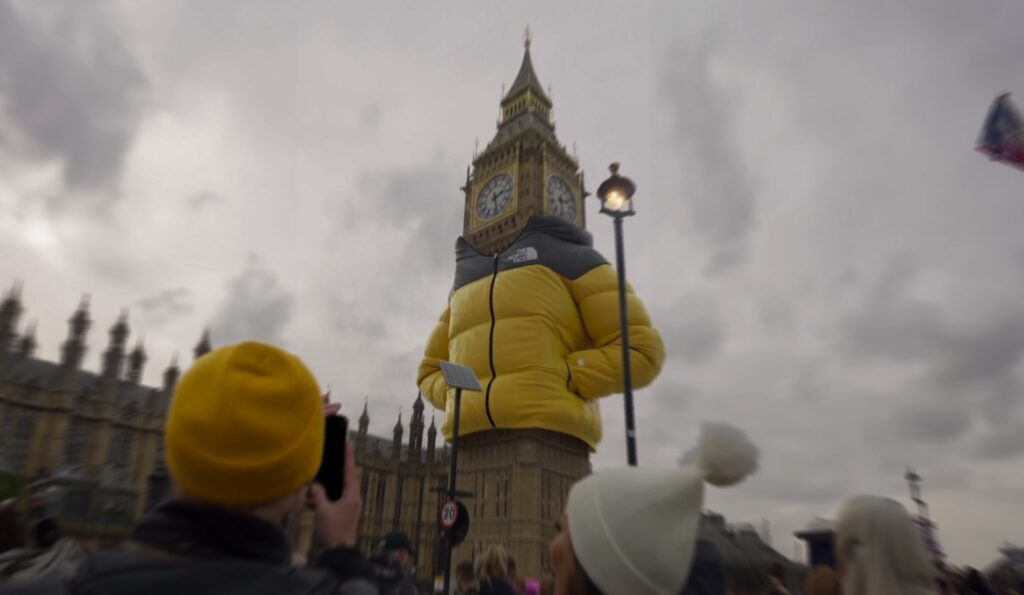
The pattern we see is consistent: audiences forgive spectacle and punish ambiguity.
The campaigns people love operate like a magic trick. Nobody storms the stage because the magician didn’t actually saw someone in half. The audience being aware of the trick is the pleasure. The best FOOH plays the same way: the impossible object is so gleefully impossible that the video reads as wit, not deception. The physics stretch. The scale winks. The comment section is part of the show.
The campaigns that backfire share a different trait: plausibility without disclosure. A composited installation that a reasonable person could believe exists – a realistic pop-up, a believable projection, a product placement that looks documentary – invites people to visit, share, and report on something that isn’t there. When they find out, the story stops being about the brand’s imagination and starts being about the brand’s honesty. And once one “was this real?” moment goes badly, every future post gets the skeptical read.
That’s the whole design principle in one line: make it spectacularly impossible, or label it clearly. The dangerous work lives in between.
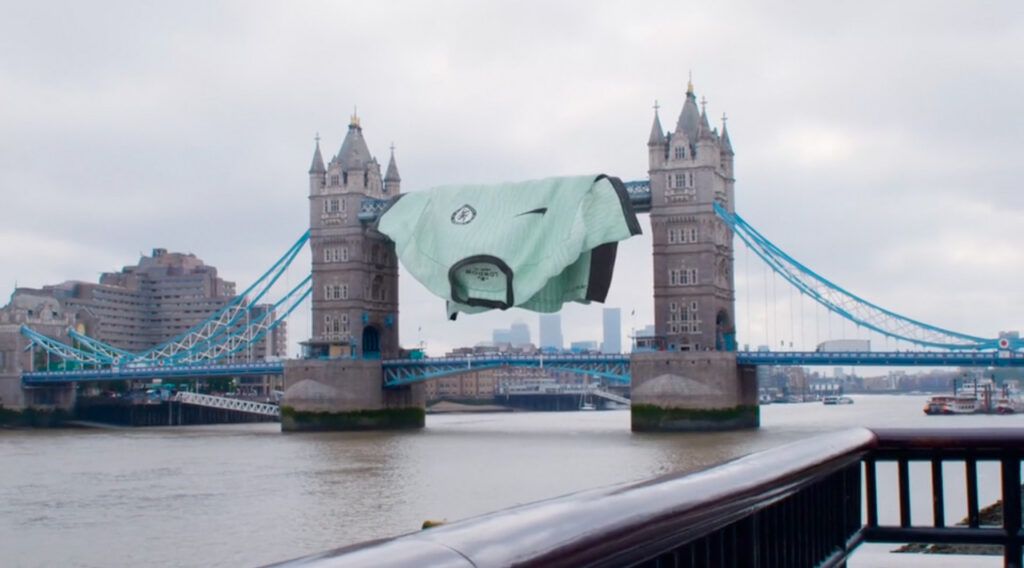
The informal era is closing – just not from the direction most teams expect. Federal regulators have signaled restraint on AI enforcement this year, but the FTC’s position on synthetic content in advertising hasn’t moved. Existing deception and endorsement rules apply to AI-generated material with the same force as anything else, and content that presents as real when it isn’t sits squarely inside them. The real momentum is in the statehouses.
New York’s disclosure requirement for AI-generated synthetic performers in advertising took effect this June, with similar bills introduced in other states. Which means a national campaign now answers to a patchwork rather than a rulebook. Nobody wrote any of it with FOOH in mind, and that’s exactly the problem. Rules built for deepfakes and virtual influencers don’t pause to ask whether your levitating sneaker was meant as a joke. (Not legal advice; which statutes touch any one campaign depends on where and how it runs.)
For most brands the practical translation is boring and freeing at the same time: a small, confident label – “CGI,” “digital art,” “not a real installation” – costs the campaign nothing. The audience already suspects; confirming it reads as confidence. What the label buys you is the difference between a clever stunt and a deception if anyone official ever asks. Think of it as the permit. A physical stunt needs one before the crane arrives; the digital stunt’s permit is the disclosure (and it’s a lot cheaper).
Now that generation is cheap, the differentiator moved back upstream to the thing AI can’t source for you. The real-world foundation for your illusion. Four production calls we’ve learned matter most:
None of this requires a bigger budget. It requires treating a thirty-second social film with the same production discipline as the work that runs on television – which, not coincidentally, is where the format’s best examples came from.
Yes – with the volume in mind. A consumer brand’s FOOH misfire costs it a news cycle. Customers read a public company’s feed – and so do investors, journalists, and analysts. “This company published something fake without saying so” is a sentence that travels differently when there’s a ticker attached. The standard doesn’t change; the margin for ambiguity shrinks. For a listed brand, we approach the disclosure as essential, keep the illusion firmly in the spectacularly-impossible zone, and keep the record of who approved what. (What the broader flood of AI-generated content is doing to audiences’ appetite for the real thing is a separate argument, and we’ve made it here.)
Done that way, FOOH is actually a natural fit for corporate moments that struggle for attention – a launch, an anniversary, an opening – because it delivers scale without a crane.
FOOH is what happens when production craft and internet culture shake hands: a format where being fake is the point, as long as everyone’s in on it. The brands getting it right aren’t the ones with the best prompts. They’re the ones treating the illusion like an actual shoot. Real plates, real physics, a real decision about the reveal, and a paper trail behind all three.
If you’re planning FOOH content, send us the idea and the location you have in mind. We’ll tell you honestly what needs a camera, what needs a compositor, and where the label goes.
FOOH – fake out-of-home – is digital video that composites CGI or AI-generated brand spectacle onto real footage of real locations, made to resemble an outdoor installation that never physically exists. It runs on social media; nobody buys physical ad space.
The format itself is legal; the risk sits in ambiguity. The FTC applies existing deception and endorsement rules to synthetic content, and New York now requires disclosure of AI-generated synthetic performers in ads, with similar bills pending in other states. A clear label and an obviously impossible premise keep most campaigns comfortably clear.
Best practice is yes – a short caption label such as “CGI” or “digital creation.” If the depicted installation is plausible enough that a reasonable viewer might believe it exists, the disclosure stops being best practice and becomes essential.
Because the real plate is what sells the illusion. A genuine location brings specific light, texture, and imperfection that fully generated environments lack – and generated backgrounds converge on the same generic look across every brand using the same tools.
Yes, and it suits attention-starved corporate moments well. But a listed company’s content reaches investors and press as well as consumers, so treat the disclosure standard as non-negotiable and keep the illusion unmistakably impossible.
Getty Images has been one of the biggest names in visual content for decades, and Getty Custom Content is its answer for brands that want imagery created specifically for them: a global creator network, exclusive selected assets, and established rights infrastructure.
But Getty is not the only way to build a custom brand footage library.
A growing set of production companies, creator networks, and custom stock specialists now solve the same underlying problem. How do you create a large volume of high-quality, on-brand visual content that works across campaigns, instead of producing everything one project at a time?
If you’re evaluating Getty Custom Content alternatives, the most useful question is not who can shoot the footage. It is this. What kind of content library are you trying to build, how will you use it, and which production model creates the most long-term value?
Here is the framework sophisticated brands use to decide.
Getty Custom Content is Getty’s custom production offering for brands that need exclusive photography or video built around a specific brief. Unlike traditional stock, which already exists and can be licensed by many customers, Custom Content is produced for the commissioning brand alone.
That distinction matters. You are not buying stock. You are commissioning a stock-style content library for your brand.
This is the biggest distinction, and the one most often missed.
A campaign shoot is optimized around a specific edit. Custom stock is optimized around coverage. Instead of capturing only what today’s commercial requires, the crew intentionally captures variation. Different compositions, focal lengths, talent combinations, actions, environments, and framings. Vertical and horizontal. Close-ups and wides.
The goal is footage that stays useful long after the original campaign ends.
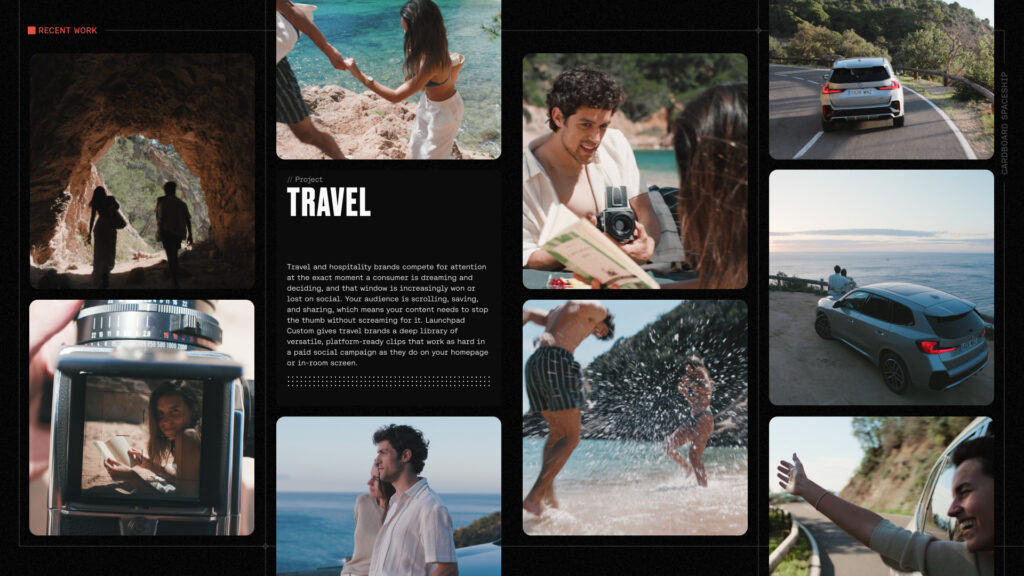
At Cardboard Spaceship, licensed stock footage productions are structured specifically around building an evergreen library rather than a single deliverable. The model emphasizes versatile coverage that can be re-contextualized across messages, channels, and seasons.
When comparing providers, ask one question. How is your production process different when the goal is a reusable footage library? If the answer sounds exactly like their commercial process, they are not really offering custom stock.
Shoot cost alone is a misleading number. The metric that matters is cost per usable asset.
A production that generates 150 highly usable clips creates fundamentally different economics than one that generates 20, regardless of the day rate. Before signing, ask prospective partners:
A provider that structures shoots as stock-ready productions should be able to answer these questions immediately, with specifics.
Different providers use very different creative models, and none is inherently better.
Getty’s advantage is scale. Its contributor network spans markets and geographies, which matters for multinational brands commissioning content across regions.
Curated production models sit at the other end. Cardboard Spaceship’s Custom Stock approach selects experienced filmmakers around the creative needs of each production, with an emphasis on cinematic quality and creators who understand how footage functions inside a licensed library.
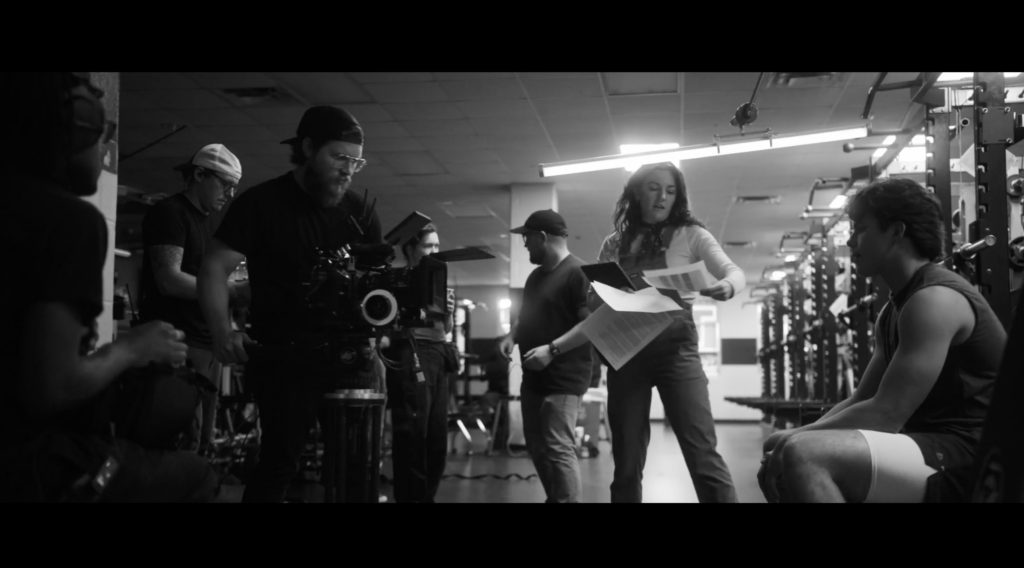
Distributed creator platforms occupy a third position, connecting brands with photographers and videographers who produce product-centered content at volume.
If geographic reach is the priority, scale wins. If cinematic consistency and creative direction are the priority, curation wins. Be honest about which one your brand actually needs.
“Custom” can mean very different things. Before choosing a partner, understand who controls creative direction, casting, locations, wardrobe, shot lists, camera style, and final asset selection.
For some brands, the goal is simply content more relevant than generic stock. For others, every frame needs to look unmistakably like the brand. That second standard requires more than sending creators a brief. It requires a production partner who aligns on brand, audience, and distribution before a camera turns on, then lets the client curate the strongest footage into the final library.
When interviewing potential partners, ask one simple question. Who makes the creative decisions? The answer tells you most of what you need to know.
Great footage is useless if nobody knows where the company is allowed to use it. Rights should be one of the first things you compare, not a detail resolved after production.
Any credible provider should answer these clearly, in writing:
Cardboard Spaceship delivers selected clips as cleared, licensed assets intended for broad use across paid, owned, and earned channels. Do not assume every provider’s definition of custom content includes the same rights.
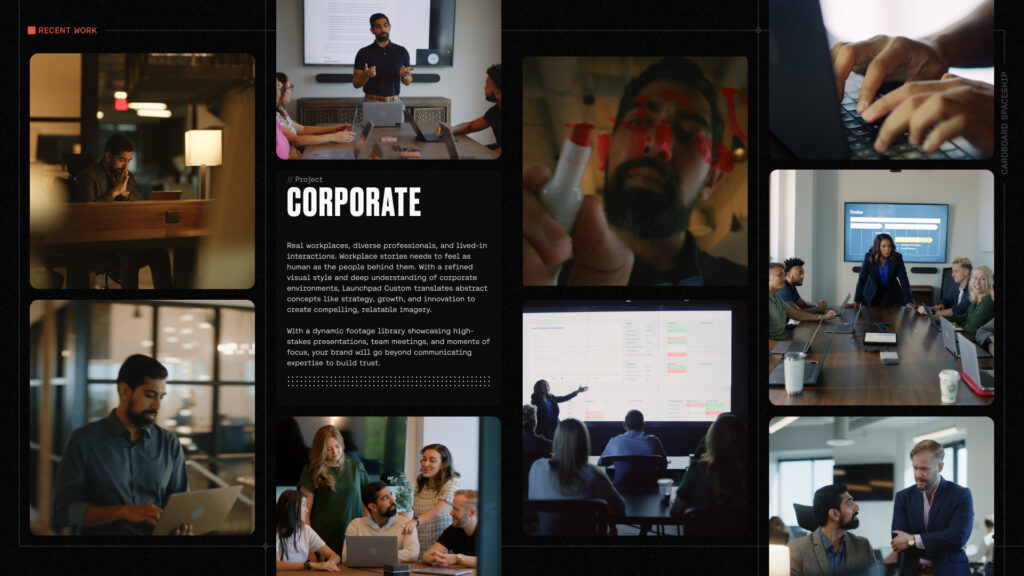
A strong custom library should reduce how often your team says, “We don’t have anything that works for this.”
Consider everywhere a single library may eventually appear. Paid and organic social. Websites and landing pages. Recruiting campaigns. Investor presentations and corporate video communications. Product launches, trade shows, and brand films.
The footage does not need to be created for any one of those deliverables. It needs to be flexible enough to work in many of them. That is why evergreen actions, clean environments, and strong coverage carry so much value.
The real return on custom stock is not what the footage does in its first month. It is what the footage eliminates the need to reshoot over the next two or three years. Content that compounds instead of expiring with a campaign.
Not every project should be a library. If your real need is one hero commercial or a single brand film, designing the shoot around custom stock adds complexity you do not need. A full-service video production engagement built around that one deliverable will serve you better.
The decision comes down to the question you are asking. “How do we make this one piece exceptional?” points to traditional commercial video production. “How do we stop starting from scratch every time we need content?” points to custom stock.
This is the distinction that should drive the entire evaluation.
Traditional stock is an expense. A well-constructed custom stock library behaves differently. It becomes a brand asset. Each production adds new people, environments, products, and stories to a growing visual ecosystem, and every reuse increases the return on the original investment.
The question stops being what the shoot costs. It becomes how many future pieces of content the shoot can help you create.
If the goal is simply another video, commission another video. However, if the goal is a proprietary footage library that gets more valuable every time it is used, build a proprietary custom stock footage library that delivers more value with every campaign. Choose a provider that creates versatile footage for long-term use across marketing, advertising, social media, and future productions.
Cardboard Spaceship helps brands create reusable video content libraries that maximize the value of every shoot. Through our custom stock model, we deliver premium, cinematic content – purpose-built for your brand, and designed to work across campaigns, channels, and time.
If that is the library you are trying to create, we should talk.
There is no single best alternative for every organization. Brands seeking premium cinematic footage built as an evergreen library are best served by a curated production model like Cardboard Spaceship’s Custom Stock. Brands needing distributed product content across markets may prefer a creator-network platform. The right choice depends on what you are building.
Custom stock footage is professionally produced video created around a specific brand but intentionally shot for reuse across many future projects. It can feature the brand’s people, products, locations, and visual style while retaining the versatility of stock.
A commercial shoot is optimized around completing one specific edit. A custom stock production is optimized around creating a large collection of individual clips that support multiple future campaigns and deliverables.
It depends on the agreement. Rights, exclusivity, and ownership vary by provider, so examine the specific license rather than assuming “custom” means unrestricted ownership. Cardboard Spaceship delivers selected Custom Stock clips cleared and licensed for broad brand use.
It is most valuable for organizations with ongoing video needs across multiple campaigns and channels. If footage from one production can be reused in paid media, websites, social, presentations, and future edits, evaluate the cost across all of those uses, not against a single video.

Nobody holds a meeting about where footage comes from. A launch needs shots, the timeline is tight, somebody charges a subscription or a generation credit, and the work ships. Then it happens again, and again, and the pattern hardens into a habit. In our experience that’s how footage sourcing actually works: not a decision, an accumulation. Two years of it and a brand is running a visual identity assembled from material other people made, none of it owned, some of it live in a competitor’s ad that same week.
There are three ways to get footage: generate it, license it, or commission it. Teams choose poorly because they compare the cost of a clip today – instead of what the material has to do over the next two years. They price the clip instead of the asset – the one that pays back the longest: footage shot for them, that only they can use. That single substitution is what leaves brands paying repeatedly for footage they never come to own.
Here’s a short breakdown:
We’re on the supply side of this market. We shoot footage, we clear it, we manage the rights, and we license it. Our existing collections live on Filmsupply, which licenses cinematic work from established production companies rather than aggregating clips from anywhere, and we build custom libraries for brands that need material nobody else can access.
So, this is not a neutral comparison, and we’d rather say that plainly than pretend otherwise. Read it the way you’d read a seller’s disclosure: written by the seller, yes, but the seller is the one who knows which floorboards creak.
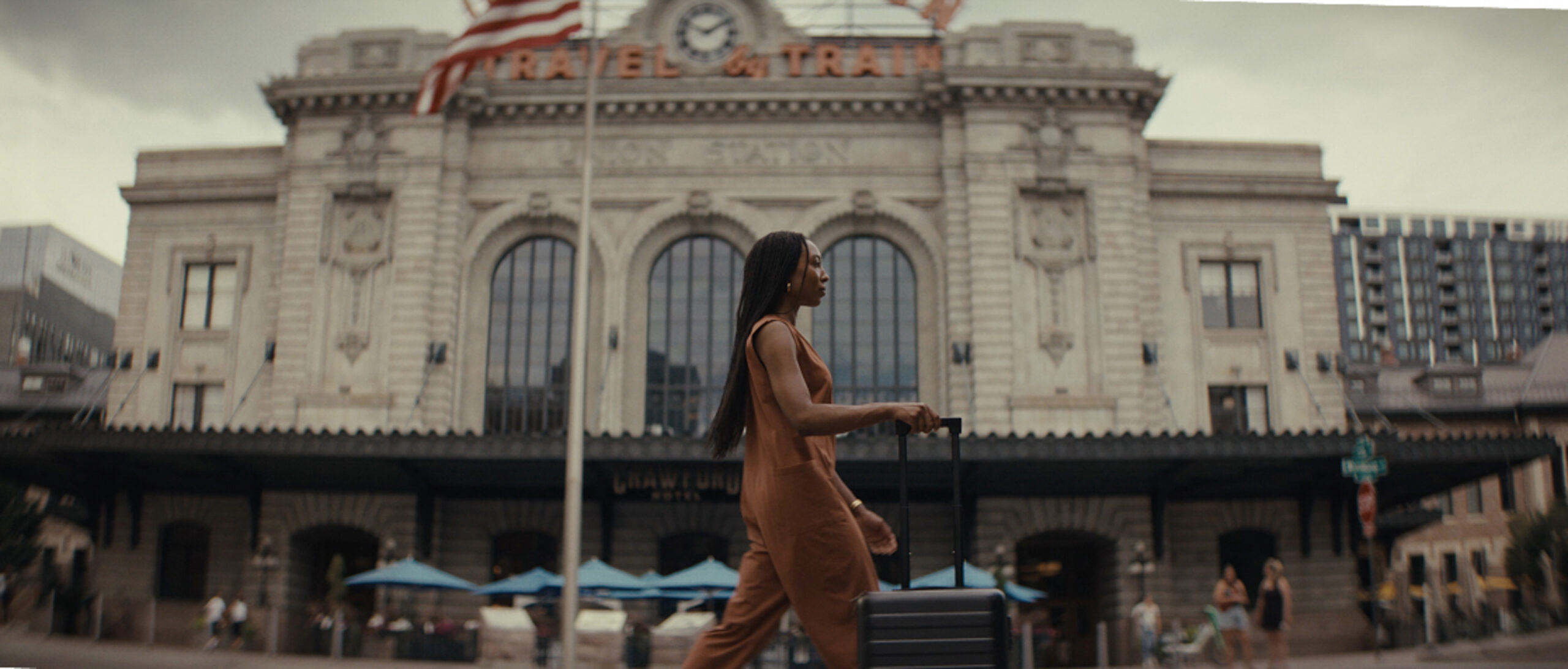
You’re buying three things, and the clip is only the one you can see: a set of rights, an exclusivity position, and a shelf life.
AI-generated video is weak or unsettled on all three. Commodity marketplace stock is usually fine on rights and poor on the other two: thousands of buyers hold the same clips, the sources are unrelated to each other, and no continuity from one clip to the next – which is why footage assembled that way rarely cuts together into anything that feels like one brand. Curated licensed footage, the kind that comes from real productions rather than a submissions pipeline, is strong on rights and genuinely strong creatively, and it’s shared by design. Custom footage is the only option where you set all three variables yourself.
So the real question isn’t licensing or custom. The question is whether your brand’s look is something you own or something you rent. Most brands never notice they’ve made the choice.
Licensed footage is material someone shot, someone appeared in, and someone cleared. A professional license from a reputable source should give you three protections:
The word “stock” hides an enormous range of products. At one end sit open marketplaces aggregating footage from thousands of contributors, sometimes with limited visibility into how any individual clip was produced. At the other sit curated libraries built from real commercial productions, where the material came off a real set with a crew, a director, a producer, cleared talent, and an established clearance process behind it. Both get called stock footage. They are not the same product, they don’t deliver the same result, and only one of them enters a premium brand film without immediately announcing itself as a stock shot.
Our collections sit on Filmsupply for exactly that reason. The platform licenses work from production companies rather than running an open submission marketplace, so what you’re licensing came from professional sets and established production teams.
What licensing doesn’t give you, by design, is exclusivity. Other brands can license the same material. That’s a fair trade while the footage supports your story. It gets harder to justify once the footage starts to define it.
Generation gives you speed, volume, and creative flexibility, and for some projects those benefits genuinely outweigh the limitations. What it cannot give you is a record. For public-facing brand work, the ownership and rights record still has four specific gaps:
Custom stock footage is material shot to your brief and licensed to you. Sometimes that’s a commissioned shoot built around a single campaign. More often the stronger investment is a purpose-built library designed to feed everything the brand expects to produce over the next several years.
It uses the same crews, cameras, production standards, and clearance processes as premium licensed work. The difference is that every decision gets made around your brand: your people, your products, your facilities, your locations, your visual language, your content calendar. The production record is clean because you commissioned the work. Releases get collected on the day and attached to the assets. Usage terms are written for what you actually need. Exclusivity is available.
Rights coverage is the foundation, not the reason. The business case is what a library does to your cost, your speed, your consistency, and your competitive position.


Four things worth the money, and only the first one is about risk.
Generated video reflects the patterns in its training data. Marketplace stock gravitates toward its bestsellers. Both roads arrive at the same visual shorthand: the sunlit open-plan office, the slow push toward a laptop, the hand reaching for the product, the drone pulling back over the coastline. That’s how two competing brands end up speaking in nearly identical pictures, and occasionally running the identical clip.
Custom footage changes the structure of that problem rather than treating its symptoms. Instead of trying to make shared material feel distinctive in the edit, the distinction starts at production: your environments, your product, your people, your framing, your grade, your movement. The work looks like your brand because it could not have been made for anyone else, and nobody can license it out from under you because it exists nowhere else.
Most comparisons put a shoot day next to a clip price and stop there. The metric that matters is cost per deployed asset over the useful life of the footage. One well-planned library shoot can support the campaign it was commissioned for, the paid social cutdowns, the organic social calendar, the site refresh, product launches, sales presentations, recruiting content, trade-show loops, executive communications, investor updates, and next year’s brand work.
After production, the cost of those assets becomes an edit rather than another shoot. The investment looks expensive exactly once, on the day. The footage keeps working long after that.
This is the benefit brands underrate going in and the one they notice first once they have it. It’s Thursday, something moves in your category, and the window to say anything is about four days wide. Without a library, that starts with a scheduling call: crew availability, a location, talent, maybe a permit, and by the time everything is booked the moment has closed.
With a library, it starts in the edit bay. Same idea, same brand, entirely different outcome, decided months earlier by whether the shelf was stocked.
A media buy ends. A well-built library doesn’t. Years after the original shoot, the material is still generating new edits, new campaigns, new presentations, and new brand moments – at zero marginal production cost. It also does something quieter and more valuable: it establishes a consistent visual language that you fully own. That’s the difference between an expense and an asset, and it’s the whole argument in one line.
Most custom shoots underdeliver for a boring reason: the team scoped a campaign and got campaign footage. Beautiful, on-brief, and useless three months later. A library shoot is a different animal, and the differences are consistent enough that we can list them.
None of that requires a larger production budget. It requires deciding, before the truck rolls, that this footage has a job after this campaign.
We do both, so here’s the honest distinction.
The pattern we see most often goes like this. A brand licenses campaign by campaign for a year or more. Somebody eventually adds up the invoices and finds real money spent on material the company still doesn’t own or control. They commission a library, and it costs less than the eighteen months of piecemeal licensing that preceded it. Nobody planned that spend. It just accumulated, the way these things do.
The failure mode isn’t usually a lawsuit. It’s an ordinary Tuesday.
The hero spot gets pulled two weeks into flight while somebody hunts for a release. The agency has to recut around a clip it can’t clear, at your cost, against your launch date. The founder video for the funding announcement gets quietly shelved because nobody can say where the b-roll came from. A launch date slides while legal, procurement, the agency, and the footage provider work out whose problem it is. The brand pays for the new edit, the delayed media, the missed window, and all the internal hours in between.
Companies in regulated industries or speaking to investors carry legal and reputational exposure on top of all that. Most brands never face the legal version. The operational one is expensive enough: a pulled campaign and a rebuilt edit can cost a marketing team most of a quarter it had already spent.
The reason it keeps happening is that footage sits in a blind spot in how work gets approved. Ask a review team to read a script and every sentence gets scrutiny: claims challenged, disclosures revised, individual words through several rounds. Ask who holds the release for the person appearing underneath those words, and the room goes quiet. We’ve watched this play out inside global financial institutions, where the review process is as rigorous as it gets anywhere, and the pattern holds even there. Legal reads every line. Nobody asks the same questions about the pictures. If the gap exists there, it exists on brand teams working with lighter review and faster turnarounds.
Generation is genuinely useful whenever the footage isn’t being treated as a final, defensible brand asset. Internal previsualization, mood boards, early concept exploration, pitch materials, storyboards, animatics, rough cuts that unlock production approval, testing creative directions before committing budget – the low-stakes surfaces where speed beats the paper trail. (What the flood of generated content is doing to audiences’ appetite for the real thing is a separate argument, and we’ve made it here.)
The distinction isn’t whether the technology works. It’s how much exposure the finished material will face. A private concept presentation carries one level of risk. A paid social flight, a homepage film, a national spot, an investor presentation, or a product launch carries another. The line is exposure, and it arrives earlier than most teams assume.
Four questions, at the decision level:
Clear answers, delivered in writing, usually mean a serious source. Vague answers usually reveal what the lower price was actually buying. The full plain-language walk through licensing terms deserves its own piece, and it’s coming, but these four will keep you out of most of the trouble.
The loudest voices in the AI-versus-stock debate mostly sell generation tools, and even they concede that authentic footage with a real paper trail is what survives high-stakes commercial work. The industry identified the category that holds up under scrutiny, but hasn’t explained why that category is valuable from the perspective of the people who actually produce it. That’s the part we can speak to.
So price the decision properly. A generated clip solves a creative problem quickly and leaves you owning nothing. A licensed clip solves an immediate production need with cinematic quality and a documented record, shared with whoever else licenses it. A custom library becomes something different in kind: an exclusive content asset that lowers future production costs, keeps the brand cohesive across departments, and lets your team move at the speed of the moment for years.
We license our collections through Filmsupply, and we build custom libraries for brands that need footage nobody else can access. When a company is weighing the two, we start with what it expects to produce over the next several quarters. Sometimes the library obviously earns its keep. Sometimes the smarter answer is to license the six shots the campaign actually needs, and we’ll say so. Either way, the point is to decide deliberately, before another year of footage spend quietly accumulates. Our Licensed Stock Footage page covers how purpose-built collections come together.
Four: exclusivity, since nobody else can license material shot for you; lower cost per deployed asset, since one library shoot feeds campaigns, social, sales, and recruiting for years; faster turnaround, since reactive content starts in the edit bay instead of a production cycle; and a complete rights record, since releases get collected on the day.
Scope from your content calendar rather than a clip count. List what the brand will produce over the next eight quarters across campaign, social, sales, recruiting, and executive needs, then build the shot list from the gaps. Most libraries underdeliver because the team scoped a single campaign and got campaign footage.
For low-scrutiny surfaces like internal previews and concept tests, generally yes. For public-facing work the risk remains unresolved: no talent releases exist, the courts are still fighting over the data the models trained on, and while some enterprise tiers now indemnify against copyright claims, consumer plans typically pass the legal exposure to the user, and no tier covers likeness.
Under current U.S. law, nobody. The Copyright Office holds that purely AI-generated content cannot receive copyright, and the Supreme Court left that rule intact in March 2026 by declining Thaler v. Perlmutter. You can use the clip commercially, but so can anyone else, because no one owns it.
Indemnification is the licensor’s contractual promise to defend you and cover losses if the footage triggers a claim, for example from someone who appears in it. Note that AI-platform indemnification, where offered, covers copyright claims only; a footage licensor’s indemnification stands behind the talent releases too.
Licensed stock footage is existing material you license under defined terms, shared with other licensees by design. Custom stock footage is shot to your brief, with releases collected for your exact use and exclusivity available: a library your brand controls rather than shares. Licensing solves an immediate need; a custom library becomes an asset that produces content for years.
When you’ll produce content continuously rather than campaign to campaign, when your people, product, or facilities are the story, when exclusivity matters competitively, or when your annual licensing spend has quietly grown past the cost of a shoot day. Many brands license for a year, then commission a library that costs less than the licensing did.
A fall fashion campaign lives or dies on a window of about ten days. That’s roughly how long peak foliage holds in New England before the color turns and drops. Schedule the shoot a week early and the trees read green; a week late and the branches sit bare. Add a single grey morning and the whole crew stands around waiting for a sun that may not arrive. For decades, brands simply accepted that gamble as the cost of shooting the season – you booked the location, prayed to the weather, and built contingency days into a budget that could not absorb them.
LED volume commercial production removes the gamble. Instead of chasing the perfect autumn, the production loads the perfect autumn onto a wraparound LED wall, renders it in real time, and wraps it around the talent so completely that the light spilling onto their faces is the same light you see in frame. The technique migrated out of episodic television and tentpole film – where studios built it to fake distant planets – and has landed, over the past three years, squarely inside the budget range of commercials, brand films, and product launches. What was once a line item only a studio franchise could justify is now a decision a brand marketing team can actually make.
And a decision is exactly what it is. An LED volume moves a commercial’s risk into prep instead of weather or post: the team builds the environment before the shoot, the client approves the real image on the day, and the camera captures true light and true reflections in the moment. That is the whole trade. The LED volume is not a gadget or a spectacle – it is a strategic choice about where a production carries its risk, and like every strategic choice it has a right answer and a wrong answer depending on the brief. So here is how that choice plays out on set, drawn from work across three categories: a fashion campaign, a luxury product launch, and the automotive driving shot the technique was practically invented to solve.
Every commercial that puts a person in an environment has three ways to build that environment, and each one moves the risk to a different place in the schedule.
As Dimension’s virtual production supervisor James Franklin puts it, if an actor misses a line, nobody drives the vehicle back to a start location; you reset at the click of a button. The cost moves forward into planning, where you can control it, instead of sideways into weather or backward into post, where you can’t.

This is why “what you see on set is what you get on screen” is not a slogan but a procurement argument. When the frame is real at the moment of capture, approvals happen live. The client signs off on the actual image in the room, not on a promise of one. If you have ever sat through three weeks of post revisions waiting to see whether the composite landed, that single shift – sign-off on the day – is often worth the price of admission on its own.
It also reshapes where the brand and the product sit in the frame. On L.L.Bean’s New Arrivals fall campaign, the environment wasn’t a backdrop behind the clothing; it was a light source acting on the clothing. The golden hour on the wall is what warmed the wool, caught the texture of a flannel, and put a believable autumn glow on skin. The product and the world shared one light source because they shared one room. Green screen structurally cannot do that.
Three things separate a volume that looks expensive from one that looks like a cheap trick: light, reflections, and the absence of greenspill. The trade press files all of this under in-camera VFX, or ICVFX, and the name is accurate – the effect happens in the camera, on the day, or it doesn’t happen at all.
On a green screen, the compositor adds the environment later, which means the light on your subject is always an approximation of a place that doesn’t exist yet. On a volume, the wall is the light.
Talent standing inside an L.L.Bean autumn bathes in the amber of the rendered trees; a face turned toward a virtual sunset catches that sunset on the cheekbone. The interactive nature of that lighting, as October Media’s Jonathan Davenport notes, even lets performers do things that would be unsafe on a real road – appear to drive through traffic while the passing scenery reflects correctly in their eyes – because the danger is virtual but the reflection is real.
And for some products they are the only reason that matters. A reflective surface is a lie detector for fake environments. Put a chrome car panel or a glass decanter on a green screen and an artist has to paint a convincing world into every curved reflection by hand, frame by frame. Put it inside a volume and the reflection is simply true.
Bowmore’s ARC-54 – the second and final release in the distillery’s partnership with Aston Martin, launched in April 2025 in a run of just 130 handblown decanters – is a near-perfect candidate for the approach: the bottle’s wave form takes its shape from the venturi tunnels of the Aston Martin Valkyrie hypercar, all curved glass and moving light.
According to the production studios behind the announcement film, MDRN Love and Silvertown shot the decanter inside a controlled LED environment whose elegant, simple content rolls across the glass in real time, producing the kind of refined, luxurious reflection that sells a 54-year-old single malt. The principle is the lesson: when the camera captures the reflection on the day, it is true the way light has always hit glass – not painted in afterward.
And it is the quiet one. Anyone who has graded green screen footage knows the green contamination that creeps onto hair, fabric, and skin, which a colorist then scrubs out shot by shot. Bild Studios’ Joanna Alpe describes the volume difference plainly: no green spill means natural skin tones, and color management becomes straightforward rather than a battle. For fashion, beauty, and food – categories where skin tone and material color are the product – that is not a convenience. It is the difference between believable and not.
The driving shot is where all three reasons converge, which is why it became the technique’s proving ground for commercial work, as specialists told Definition Magazine’s feature on VP driving scenes. The old method, the low loader, never quite looked right: the vehicle sits too high on the horizon. On a volume, Franklin notes, you can slide the content on the wall vertically to fix the horizon line exactly, spin it 180° to shoot the reverse, or turn it 90° for a side profile – and for a city sequence, shooting a 360° plate once and bringing it into the volume beats shutting down whole streets. Alpe describes the payoff in one image: drive the car “under” a bridge on the wall and the bridge’s shadow passes right over the vehicle, because the light is doing what light does.
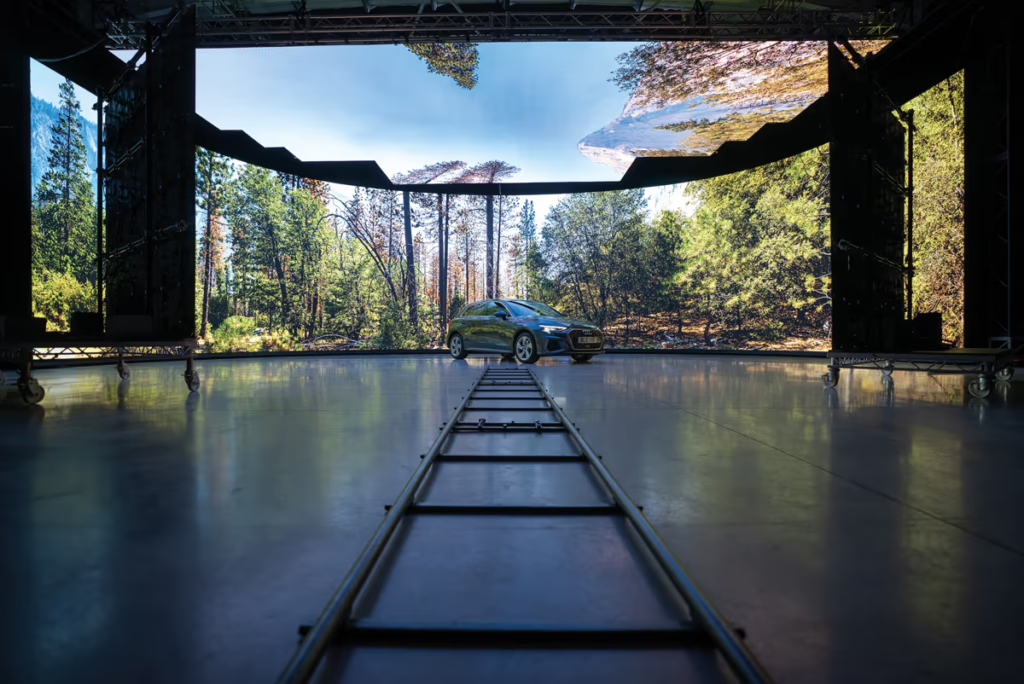
None of this runs itself, and the honest version of the story includes the problem-solving. DPs working a volume watch for the seam where wall panels meet ceiling panels showing up in a reflection. Movable “wild walls” that tilt help close that gap. They watch for moiré, especially in a windscreen. And the best results, as Davenport is careful to say, rarely come from the wall alone: a practical wind machine moving an actor’s hair, real rain hitting the glass, physical haze in the room. The volume supplies the world; practical texture supplies the life. The craft is in knowing which is which.
Start with the result a viewer can judge. L.L.Bean’s New Arrivals didn’t read as a studio trick. It read as fall, and it earned a Platinum Viddy Award – a campaign across broadcast and digital that captured the emotional pull of the season without betting the budget on the season actually showing up.
The schedule is where a producer sees it first. A volume collapses multiple “locations” into a single stage day. Sunrise, golden hour, and dusk without moving the truck, and without flying a crew to three countries to get them. Decisions that used to happen in post happen in the room, which compresses the back end as much as the front. And because the engine renders in real time, late changes that once meant a reshoot – a different sky, a warmer grade on the environment – become an adjustment between takes.
The sustainability math is becoming part of the brief, not a footnote to it. A controlled studio shoot that doesn’t fly a unit to a location cuts the travel and carbon load of the production – research led by Ulster University’s Studio Ulster, presented at COP28, found that bringing virtual production into film and high-end television pipelines reduces carbon emissions by 20 to 50 percent compared with traditional methods, and some studio analyses have measured even steeper drops.
For an ESG-conscious brand, that argument now carries weight in the room where the budget decision happens. And advertisers themselves, alongside broadcasters, are the ones industry analysis credits with accelerating the technique – seeking real-time content that lowers travel, set-build, and post costs. Independent market-research firms project sustained double-digit annual growth for virtual production into the early 2030s; their estimates of the market’s exact size diverge widely, but the direction is consistent. The trajectory – out of blockbusters and into commercial budgets – means this is no longer an exotic option to admire. It is a tool on the table for the next campaign.
The throughline connecting the impact back to the craft is simple: the volume doesn’t just save money, it protects the creative. The control that makes the schedule efficient is the same control that guarantees the golden hour, the clean skin tone, the true reflection. Efficiency and craft, for once, pull in the same direction.
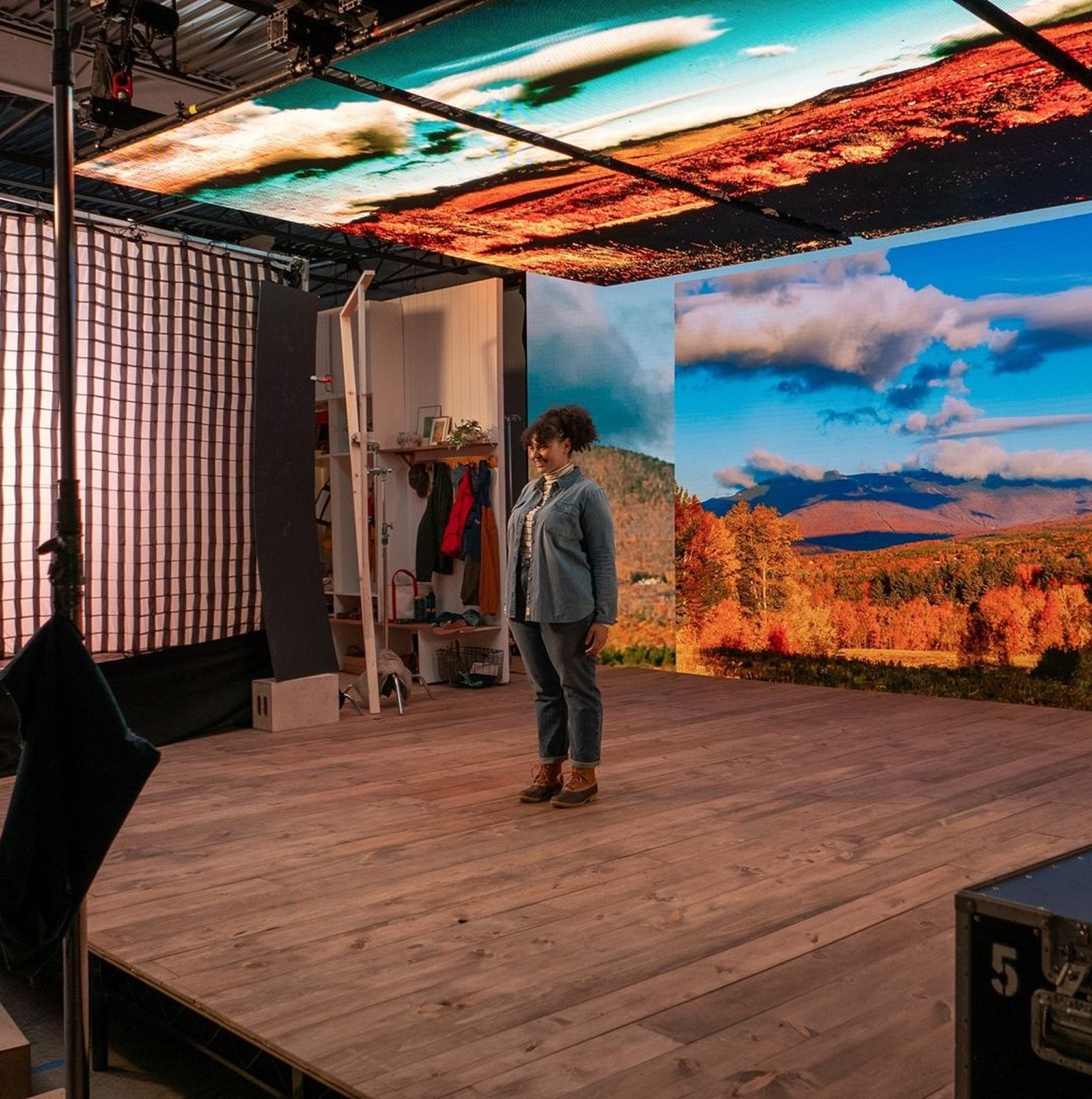
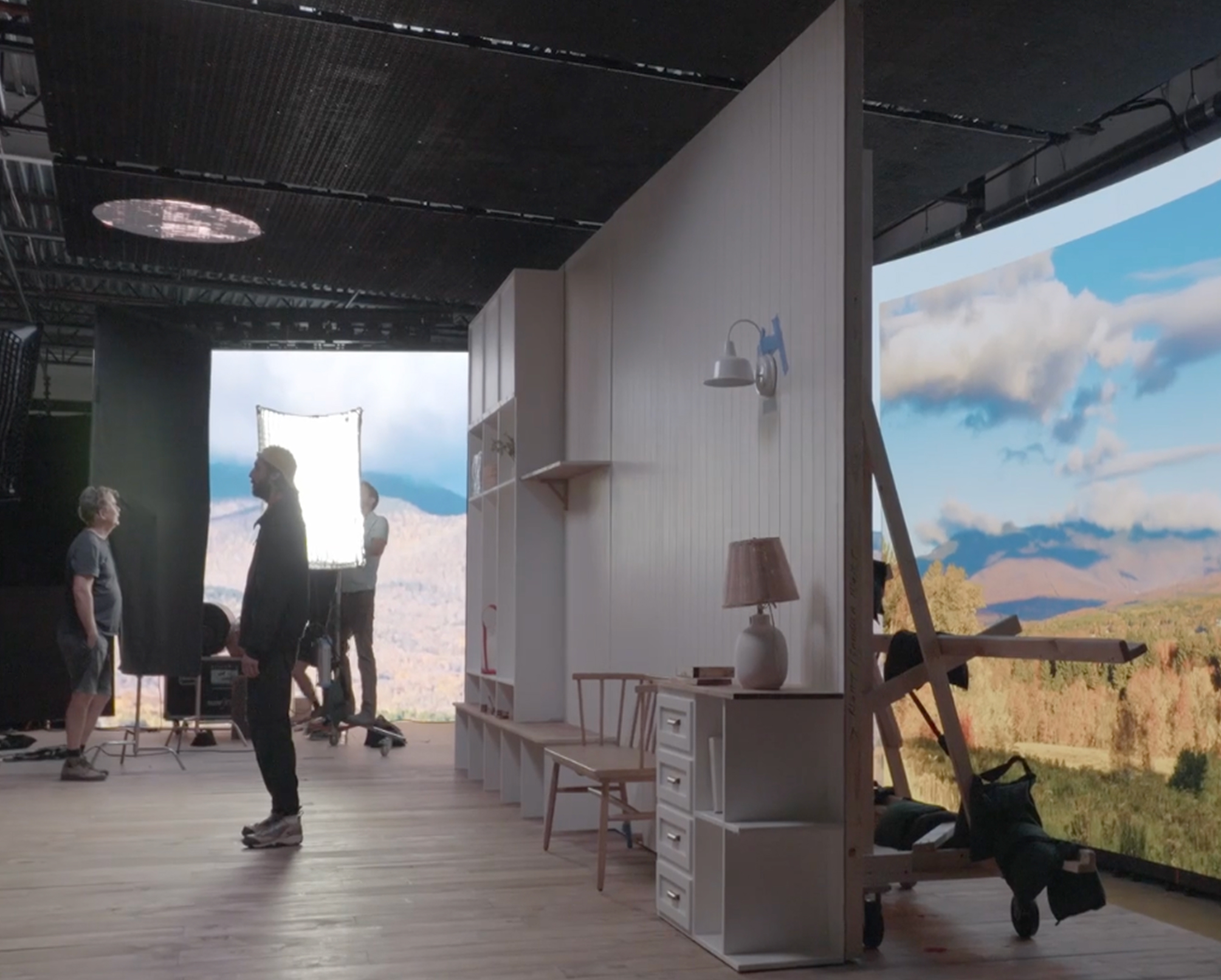
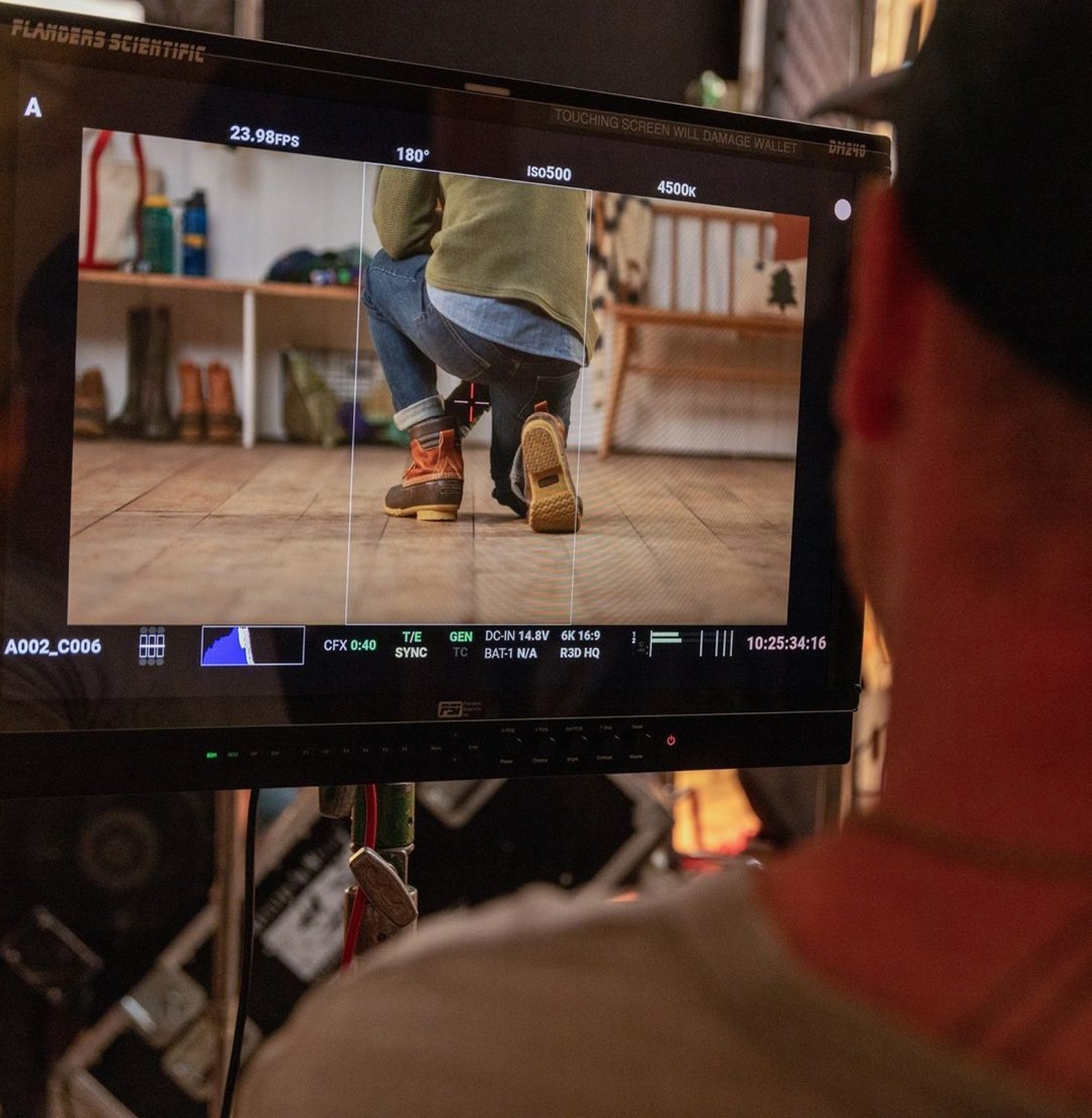
Five things worth taking into your next production conversation.
The volume’s real advantage isn’t the screen – it’s that it forces you to build the world before the shoot, where decisions are cheap, instead of leaving them to weather or to post, where they’re expensive. If your concept depends on a controlled, repeatable, sign-off-on-the-day environment, that’s the signal. Budget the previs and the virtual art department time like you mean it; that prep is the shoot.
If your hero is reflective – a car, a watch, a bottle, anything chrome or glass – the in-camera reflection is the single strongest reason to be on a wall. Bowmore’s decanter sells itself in the reflection rolling across the glass. Ask whether your product’s surface is doing the storytelling. If it is, green screen will fight you the whole way.
The mistake is treating the wall as a backdrop and lighting the talent separately. The win is letting the rendered world be the key light – the autumn glow, the sunset on the cheek – so subject and world share a source. Plan the environment’s light as the scene’s light from the first conversation, not as set dressing added after.
The volume is not a reason to send the SFX team home. Wind in the hair, rain on the windscreen, haze in the air – the physical textures push a volume shot from convincing to invisible. The people who do this daily will tell you the wall plus practical beats the wall alone, every time.
This is the honest one. If the concept lives on the genuine unpredictability of a real place, the chaos of a real crowd, or a vista no engine will earn the budget to build, shoot it for real. The volume is a precision instrument, not a replacement for the world. The strongest production partners will tell you when the wall is wrong for the brief – and a hybrid of location plates and a volume finish is often the smartest answer of all.
The deeper story under LED volume commercial production is a swing back toward the in-camera – toward light that is real because it was real in the room, reflections that are true because they happened on the day, actors playing to a world they could actually see. After a decade of pushing more and more of the image into post, the craft is migrating back onto the set, where a director and a DP can shape it in the moment. It’s the same current we wrote about in AI Is Making Us Fall Back in Love with Human Storytelling: the more synthetic the feed gets, the more value pools around the things that demonstrably happened. The volume is the tool that makes in-camera truth possible at a commercial budget.
What that asks of a production partner is the ability to hold two disciplines at once. The real-time engine and the virtual art department on one side, the lens, the light, and the practical SFX on the other – and the judgment to know, for a given brief, where the wall ends and the world should begin. That judgment is the actual product. The screen is just the easy part to buy.
The brands making the most of this aren’t asking can we shoot on a volume. They’re asking what does this specific story need to be true in camera – and building the production around the answer. If you’re weighing a volume against a location for your next brand film or product launch, have that conversation before the budget locks, not after. Where the risk lives is a choice. Make it on purpose.
Thinking about your next brand film or product launch? The volume-or-location question is worth settling before the budget locks, not after – and it’s a conversation we have with brands all the time. If you want a straight answer on whether your concept belongs on a wall, talk to us.
Investor day production, even in the simplest sense, is no small task. Your company will spend six to nine months and a budget that can run past a quarter of a million dollars to prepare for a single day. The leadership team will rehearse. Legal and finance will sign off on every number. The deck will move through draft after draft. Then, somewhere in the second Q&A session, an analyst three rows back – or half-watching the webcast from a desk in Boston – will form the quiet judgment that moves your stock.
That judgment rarely turns on the strategy itself. It turns on whether you made the strategy easy to understand, easy to believe, and easy to repeat.
The research bears this out. When Corbin Advisors surveyed 453 investors, analysts, and IR executives in 2020, 76% of the investors and analysts said strong investor day content pushed them to buy shares or upgrade a rating. In the same study, 53% said weak content – content that confused them or raised more questions than it answered – pushed them to sell or downgrade. Same room, same executives, same numbers on the slides. Execution flips the outcome.
That study dates to late 2020, and two forces have only sharpened its conclusion since. The room is now permanently hybrid, and your first reader is increasingly not human. More on both below. The throughline holds: the strongest companies stop planning the investor day like a meeting and start producing it like a broadcast. That is what it has become.
A best-in-class investor day educates the market on strategy, gives investors access to leadership beyond the C-suite, and presents content substantial enough to stand on its own. Investors reward that with buys and upgrades – and punish poorly delivered content with the opposite. Increasingly, the deciding factor is production: a broadcast-quality webcast, a deck designed to survive scrutiny, educational video, and a durable digital home for the content afterward.
Institutional shareholders, active and passive alike, want deeper transparency into strategy and a sharper case for competitive advantage. Investor bandwidth keeps shrinking while the competition for attention climbs. Investors still value the format when companies use it well: 94% call investor days a good use of their time, though about a third qualify that endorsement, crediting the events only when the company executes.
Most companies leave the opportunity on the table anyway. Corbin found that 68% have held an investor day, yet only 19% hold one annually and 17% biennially, even though investors say they want these events every year or two. Show up on a credible cadence, execute when you do, and you already stand apart.
An investor day is not a low-risk educational exercise. It is a high-leverage moment that either reinforces confidence or creates friction, and production quality usually decides which. The upside is just as concrete as the downside. When Starbucks held its investor day in New York in January 2026, it used the platform to put a multi-year financial outlook behind CEO Brian Niccol’s “Back to Starbucks” turnaround, and it put leaders beyond the CEO on stage to walk investors through the plan. That is the job an investor day exists to do: turn a story investors have already heard into a framework they can underwrite. A clear narrative, backed by numbers and delivered well, still shapes how the market models your future.
Strip away the logistics and three themes run through the research.
The single biggest draw is exposure to management investors don’t normally see: business unit presidents, segment leaders, the next layer beyond the C-suite. In Corbin’s survey, 83% name next-level leadership presenters among the most important elements of an investor day, just ahead of access to senior leadership at 75%.
Investors weigh depth and credibility, not just the headline strategy. When only the CEO and CFO field questions, the bench looks thin. When the whole leadership team answers with confidence, the company looks durable.
71% of investors prefer content-rich slides supported by voiceover over image-heavy slides that lean on narration. They want the presentation to stand on its own.
This is not a minor preference: 88% rank the investor presentation as the leading source of company-generated information – on par with meeting management directly – and 78% call it Important to Critical to their due diligence, returning to the deck and transcript long after the room has cleared.
Investors want a credible long-term view – targets or milestones, framed as ranges with stated assumptions. A clear 60% prefer a three-year horizon for financial targets over any other timeframe. Without that forward view, the strategy reads as aspiration rather than commitment.
Here is where a production lens changes the conversation. Most of the avoidable failures aren’t strategic. They’re executional.
When Corbin ran its survey in 2020, 85% of investors still preferred to attend in person, and a live video stream of management counted as the rarer, more expensive option – even though 72% of remote investors said they wanted exactly that. That world is gone.
Hybrid is now the default, not the exception: investors expect a broadcast-quality stream, live virtual Q&A, a quickly published replay, and increasingly a virtual facility tour, and they judge the virtual and hybrid side of the event by the same standard as the room. Seeing and hearing executives still builds the familiarity and trust that drive investment decisions, but most of that audience now watches through a screen. Audio-only with a static deck quietly tells your most time-constrained investors that they’re second-class attendees, and nothing erodes credibility faster than a feed that drops mid-presentation.
When a dozen contributors assemble a deck with no design discipline, it cannot stand on its own, which is exactly what investors need it to do, often for years. The deck is not a backdrop. It is infrastructure for understanding, and its shelf life runs in years, not days.
This is the most useful and most misread finding in the report. Investors rate video as one of the least important investor day elements – but only because most corporate video at these events is promotional.
The same audience welcomes educational video: a look at a technology or manufacturing process, an operational deep dive, a customer’s voice, a facility most investors will never visit in person. The problem was never video. It was the brief.
Many teams treat the investor day as the finish line. The research frames it as the starting line – the event that should anchor every subsequent quarter of communication.
None of this replaces the strategy work – the perception study, the message alignment, the months of dry runs and Q&A preparation, and the discipline of staying inside Regulation FD under live questioning. It makes the work land.
Corbin’s research predates a shift now reshaping how investors take in your investor day. A human still makes the call. But more and more often, a machine reads first. Institutional investors increasingly run financial disclosures and IR materials through AI tools that surface guidance, detect sentiment shifts, and even scrutinize tone and word choice in executive commentary. The practice isn’t universal, but the investment community is moving decisively from experimentation to adoption, and these agents routinely ingest earnings transcripts, investor presentations, and IR-site analytics.
That adds a second reader to the brief without removing the first. AI systems reward material they can parse cleanly and misread or skip the rest. An image-heavy slide that hides the substance in a voiceover, a chart with no underlying text, a video with no transcript, a PDF with broken structure: each one reads clearly to a person in the room and poorly to the model summarizing your story for a portfolio manager. Notice the irony. The content-rich, self-contained deck investors asked for in 2020 is the same deck the machines can read in 2026.
So the discipline that serves human investors now does double duty. Clear structure, substance on the slide, a transcript attached to every video, and a clean, durable content home all read as quality to a person and as signal to a machine. Your microsite, deck, and transcript are not just an archive. They are the training data for how your equity story gets summarized when no one from your company is in the room to correct it.

Investor audiences do not only evaluate numbers. They also read confidence, coherence, and credibility, and those come through as much in how you present a story as in what it contains. The more complex the business and the higher the stakes, the more discipline the communication system demands.
That’s why we don’t treat the deck, the stage, the webcast, the video, and the microsite as separate assets. They’re connected parts of one investor experience. A confident leader on a clean stage, a deck that reads as clearly on a laptop in Boston as it does in the room, an educational video that earns its place, and a microsite that keeps the story intact for years – those reinforce each other. And in 2026 they have to land twice: once for the people in the room and on the webcast, and once for the AI systems parsing the record afterward. When any one of them is weak, the friction shows up in the Q&A and, eventually, in the rating.
Good investor communications make the story easier to understand, easier to believe, and easier to repeat. An investor day is the rare moment when you control all three at once. It’s worth producing like it.
Before your next investor day, ask one question of every element: will this still hold up six months from now, on a screen, parsed by an analyst’s AI, with no one there to explain it? If the deck can’t stand alone, the webcast looks like an afterthought, or the content disappears the week after, that’s where the ROI leaks out. Fixing it is a production problem, and production problems are solvable.
If you’re mapping out an investor day, roadshow, or analyst day and want the experience to reinforce your thesis rather than undercut it, we’d be glad to talk through how to produce, stream, and archive it.
Investors point to three things: meaningful access to leadership beyond the CEO and CFO, content substantial enough to stand on its own, and a credible long-term view of the strategy. Disciplined planning and execution – including a well-produced webcast and a deck that survives scrutiny – separate best-in-class events from forgettable ones.
Yes. Many investors still value attending in person, but hybrid is now the default rather than the exception. Investors joining remotely expect a live video stream of management with the slides visible, live virtual Q&A, and a quickly published replay. Produce the webcast as a reliable, broadcast-quality experience, not an audio afterthought, because most of your audience now watches through a screen.
Very. In Corbin’s research, 88% of investors rank it as the leading source of company-generated information, and 78% call it Important to Critical to their due diligence – returning to the deck and transcript long after the event. Design it to stand on its own, because it stays relevant for years.
Promotional videos tend to fall flat with investors. Investors welcome educational video – showcasing technology, operations, a process, or a customer’s perspective – especially when it gives remote viewers access to something they couldn’t otherwise see. The format isn’t the issue; the purpose is.
Treat the event as the beginning, not the end. Archive the webcast, deck, and transcript on the IR website or a dedicated microsite – Corbin’s best-in-class benchmark is five years, not the minimum twelve months – and reference the content in ongoing communications so the story stays consistent and easy to repeat.
Two shifts stand out. Hybrid is now the default rather than the exception, so a broadcast-quality webcast with live virtual Q&A is table stakes, not a premium add-on. And investors increasingly run your deck, transcript, and IR page through AI tools as a first pass, which puts a premium on clear structure, substance on the slide, and transcripts attached to every video. The fundamentals investors wanted in 2020 still hold; the audience and the channels around them have widened.
About: Corbin Advisors’ 2020 report argues that investor days are one of the highest-return communication platforms a public company has – but the return only materializes when a company executes the event against a specific set of investor expectations: real transparency, access to leadership beyond the CEO and CFO, content-rich substance, ample Q&A, credible long-term targets, and disciplined planning. Corbin’s data shows a wide gap between what investors want and what most companies deliver, and frames the investor day as the beginning of a communication arc rather than a one-day event.
The Cardboard Spaceship angle: Corbin defines what investors want. We extend it into how you produce it – and we update that 2020 study for 2026. The distance between a “run-of-the-mill” and a best-in-class investor day is increasingly a production and orchestration gap, not just a content gap: the deck that has to stand on its own for five years, the broadcast-quality webcast that hybrid audiences now treat as table stakes, the difference between promotional and educational video, and the digital home where the whole event lives afterward.
Two 2026 realities sharpen the case – hybrid is now the default format, and AI tools read your deck, transcript, and IR page before a human does, rewarding clean structure and penalizing image-heavy, transcript-less content. High-stakes investor moments need a production system, not a vendor patchwork.
A production analysis of Your Way Out – and what it proves about the new math of brand trust.
Twenty-seven minutes into the 98th Academy Awards, Coinbase dropped the audience into a video game. A man in a slightly off-kilter suit moves through a city of stiff-walking NPCs. The camera holds high and isometric – locked at the angle of a 2002-era GTA. A yellow cursor tracks him across the frame.
Then he breaks formation.
The world starts to peel. Pixelated textures give way to skin. Mechanical gait gives way to a run. Sammy Davis Jr.’s “I’ve Gotta Be Me” rises as he steps out of the system entirely, into an actual street, surrounded by humans who are unmistakably, gloriously real.
Then a single line:
Your way out of their system.
The spot is sixty seconds. The argument behind it has been building for years.
Here is what makes Your Way Out the most important commercial of 2026: it depicts a synthetic, machine-controlled world, and it does so without using a single frame of CGI or generative AI. The medium is the message. Every craft decision in the film is also a strategic argument.
And Coinbase made sure you knew it.
Coinbase came into 2026 with a brief most agencies would envy and most production teams would dread: two tentpole moments, three months apart, no creative overlap allowed.
February’s Super Bowl spot turned American living rooms into a Backstreet Boys karaoke session, the first major work from Coinbase’s new marketing leadership under CMO Cat Ferdon, VP Creative Joe Staples, and VP Brand Gareth Kay.
Spectacle. Party. National volume.
Then the Oscars window, and a different brief entirely.
“Before talking about features, we think it’s important to give people a reason to care,” Staples told Little Black Book. The Super Bowl was about “making the most of the spectacle and the party,” while The Oscars work needed to be “narrative-driven” and “craft heavy,” to match what’s celebrated at the Academy Awards.
That distinction (spectacle for the Super Bowl, craft for the Oscars) is the strategic foundation. The room treats craft as the entry fee. The work had to earn it.
But it also had to do something harder.
Your Way Out isn’t a spot. It’s the launch of a creative platform – Your Way Out of Their System – designed to carry Coinbase’s repositioning from crypto exchange to path to greater economic freedom across all of 2026. The Oscars film had to function simultaneously as a tentpole hero and as the foundation document for everything that follows.
The broadcast did both. And it landed in the middle of the loudest argument advertising has had with itself in years.
The film’s central metaphor, the NPC, does enormous narrative work in remarkably little time.
Non-playable character, a gaming term turned Gen Z shorthand for anyone moving through life on autopilot. It borrows a cultural artifact most viewers under 35 already know how to read instantly. It smuggles an existential argument inside a familiar joke. And it gives the film a visual language that carries the entire first act without a single line of dialogue
That choice – spending the first 40 seconds of a 60-second spot inside the metaphor rather than introducing the brand – is the move.
Most brand films lose nerve sooner. They cut to the product. They drop the logo. They translate the metaphor into a benefit before the audience has fully entered the world.
That restraint is exactly what allows the metaphor to land without feeling like a sales pitch. The brand earns the close because it didn’t take it early.
The second move is cultural timing. The NPC reference doesn’t just appeal to gamers – it speaks to a deeper anxiety that’s been building through 2025 and 2026 around AI displacement, automation, and what Fortune calls “an ever-gnawing desperation to escape what’s become known as the ‘permanent underclass.'”
Your Way Out doesn’t argue against AI explicitly. It dramatizes the feeling of being trapped in a system that operates without your consent, then offers an exit. The argument lands because it’s already in the room.
Three connected creative decisions:

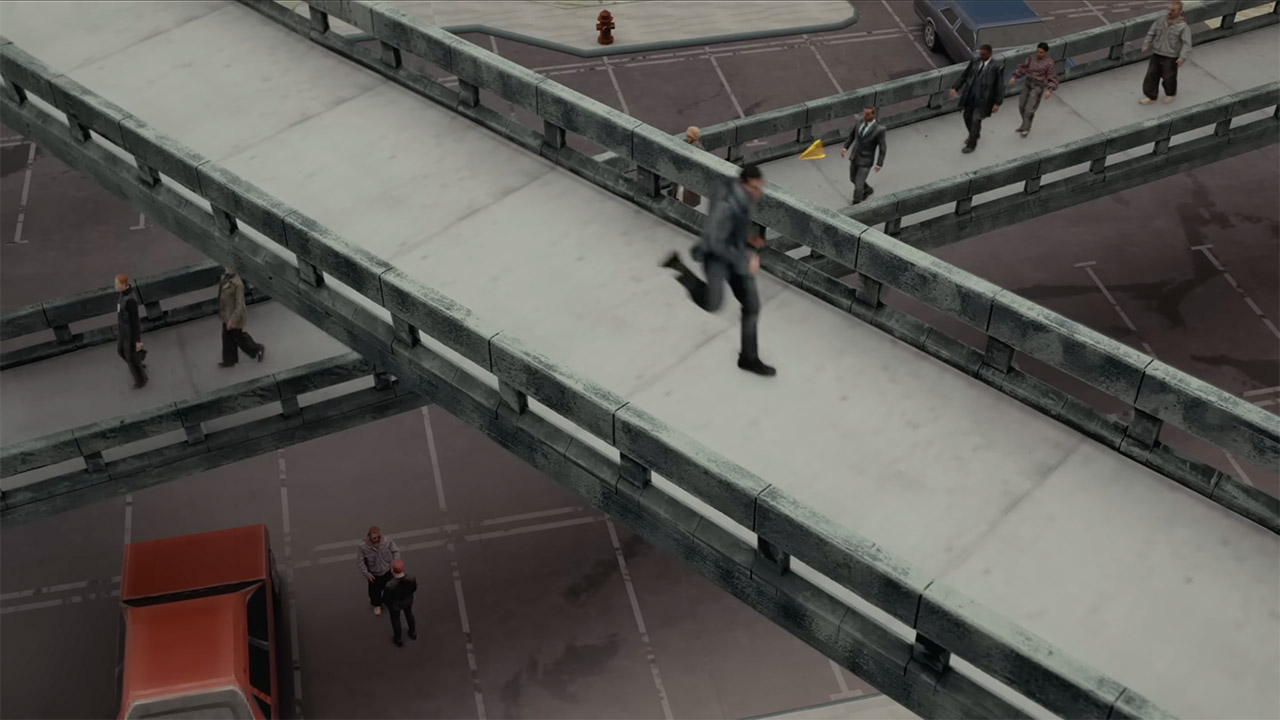

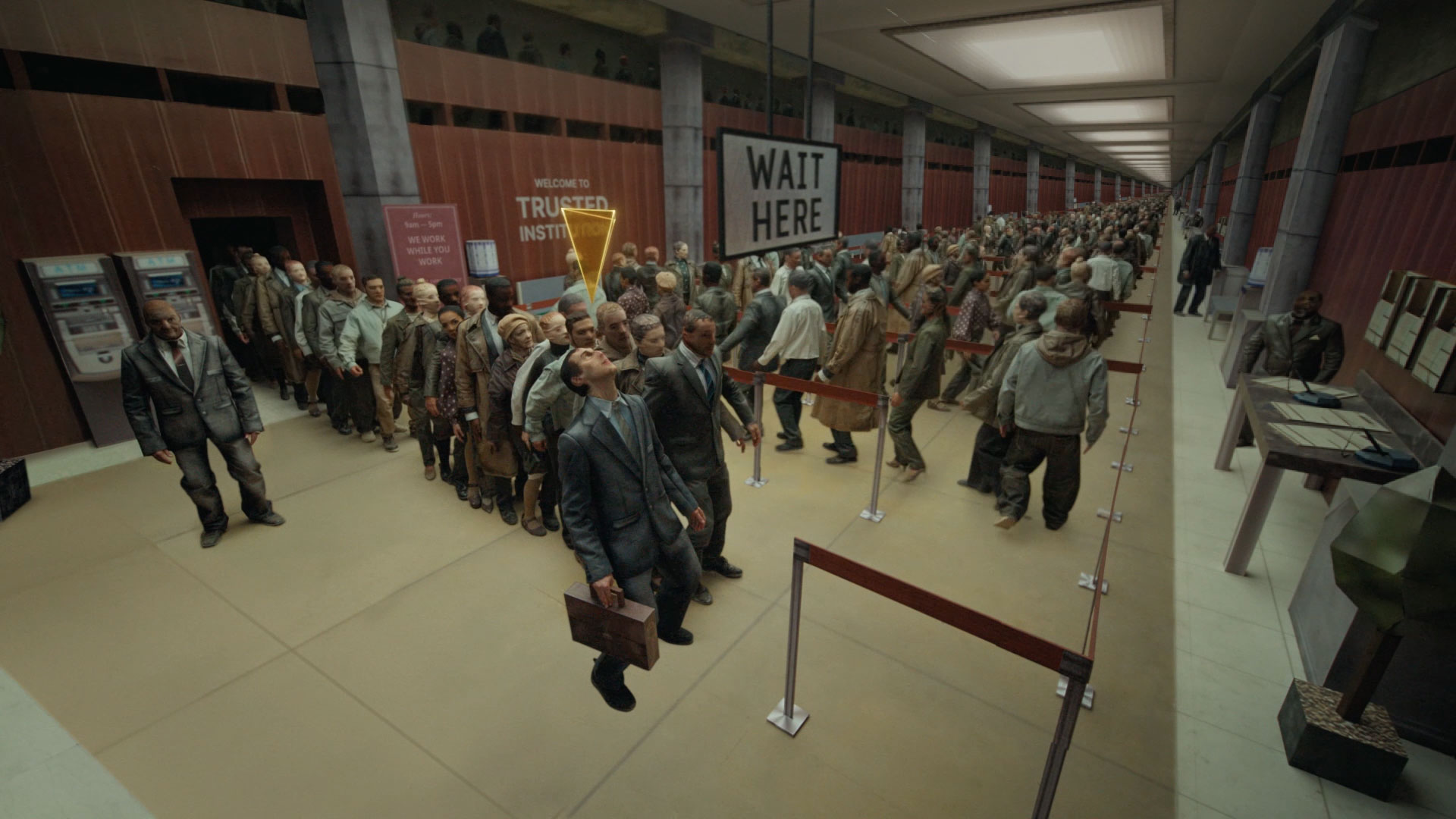
This is where how it was made becomes the entire conversation.
Director Oscar Hudson, working through MJZ, made the call that reset every department’s job description: shoot it for real. The spot uses minimal VFX (only the cursor arrow chasing the protagonist), plus a few set extensions and miniature comping into bigger sets.
Everything else is real. In-camera. Practical effects.
That single decision changed what each craft specialist had to solve.
Suit details (buttons, lapels, fabric texture) were 2D-printed directly onto fabric to replicate the flat, low-poly look of game characters.
Costumes were weighted to mimic the blocky drape of game-engine cloth simulation, so fabric moved with a slightly artificial physics. Masks bearing the actors’ own faces were reprinted and placed back over their heads, creating an eerie texture-mapping effect that read as low-resolution rendering.
Sets were printed, pixelated, and calibrated against camera distance so the surfaces resolved as game-world textures from the isometric angle.
The shoot took place in Cape Town, where the team spent three weeks preparing sets before a single frame was shot.
Game engines don’t render real shadow physics. The lighting design had to imitate flat, shadowless game lighting without the result reading as bad cinematography.
The production team called it “an unusual and difficult challenge for the gaffer.” That’s underselling it.
Choreographer Maeva Berthelot studied video game animation cycles and trained the cast to walk like NPCs, with arms swinging at unnatural angles and heads turning mechanically. The lead actor was directed to make a gradual, nearly imperceptible transition from game-character motion to organic human motion across the runtime.
This is the most overlooked craft layer in the spot. It is arguably the one carrying the most narrative weight.
The metaphor only works if the audience feels the transition before they see it.
DP Ben Fordesman locked his camera roughly 9 to 10 meters above ground for the majority of the film, building the visual rules of the game world so the break-out had rules to break. A giraffe crane on a flat-bed truck tracked the protagonist at running pace, maintaining the isometric angle in motion.
A custom-built wire-cam executed the moment from game world to real world in a single continuous take.
The camera started high and steady at the isometric position, dropped down as the operator transitioned to handheld, with sparks flying and smoke drifting in. The crew rehearsed height, speed, and timing across multiple takes until the moment landed precisely.
Every department on this production was solving the same backwards problem: how do we use the most analog craft tools available to imitate digital artifacts?
It’s the inverse of how most commercial post pipelines work. And it’s exactly the choice that makes the work mean what it means.
You cannot generate this spot. The fact that you cannot is the entire value proposition.

Trade press picked the work up immediately. Adweek, Ad Age, Campaign US, Little Black Book, Creative Review, SHOOTonline, and others. Mainstream pickup followed in Fortune and Yahoo Finance. The behind-the-scenes content has been circulating in commercial-craft communities for weeks.
But the more interesting impact is what Your Way Out did to the conversation around it.
Creative Review placed Your Way Out directly inside this shift, framing the in-camera decision as “part of a wider focus on craft that is emerging in advertising right now, in part as a backlash to AI.”
That’s accurate — and it’s the frame the industry is starting to operate from.
The platform extension matters here too. Your Way Out of Their System is designed to accumulate cultural weight across 2026 as Coinbase’s product rollouts continue.
The clearest measure of impact, though, is harder to put on a spreadsheet: Your Way Out gave the craft side of the AI argument its most articulate execution to date. Every brand team in a meeting right now deciding whether to commission AI-generated creative has a new counter-example to point at.
Four lessons live inside this work for any brand team or production lead trying to make ambitious commercial work right now.
The deepest strategic move in Your Way Out isn’t the script or the casting or the venue choice. It’s the alignment between what the spot says and how the spot was made.
So, a film about escaping a synthetic, system-controlled world that was, itself, made synthetically would have undercut its own argument before the credits rolled.
The in-camera choice isn’t aesthetic preference – it’s the brand’s position expressed through methodology. When form and thesis align, the work doesn’t have to explain itself. The viewer feels the consistency before they articulate it.
The most important strategic decision on a craft-heavy project is rarely the brief or the budget. It’s the person you trust to carry the concept from treatment to final cut – and hold the line through the noise of production.
Toby Treyer-Evans of Isle of Any was direct on the record: Hudson’s insistence on shooting in-camera “immediately took it up a notch.”
The right director for a craft-heavy brief is rarely the one who can deliver the most options. It is the one with the conviction to close options that would weaken the work, and the technical authority to make the closure feel like generosity rather than restriction.
The most invisible craft layer in Your Way Out is the choreography. It is also the one doing the most narrative work. The transition from game character to human is sold by the protagonist’s gait before it is sold by the picture, the grade, or the score.
Generic casting and direction would have produced a film that looks like the spot but doesn’t feel like it. Specificity in performance design is what makes this kind of work travel.
The lesson isn’t “cast great actors.”
The lesson is: identify the single behavior that proves your case, then build every department around catching it.
This is the lesson the rest of the industry has not yet caught up to.
Coinbase did not just make Your Way Out. They produced a parallel ecosystem of behind-the-scenes content. The Muse by Clios production essay. The Little Black Book deep-craft feature. The YouTube BTS cut. Choreography breakdowns. Costume photography. Set-build documentation.
The proof that the spot was made by humans is now its own marketing asset.
In the AI era, brands aren’t just buying creative anymore. They are buying credibility. And credibility now requires receipts.
The thing to watch is not whether the AI-versus-craft debate gets resolved. It won’t.
The thing to watch is how brands rebuild trust in a world that doesn’t trust what it sees anymore.
Your Way Out points at the answer. The receipts are the asset.
A decade ago, behind-the-scenes content was supplemental. A courtesy for fans, a deliverable to fill out the scope of work. Today it is load-bearing. And when you look at what Coinbase’s BTS ecosystem actually accomplished, the structural shift is clear.
When audiences can’t verify by looking, they verify by witnessing the making. The willingness to spend real money proving you spent real money on human craft is becoming its own brand differentiator. It’s a budget line. It’s a strategic call. It’s increasingly the difference between a brand that earns trust and one that has to keep buying it.
A spot this stylized, in 2026, triggers the same first instinct in every viewer: “Wait, is that AI?” The behind-the-scenes doesn’t just answer the question. It turns the question into a point of brand engagement. The doubt becomes the click.
The spot ran on March 15. The behind-the-scenes coverage is still circulating six weeks later. Each BTS asset, the Muse by Clios essay, the Little Black Book craft feature, the production photography, the choreography breakdowns, generates its own news cycle. One sixty-second hero. Six weeks of compounding press.
Trade press did the heavy lifting. Adweek, Ad Age, Creative Review, SHOOTonline. These aren’t ads. They’re third-party validation Coinbase doesn’t have to buy again. And earned media is the only kind of media most audiences still trust.
When the Muse by Clios essay dropped, it didn’t just circulate among advertising readers. DPs posted the wire-cam transition. Choreographers shared the NPC movement work. Production designers passed around the printed-set photography. Every specialist who shared their behind-the-scenes work and experience extended the campaign into the exact audience that shapes future brand briefs: their peers, their creative directors, their CMOs.
Trade press buys reach. Sharing buys credibility. Coinbase produced the kind of work that earned both.
Every brand currently briefing a craft-led campaign now has to ask the same question: are we producing the proof? Coinbase didn’t just compete on the spot. They re-priced the entry fee for the category.
For most of advertising’s history, the asset was the proof. You saw the spot. You trusted what you saw. You formed an opinion. The making was opaque, and nobody asked.
That contract is beginning to break.
The asset is no longer self-verifying. AI floods every channel with content that sounds confident, looks perfect, and means nothing. Audiences have learned, faster than the industry has, that what they see and what’s true are no longer the same thing.
So brands have to externalize the proof. The validation has to live outside the asset itself.
This isn’t a content trend. It’s a structural change in how brand trust gets manufactured.
Brands that don’t see the shift as structural will keep treating BTS as a deliverable. The brands that win this era will treat it as architecture.
If proof is load-bearing, the implications cascade.
You hire differently. The director who can shoot in-camera is more valuable than the one who can move fast. The choreographer or specialist who carries the invisible production layer is no longer optional. The DP who can be quoted on the work becomes part of the asset.
You budget differently. BTS becomes a line item with its own creative direction, its own production schedule, its own distribution plan. Not capture-of-opportunity during principal photography. A second campaign running in parallel.
You brief differently. The choices that prove the production value get scoped at the front of the project, not discovered at the end. You design the proof layer with the same rigor you design the asset.
You measure differently. Six weeks of trade press coverage is brand value. Sharing across creative communities is brand value. Industry benchmark-setting is brand value. None of it shows up in standard attribution models. All of it shows up in the next pitch.
Coinbase made a sixty-second commercial about escaping systems that operate without your consent. They made it without using systems that operate without your consent. And then they showed you exactly how it happened.
That’s brand strategy expressed through methodology – and it’s the kind of thinking that shapes how we build every production at Cardboard Spaceship.
Coinbase’s Your Way Out directed by Oscar Hudson via MJZ. Aired during the 98th Academy Awards broadcast, March 15, 2026.
Cardboard Spaceship is a creative agency specializing in commercial video production, event production, and full-service design for brands navigating the moments that matter.
Here’s the paradox nobody saw coming: the more AI-generated content floods the market, the more valuable human storytelling becomes.
For leaders at publicly traded companies, this isn’t just an interesting cultural observation. It’s a strategic inflection point. The brands that recognize it now and act on it, will own the attention that everyone else is busy diluting.
Everyone predicted AI would make content cheaper and faster. But what was less fully anticipated was when every company’s blog posts, social captions, earnings narratives, and brand videos start sounding like they came from the same machine. Because they did.
The Wall Street Journal recently put numbers to what leaders are already sensing: demand for skilled brand storytellers in business is surging. Companies aren’t just looking for writers who can produce. They’re searching for creatives who can tell a story, a skill that turns out to be surprisingly hard to automate.
When everything sounds the same, differentiation and a genuine brand voice becomes the most powerful assets a company can have. And right now, authentic human creativity is the scarcest form of differentiation in the market.
Most conversations about AI vs human creativity frame it as a competition. Replace or be replaced. That’s the wrong lens — especially for marketing leaders managing complex brand narratives for public companies with real stakeholder expectations.
The more useful frame: AI has raised the bar. Human creativity has to raise the ceiling.
AI can produce competent content at scale. What it does less reliably is make strategic narrative decisions. What tension to build, what to leave unsaid, what story angle earns an investor’s trust versus triggers their skepticism. These are deeply human judgments, shaped by experience, emotional intelligence, and an understanding of how people actually make decisions.
Our Co-Founder at Cardboard Spaceship said it best: “We’re missing the power of good, well-written copy and when we see it and feel it, it rises to the top more quickly than it did years ago.” –Matt Engelking
That’s the shift. In a sea of generated content, human storytelling doesn’t just stand out, it commands attention in a way it simply didn’t need to before.

Here’s what’s catching companies off guard: the gap isn’t in content volume. Most teams can produce more than enough. The gap is in story, the ability to take a company’s real narrative and shape it into something that moves an audience from passive awareness to genuine conviction.
A skilled storyteller makes decisions AI can’t: what’s the emotional entry point for this audience? Where does this narrative need to surprise? What does this piece need to make someone feel in order to drive the purchase we want?
In video production, where story is everything, this gap is impossible to hide. A technically flawless corporate film with a weak story gets skipped. A simply produced video built around a story that earns its ending gets shared in board meetings. Story is the load-bearing wall. Production value is the finishing work.
AI is getting very good at finishing work. The load-bearing wall still requires a human architect.
For marketing leaders at public companies, this moment calls for a clear strategic posture.
You can produce more. Or you can produce better.
The companies winning stakeholder attention right now aren’t out-publishing their competitors, they’re out-storying them. That means investing in human creatives who understand your business, your investors, and the critical difference between content that fills a calendar and content that builds a brand.
“The percentage of LinkedIn job postings in the U.S. that include the term “storyteller” doubled in the year ended Nov. 26, to include some 50,000 listings under marketing and more than 20,000 job listings under media and communications that mentioned the term, according to the professional-networking platform.”- WSJ,Dec. 12, 2025
The WSJ’s storyteller talent crunch isn’t a hiring trend. It’s a market signal. The companies that treat authentic human creativity as a strategic asset, not a line item to optimize, will have a durable advantage over those who handed their voice to the lowest-friction option.
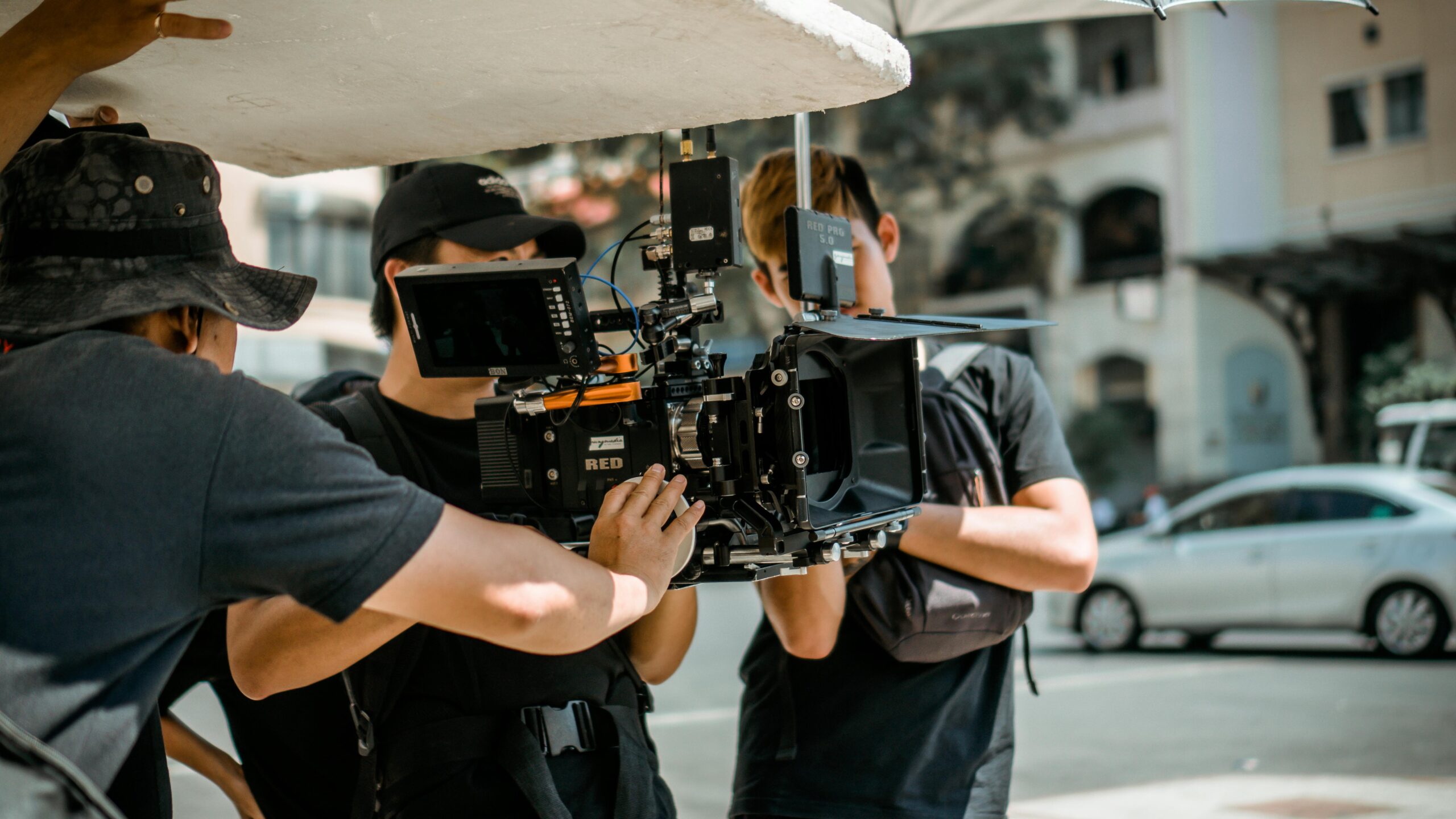


The AI vs human creativity debate will keep evolving. The tools will get better. The generated content will get more convincing. But the human capacity for genuine, creative storytelling, the kind with a real point of view, earned tension, and a heartbeat, isn’t going anywhere.
At the center of every strong brand narrative is a story someone chose to tell with intention. That decision belongs to a human and executing it well belongs to a production partner who treats storytelling as the foundation, not the afterthought.
That’s what Cardboard Spaceship is built to do. If you’re ready to work with a team that puts story first, let’s talk.
Hybrid event production connects an in-person program with a live online experience through one coordinated production system. The team aligns staging, cameras, audio, graphics, streaming, speaker support, and audience interaction so people in the room and people joining remotely experience the same clear story. Cardboard Spaceship provides full-service event production for live, virtual, and hybrid programs.
A strong hybrid event does more than point a camera at a stage. It gives every audience a deliberate point of view, clear sound, useful ways to participate, and consistent visual standards from the opening cue through the final question.
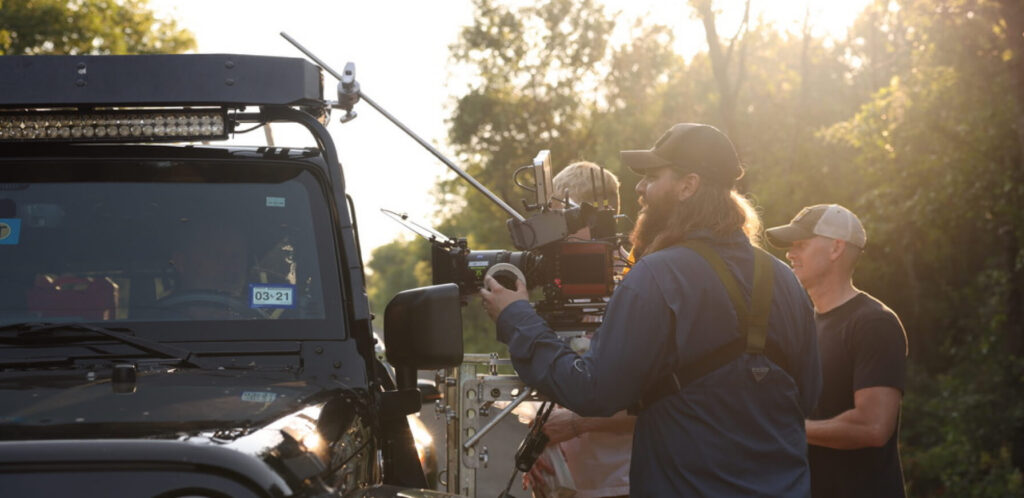
Global meetings often bring together teams, investors, customers, and speakers across countries and time zones. Hybrid production gives them one shared program while adapting the experience to each viewing environment. In-room attendees follow the stage, while remote attendees receive a broadcast with intentional camera direction, branded graphics, clear audio, and moderated participation.
The production team also plans for the realities of a distributed audience. Platform access, speaker time zones, captioning, playback, technical support, and on-demand delivery all shape the experience. One coordinated plan keeps those details from fragmenting the message.
Effective hybrid event production depends on three connected systems:
Hybrid event production works when the room and the remote audience share one show. One run-of-show, one production team, and one visual system keep every speaker, cue, and interaction aligned across locations.
Start with the audience and the message, then build the technical plan around how people need to watch and participate. A practical planning sequence looks like this:
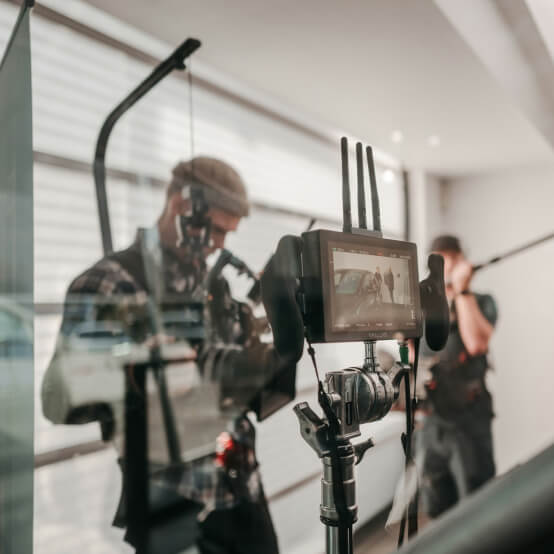
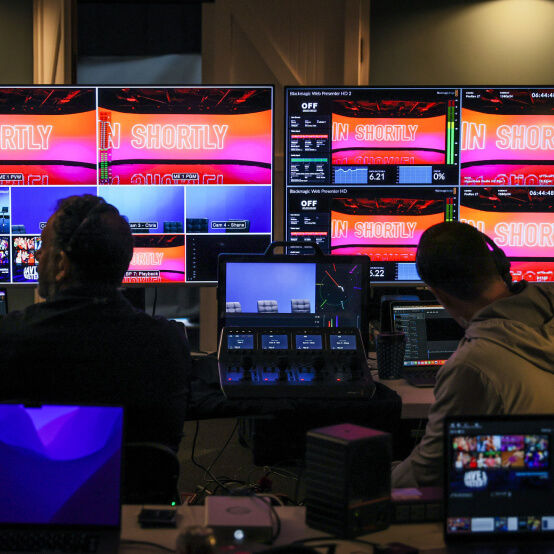
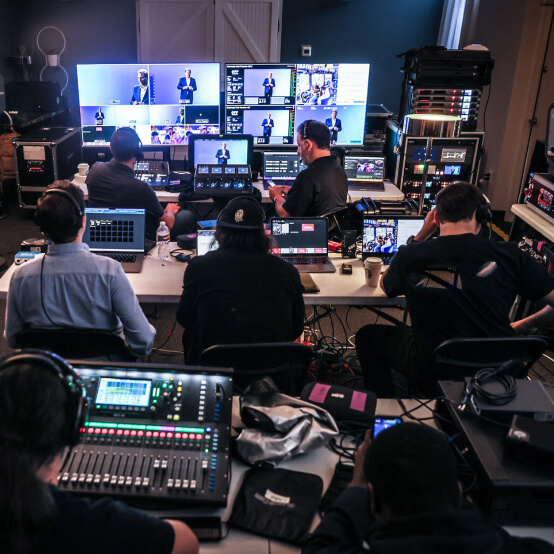
For high-quality hybrid production, begin with broadcast-level video and audio. Stable streams, clear sound, and professional visuals minimize technical distractions, enabling the audience to focus on the message.
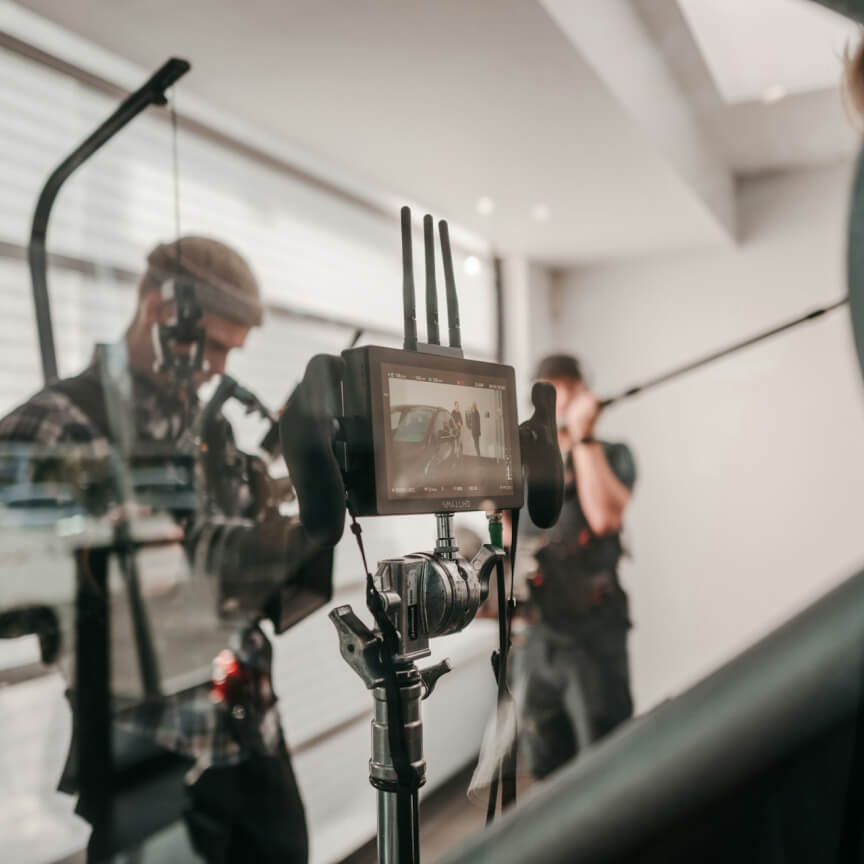
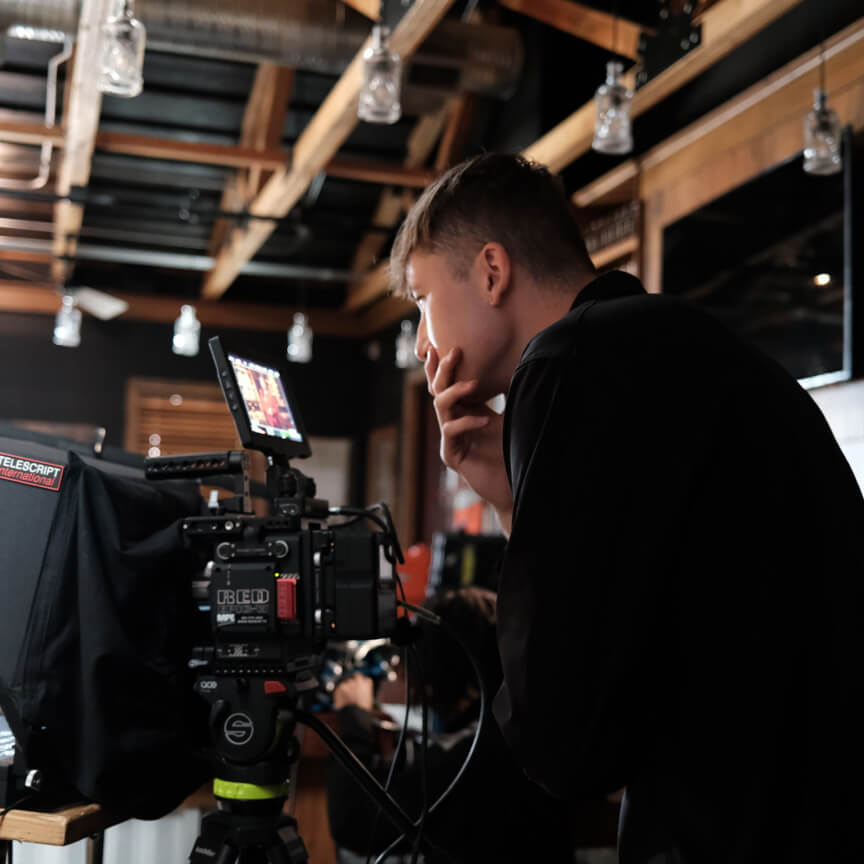
Hybrid production expands access without asking every attendee to travel. It gives leadership a consistent way to reach employees, investors, partners, or customers while preserving the energy and accountability of a live program.
It also turns one event into a reusable content system. Teams can deliver the live broadcast, publish an on-demand replay, create session edits, capture executive interviews, and build short-form recaps from the same production. Coverage of programs such as the NVIDIA GTC keynote shows how strong event production can serve both the live moment and the audience that arrives later.
These four Investor Day programs show how one production system can connect leadership, live audiences, and remote stakeholders across different event formats:
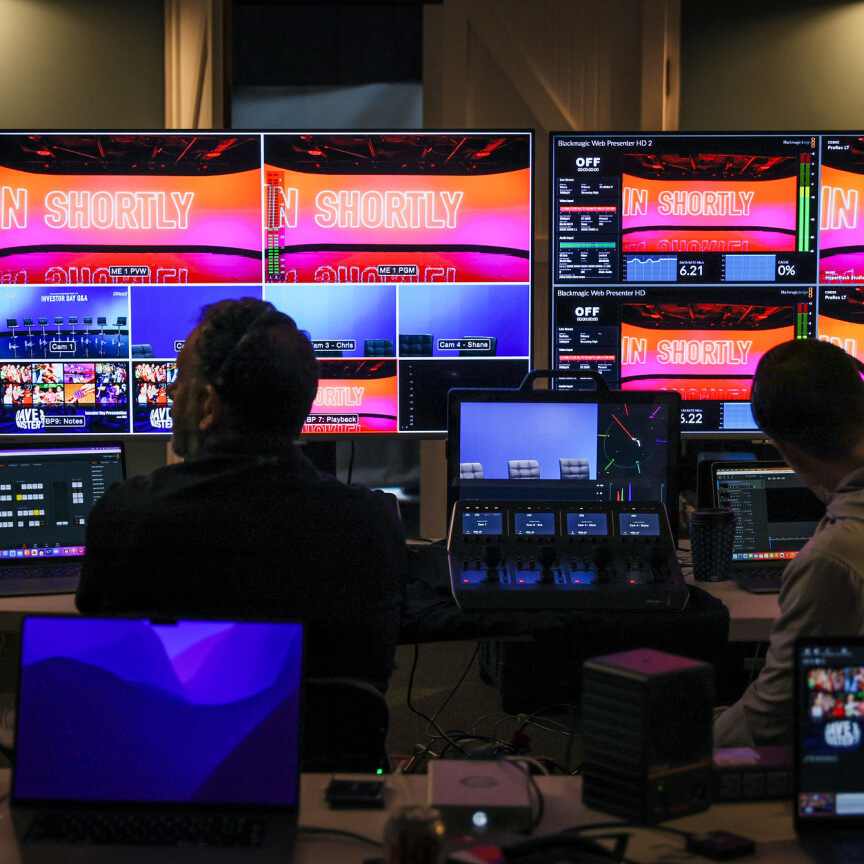
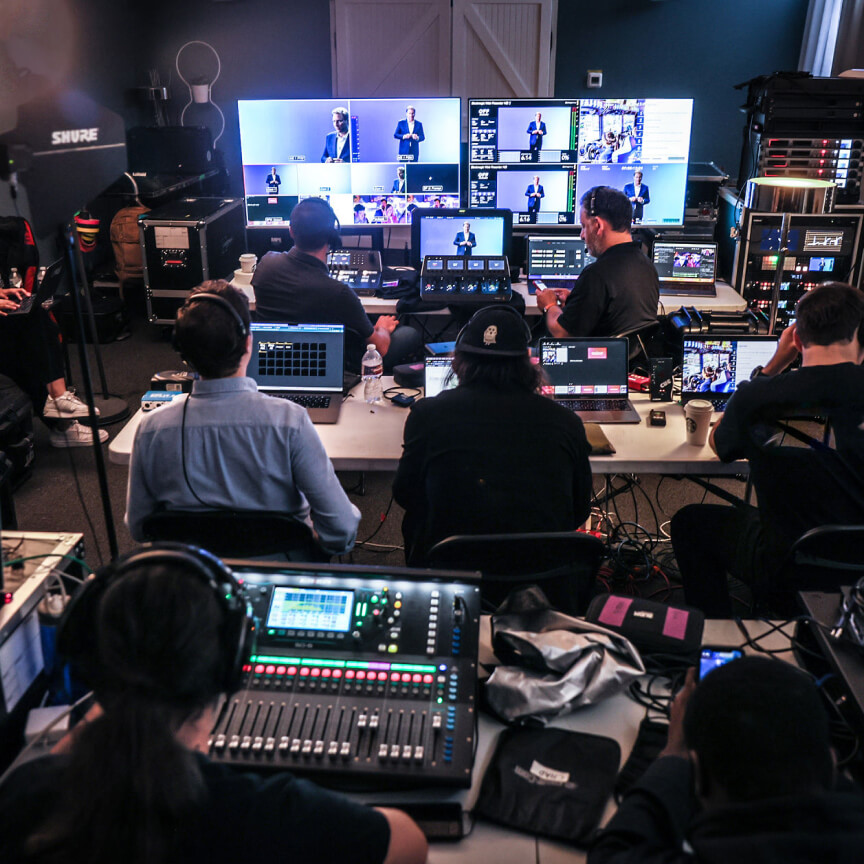
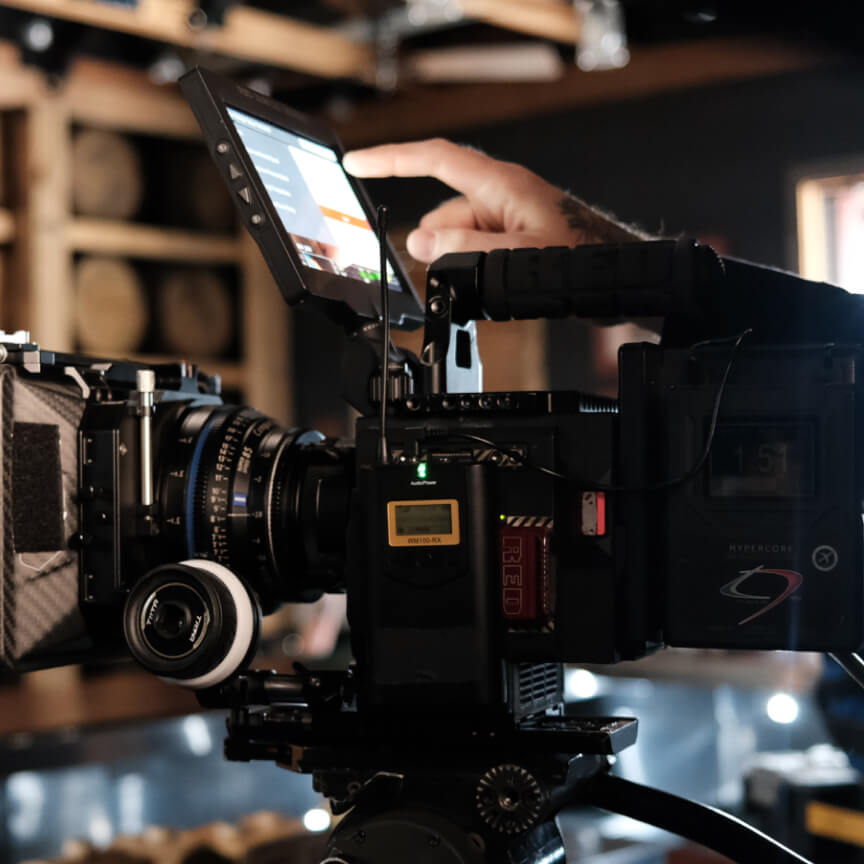
A hybrid event production company can manage the run-of-show, staging, cameras, lighting, audio, graphics, streaming platform, remote speakers, rehearsals, audience interaction, technical support, recording, and post-event deliverables. The exact scope should match the audience, venue, platform, and distribution plan.
Most teams should begin planning several weeks before the event, and complex global programs may need a longer runway. Early planning gives the production team time to confirm the venue and platform, collect speaker materials, build graphics, test remote connections, rehearse transitions, and prepare backup systems.
Give remote attendees a broadcast designed for them. Use intentional camera coverage, concise segments, branded graphics, live Q&A, polls, moderated chat, and a host who acknowledges the online audience. Clear audio and responsive technical support matter just as much as interactive features.
The best hybrid events treat the room and the stream as two views of one experience. A single production partner can align the story, run-of-show, technical systems, and post-event content so every audience receives the same confident message. Explore Cardboard Spaceship’s live, virtual, and hybrid event production services to plan the full program.
In today’s rapidly evolving digital landscape, content creators, filmmakers, and broadcasters are constantly seeking new ways to engage and captivate their audiences. The rise of Extended Reality (XR) and Immersive Reality (IR) technologies has opened up a world of possibilities for creating immersive XR video experiences that transport viewers into the heart of the story. These cutting-edge technologies are reshaping the way stories are told, offering unparalleled opportunities for visual storytelling and audience engagement.
Extended Reality (XR) and Immersive Reality (IR) are reshaping how we tell stories visually. These technologies open up new methods for engaging, immersive storytelling. They broaden the spectrum of narrative possibilities and experiences.
XR innovations have dramatically changed immersive storytelling. They allow content creators to showcase 3D experiences on traditional 2D screens, like huge video walls or curved displays. Augmented Reality (AR) supplements our real world with extra 2D or 3D elements, boosting visual appeal. Virtual Reality (VR) takes users into entirely imagined realms, offering a full sense of being there. MR blends the real and digital, letting people naturally interact in virtual spaces, opening up fresh storytelling avenues.
Technological advancement is reshaping visual media, with XR LED screens at the forefront of change. They bring a new level of immersion to immersive XR video experiences, enhancing storytelling. By offering unmatched realism and depth, these screens revolutionize both film-making and content creation.
In 2020, XR extension technology caused a major shift in film and television. It introduced LED virtual production via background walls, a game-change. This method creates scenes in indoor studios, cutting down traditional production costs. It also features real light and shadow effects, amplifying realism in virtual environments.
With XR LED screens, creators can tell stories that truly grab their audiences. This ability to visually engage viewers is a powerful tool in the hands of modern storytellers.
For filmmakers, XR LED screens offer a toolkit that marries software and hardware seamlessly. This integration simplifies production, allowing for on-the-fly adjustments that boost efficiency. Brands like Rasha Professional and Roe Visuals are leading the way in providing LED solutions, from Automated Lights to LED Video Walls, for any production’s unique requirements. Their support ensures easy setup, enabling creators to fully utilize these immersive technologies.
Establishing a virtual studio with XR LED screens stands at the forefront of modern production. It significantly boosts creativity and ensures top-notch visual results. The process integrates virtual and real settings using cutting-edge technology and careful preparation. This fusion brings forth worlds where imagination knows no bounds.
Bringing high-end XR LED displays into your studio setup is pivotal for crafting immersive digital worlds. By merging physical and computer-generated scenery, LED virtual production creates scenes that are not just seen, but felt. This technology has seen a dramatic rise in adoption since 2023, introducing greater resolution and refresh rates for a more mesmerizing experience.
XR LED displays are available in various configurations, from bar-shaped to flexible. This variety allows them to fit into any production setting with ease.
Following production best practices ensures a smooth blend of the real and the digital. It maximizes creativity and content quality by structuring key steps. From set building to camera tracking and real-time effects, each part of the process is meticulously crafted for excellence.
Curved LED displays are a standout solution for their efficiency and budget-friendliness in film and TV production. They are enhanced further by technologies like 5G, AI, and holograms, amplifying the LED display’s immersive potential.
Adopting insights from data and staying at the cusp of tech developments is vital for continuous improvement in virtual production. For example, PRG’s Los Angeles studio offers a cutting-edge space with advanced camera systems. These facilities serve both recorded and live content, showcasing a prime example of XR LED screen integration at its best.
Both XR and IR video production rely on interactive elements. They add a dynamic layer to content, engaging viewers on a deeper level.
Advanced technology has unlocked the ability to produce realistic IR shots. These shots transport viewers into the scene. For instance, virtual reality can isolate users from their immediate surroundings, completely immersing them. Augmented reality goes further, seamlessly blending digital elements with the real world. It has even revolutionized fields such as medicine.
The importance of dynamic set design is undeniable. It ensures that scenes visually captivate viewers, drawing them into the story. The latest XR tools are key to achieving this, facilitating detailed and versatile set designs. With high-tech VR, users can interact within these environments realistically. This is made possible by devices that accurately track their movements.
The rapid expansion of XR is reshaping various sectors, underlined by the sector’s expected growth to USD 125.2 billion by 2026. To balance complex set requirements, advanced XR setups offer powerful computing and collaborative tools. They support multi-user interaction and spatial computing. This infrastructure is essential for creating engaging, immersive XR video experiences.
As XR progress continues, efforts focus on enhancing real-time video integration. There’s also a push to optimize complex scene rendering for less powerful devices. This work is vital for the broader accessibility of XR applications.
XR and IR technologies have revamped how content is created. They give creators new methods to explore beyond traditional measures. These tools bring together the virtual and physical worlds, creating new, richer stories and engaging audiences in novel ways.
The tech behind XR virtual filming is a game changer. It combines LED displays, cameras, audio, and servers to make massive, lifelike displays mixing reality and virtual scenes. These setups reach new heights with 4K/8K UHD, making the videos more immersive. They also use infrared for real-time tracking and AI for automatic processes, giving creators more freedom in their work.
Zapworks shines with over 730,000 projects completed. It serves content creators globally by making WebAR solutions easy. Working with Unity adds a powerful 3D game engine to their tool, making immersive experiences top-notch. It also skips the app review step, streamlining the creation and publication process.
The XR LED seamless integration has transformed the world of film and television deeply. It blends VR, AR, and MR to create immersive experiences. This change started in 2020 and quickly became an essential trend in the industry.
Cutting-edge high-resolution panels provide impeccable clarity and vivid colors. As a result, scenes look more realistic and production speeds up.
In virtual production, an XR server merges camera tracking info with live images for the LED walls. This step is critical for smooth production.
The Infilled XII LED panels with 1.9mm pixel pitch enable a curved 4K wall, boosting creativity. Plus, Stype RedSpy systems coordinate camera tracking across various lenses. They store data in formats like FBX and XML, supporting film, broadcast, ads, and events.
One major advantage is less post-work needed. LED walls outshine green screens by offering a natural set, which allows real-time changes. The setup of 4K cameras and LED volumes crafts an engaging production atmosphere.
Software like Unreal Engine, Unity3D, and Notch have been key in making virtual scenery look real. XR technology is not just for film but enhances visuals in live shows and broadcasting. Our 12ft x 12ft LED ceiling with adjustable hoists makes a truly immersive production environment.We dedicate ourselves to the evolution of XR LED tech for top-notch virtual production. Discover the tech and witness the power it gives to creatives. Their dreams can be realized with unparalleled accuracy and efficiency.
Delving into XR IR video projects, we uncover a plethora of success stories. These ventures have had a profound impact, revolutionizing learning and engagement across industries. Their applications showcase the power of these technologies to enrich experiences.
In the field of education, augmented reality has shined brightly. Take SkyView, for instance, an app that guides students through stargazing via AR, making learning about stars and constellations exciting. Additionally, Froggipedia offers a digital dissection experience, sparing real frogs while educating students about anatomy. Medical education also benefits, with Microsoft HoloLens enabling students to navigate the human body in mixed reality.
XR IR videos also play a crucial role in bringing history to life. For instance, the 1943 Berlin Blitz coverage in 360° by the BBC, in partnership with Immersive VR Education, deepens students’ understanding of past events. Google Expeditions extends this, providing virtual trips to landmarks like Mount Everest, enriching educational experiences.
Canon’s involvement in the business sector is notable, thanks to live-streamed volumetric video that shows promise in sports and live music broadcasts. This underscores the increasing demand for 3D content in XR applications. Their cutting-edge system maps 3D point cloud data in real-time, enhancing view experiences.
The impact of XR is also felt strongly in manufacturing. A significant percentage of businesses are integrating XR into their processes for digital transformation. With the goal to adopt XR strategies by 2025, manufacturing is at the forefront of this digital evolution. The pandemic has been a catalyst, pushing the use of XR further to support remote work and digitalization.
In retail, Lowe’s uses XR to elevate the shopping experience for millions weekly. Moreover, XR is adopted to improve immersion in learning, curbing staff turnover rates. Notable is NuEyes’ AR glasses, which have life-changing implications, as seen in a young boy regaining sight with their help.
Our journey through immersive XR video experiences shows how XR and IR technologies are changing visual storytelling. They blend AR, VR, CR, and MR elements for captivating, immersive content. iDisplay notes that XR studios use real-time rendering engines, media servers, tracking systems, and high-end LED walls for quality and interactivity.
To sum up, XR and IR technologies are reshaping how we tell stories. They open up new creative possibilities and set the stage for exciting innovations in the future of media. This transformation promises a thrilling journey for both creators and viewers.
Updated August 2026: We rechecked each platform’s current licensing model, removed expired offers, and refreshed our recommendations for working filmmakers, agencies, and brand teams.
Have you ever watched scenes of a horror movie or played certain parts of a scary video game on mute? Some of you just read this and chuckled because you know exactly what I’m talking about. It loses its ability to scare you, right? Why? Because there is so much power in music. For filmmakers and video production companies, music is possibly the most important part of their creative arsenal, and choosing the right music for your production is crucial.
When we’re in the edit room and the director says “this scene needs to feel dangerous,” the conversation isn’t really about finding a “scary song.” It’s about finding a track that does specific emotional work, reliably, on the first try.
That’s why having the right music licensing platforms for video production is an essential part of a filmmaker’s toolkit. The music and sound effects you choose for a video don’t just fill space. The story and environment you create with sound determines whether the audience feels what you want them to feel – or whether they lose interest in the first 30 seconds.
This isn’t an exhaustive list of every music licensing platform on the market – there are dozens. And if they didn’t make our list, it doesn’t mean they aren’t good music licensing platforms or offer competitive pricing. We just have a few that have become our “go to” music providers for commercial video production, documentary films, and corporate interviews.
In this article, we’ll list our favorite music licensing platforms for video production and filmmaking. These are the five we actually reach for, for one reason or another, in client work and our own productions. We’ll tell you what we like, what we’re over, and where the space is heading.
Over the last decade, music licensing platforms have exploded. A few years ago, you could count the number of platforms with both hands. But now, it seems there are more and more popping up each week.
If you’re an established video production company or experienced filmmaker, you’ll more than likely have your go-to music licensing platforms you use and that’s ok. We most certainly do. But here’s a list of the top 5 we like to use each time.
Who it’s for: Commercial filmmakers, agencies, brands, and anyone who needs reliable quality
without spending hours searching.
MusicBed is a: “Curated Roster of Real Artists. Our A&R team handpicks every song from our roster of indie musicians, bands, and composers, so you can spend less time digging and more time creating.”
MusicBed is still the standard by which we measure everything else. They’ve been at this since
the early days of the licensing platform boom, and they’ve done the hard thing: said no to most
submissions. Their library sits at around 10,000+ tracks – not the largest by a long shot, but
the selection process means you’re rarely digging through filler.
As a music licensing pioneer, MusicBed has worked across every industry, provided work in every category, and truly provide music with creatives in mind.
The quality bar isn’t just marketing. It’s their selection process. Now, don’t get me wrong. Everyone has what they call a “highly selective process” however, we know from first-hand experience that MusicBed’s A&R team accepts roughly 1% of submissions. That creates a high barrier-to-entry that actually benefits the end user – every track on the platform had to earn its place.
Just like FilmSupply (a sister company focused on licensed video content), only the top 1% of MusicBed’s submissions get the right to publish their work on their platform.
This highly disciplined approach not only provides the highest quality content for filmmakers and video production companies, it also creates a high barrier-to-entry.
We love how their website is laid out. Their functionality is very intuitive, and it doesn’t take long at all to find what you’re looking for. You can browse their full library without an account, search by mood, genre, and energy, and find what you need fast. Their support team will also personally review your project if you need help finding the right track – not a bot, an actual human who watches your footage.
If you need something for a specific video or scene, MusicBed’s team will personally look at the video and help you select that perfect score.
Take a look at this YouTuber’s (Cody Wanner) experience. He was looking for a specific sound for an old production using a vintage 16mm lens. Here’s what they did for him:
The pricing is structured around real use cases. MusicBed offers individual licensing plans and
business plans, with commercial licensing built in at every tier. They recently updated their
pricing structure to be more flexible – you’ll want to check the current tiers directly, but the
model now accommodates independent creators through enterprise teams.
You can browse all their songs for free without a subscription too.
Musicbed now separates Individual, Business, and Enterprise coverage. Individual plans suit creators publishing their own work, Business plans cover eligible client and brand work, and Enterprise plans extend to larger clients and broader distribution. Check the current plan table before licensing because project scope, client size, and distribution determine the right tier.
If you want a great overview on their subscription model, take a look at this review posted by Matt Johnson on YouTube. Although this video is a couple years old, it is still very relevant today. Plus, Matt’s really entertaining too.
Who it’s for: Filmmakers, freelancers, agencies, and anyone who wants music + footage + templates in one subscription. If you’re still buying these separately, Artlist is where the consolidation makes sense.
Teams comparing broader visual libraries can start with our Licensed Stock Footage service, then use our Getty Custom Content alternatives guide to compare coverage, creative control, and usage rights.
Artlist is a sister company of Artgrid.io, and has fundamentally changed what you’re getting for your subscription. In 2022, they were a music and SFX library. In 2026, they’re a full creative production platform – and that matters more than it sounds.
You read that right. You can actually listen to their music before spending the money on a subscription. That’s really nice. It’s like the car salesman telling you to take the car home for the day and see how it feels. They know darn well you’ll end up buying it if that happens. It’s a pretty good strategy if you ask me.
Music (60,000+ tracks), sound effects (50,000+), stock footage (180,000+ clips, HD through 8K), video templates (20,000+), and AI tools for video generation, image generation, SFX, and voiceovers. If you’re a solo filmmaker or a small team trying to do more without subscribing to six different services, this is the math that makes sense.
Every track feels like it’s made by someone who cares. Less filler, faster discovery. They now offer stems on a much broader selection of tracks, which is a significant update from their earlier offering – if you’ve ever needed to isolate the vocal from the instrumental, you know why this matters.
Everything published during your subscription stays licensed forever. That’s the standard across the industry now, but Artlist executes it cleanly. Cancel, and anything you’ve already published with their music is covered. You just can’t use tracks in new projects without resubscribing.
Artlist’s AI video generation, image generation, and voiceover tools have matured considerably. They’re not replacing a composer, but for producers who need quick prototyping or internal drafts, they’re genuinely useful.
40 songs per day. For most workflows, that’s fine. For high-volume teams, it’s a friction point worth knowing about before you commit.
“Audiio is founded by former Universal Music Group artist Clay Jones and industry friends who share a vision of bringing the world’s best storytellers closer together. The team works directly with a network of publishers, labels, and independent musicians to ensure that relevant sync-worthy talent is recruited, and new music is added daily. To date, Audiio has licensed music in 80+ countries to projects ranging from nonprofit fundraisers to global television advertising campaigns.”
Audiio is our second choice for music licensing. Although they are one of the newest to hit the market, they are definitely a contender for top ranks. The founder has years of experience inside the industry and his team has an incredible ear for what’s good and what’s not.
Our team was honored when Audiio’s founders asked us to produce the launch commercial for its platform. You can watch the brand film below, produced using Audiio’s music.
For only hitting the market recently, I must say that Audiio has done an outstanding job of creating a robust library of over 5,000 songs and over 30,000 SFX that include work from major labels, indie artists and composers.
Now I get that this is much lower than most of the competition out there, but I’m looking at Audiio’s quality over quantity. I’d rather have 1,000 high-quality songs to license than 10,000 mediocre ones.
For those that like a little more conversation and discussion around a review, here’s a really good one from Eric at Travel9to5 on Youtube:
Their website interface is extremely simple to use and very intuitive. There is not a lot of guesswork when it comes to browsing their library. Their search function gives you options to filter songs based on mood, instruments, track length, vocals, energy level, genre, elements and more.
Audiio’s pricing is what sets them apart from their competition. It is very simple. They don’t offer monthly subscriptions, which I know will upset some of you. However, their annual packages end up being less expensive than most of their competitor’s monthly options so it works out in your favor.
Audiio currently offers annual Pro and Pro+ plans. Pro covers its music and sound-effects catalogs for personal and client projects, while Pro+ adds expanded AI tools and broader client coverage. Introductory offers change, so review the live plan terms before you commit.
Epidemic Sound is one of the oldest and most robust platforms around. They have a massive following and one of the largest libraries (30,000 songs and 60,000+ SFX) around with very affordable monthly pricing. With all these positive features, you might wonder why they aren’t higher on the list.
Don’t get me wrong, Epidemic Sound is great; however, there are some features they have I feel need to be updated. First, let’s get into why we like them.
As stated above, their library is massive. They have more than 35,000 songs and over 90,000 SFX. That’s crazy, but then again, that’s what you get when you’ve been around for more than 12 years. We also like them because of the depth in their library genres.
They have a very robust eclectic library which is really good if you want to think outside the box or use something for your high energy videos other than dance music.
The other gigantic plus is that they allow you to break songs into stems. This is such a huge benefit for video production companies that want only a portion of a song included in their production. So, if a producer doesn’t like the vocal track, they can strip it out and just include the instrumental part. This is really a great perk!
Epidemic Sound was originally created exclusively for YouTube creators as a way of providing cheap licensed music for their creative needs. However, over the years, they have evolved to not just social media, but production companies and other agencies too.
Epidemic Sound now separates Creator, Pro, Business, and Enterprise plans. Pro covers freelancers producing commercial online work, Business adds coverage for smaller brands and agencies, and Enterprise handles larger organizations and wider distribution. Match the plan to the client, channel, and media buy before you publish.
The only real downside to Epidemic Sound is some of the quality of tracks in their library. You may have to weed through some of the legacy tracks that were added a while ago. There are still quite a few tracks that don’t really stand up to the quality of what is added today.
Marmoset Music rounds out our 5th choice of the top music licensing platforms around. They are not just a licensing platform, but an actual agency.
They are a perfect blend between price-sensitive platforms that cater to budget-conscious creatives looking for cheap corporate interview-style video music and professional film creatives looking for high-quality expensive tracks that will set their production apart from the rest.
Marmoset’s platform is unique in that they can not only help you find the music you need for your video production, but they can also collaborate with you by creating a music score for your film or other creative needs.
If you are going to offer that service, you better know what you’re doing. It appears that they do. They staff professional musicians and other personnel that have deep industry experience.
This really helps when needing to find a song because let’s face it, it can be a mind-numbing process searching through thousands of songs to find what you’re looking for.
At Marmoset, they make it really easy. Aside from the quality of songs in their library, their interface is one of the most intuitive to use. Their search menu actually lets you customize exactly what you’re looking for.

This is so incredibly helpful because you’re not just choosing a generic search category and having to sift through numerous songs. This interface really lets you customize what you’re looking for so you’re left with options that match exactly what you’re looking for.
Price is a big factor when it comes to Marmoset. Unfortunately, if you want quality, you’re going to pay for it. Marmoset is similar to Musicbed’s pricing structure – it gets pricey really quick. But keep in mind, they aren’t just catering to the freelance run-and-gunners of the video production world. They are serving agencies in the commercial and broadcast categories as well.
Now don’t get me wrong, it’s not all pricey. They do have some reasonable options too. For example, they have an affordably priced dedicated podcasting license members can subscribe for.
Soundstripe combines subscription access with single-use licensing, stems, stock video, and coverage built for client work. We recommend it for editors and production teams that want one flexible library that can scale from digital campaigns to broader commercial distribution.
PremiumBeat focuses on clear, pay-per-track licensing for web, social, advertising, broadcast, film, and other professional uses. We recommend it when a project needs one strong track and the team wants a straightforward license without adding another subscription.
Lickd gives creators and brands access to mainstream tracks from recognizable artists alongside a royalty-free catalog. We recommend it when cultural familiarity matters to the concept and the campaign needs a licensed song audiences may already know.
The best platform depends on the work. We reach for Musicbed when a campaign needs a distinctive, cinematic track and a strong curation team. Artlist makes more sense when a small team wants music, sound effects, footage, templates, and creative tools under one subscription. Before choosing either, match the license to the client, distribution plan, and paid-media scope.
Yes, when an editor ships enough projects to reuse the library and discovery tools throughout the year. A subscription can cut search time, simplify clearance, and give the team a consistent licensing workflow. For a one-off film or a campaign with unusual broadcast rights, a single-track license or custom quote may offer better value.
As you can see, this list is highly subjective. You might not like some of our selections and that’s ok. These are just some of our favorites based on our experience from quality, website usability and pricing.
We do a lot of video work and need a lot of variation in music because, let’s face it, who wants to listen to two great pieces of commercial work with the same soundtrack, right?
Each one of these platforms offer users different advantages from licensing content whether you’re an individual creator or an organization, these five music licensing platforms for video production have you covered.