


Every earnings season produces a fresh round of commentary about whether the traditional earnings call has run its course. This cycle, the conversation centered on Salesforce’s increasingly produced, vodcast-style investor event and what it signals about how public companies should talk to the market.
The question is fair. Formats are shifting. Distribution keeps accelerating. A handful of companies now experiment with everything from pre-recorded presentations to AI-generated executive avatars. But the conclusion that the earnings call is dying misreads who shows up to that call and why.
The sharper question isn’t whether to replace the earnings call. It’s whether your earnings communications strategy does anything meaningful with everything around it.
What institutional investors actually want
Edelman Smithfield’s Hunter Stenback and Jordan Fisher make the point plainly: the primary audience for an earnings call is investors and analysts, and during earnings season those audiences process enormous amounts of information in compressed windows. They don’t want a cinematic experience. They want guidance updates, margin commentary, capital allocation clarity, and direct access to management – especially in live Q&A.
IR teams should take that framing seriously. The most valuable signal investors pull from a call often comes from tone: how a CFO handles an unexpected margin question, whether a CEO’s answer on guidance sounds rehearsed or grounded. A heavily produced format works against you here. It creates the impression that management is curating the experience instead of answering the question. Standardized, simultaneous disclosure isn’t a stylistic preference, either – the SEC’s Regulation FD builds it into the format. So no: the quarterly call is not where you deploy cinematic production value. Sophisticated investors notice when a company manages them.
Most analysis stops there. That’s exactly where companies leave the largest opportunity untapped.
Earnings innovation isn’t new
Treating the vodcast experiment as a clean break from the past misreads the history. Companies have evolved their earnings processes for years. Netflix, for one, has long run a recorded earnings interview in place of a live management presentation – a format that fits its media-company brand and gives it tighter message control. Salesforce’s produced event is newer and louder, but it sits on the same continuum rather than at the start of a revolution.
Webcasts became standard. Transcripts and replays post almost instantly. Some companies publish shareholder letters that carry more substance than the press release; others collect investor questions online in the week before earnings, a nod to the rising weight of retail shareholders. The distribution changed. The core job of the call did not.
The real opportunity is the system, not the format
The earnings call is one event in a continuous program, not an island. Most public companies still treat it as a standalone moment, and that habit costs them.
Before the call, the supporting materials carry weight. Earnings presentations, fact sheets, supplemental data packages, and the design of the webcast itself all tell analysts whether a company has its act together. A deck with inconsistent formatting, buried metrics, or a muddled sequence sends a signal management never intended to send.
After the call, the modern opportunity opens up. Executive quotes, key data visualizations, guidance language, and strategic context can travel. Owned channels, social platforms, financial media, and IR microsites carry the story into the days that follow. Companies that distribute well push the earnings message far past the investors who tuned in live.
None of this turns the call into a broadcast. It builds a system where each piece – the prepared remarks, the materials, the Q&A, the post-call distribution – does its job with precision.
A simple test: match format to audience and stakes
One question settles most of these debates. Ask what the audience is doing in the moment.
If the audience updates a model in real time, favor clarity, consistency, and direct access, and keep the format lean. That describes the quarterly earnings call and most routine investor touchpoints.
If the audience forms a durable judgment about strategy, leadership, or credibility, invest in narrative, design, and production. That describes the Investor Day, the pre-IPO roadshow, the M&A announcement, and the crisis response.
Teams that apply this test stop gold-plating the quarterly call and start investing in the moments that actually move how the market values the business.
Where produced storytelling belongs
Ambitious, produced storytelling has a home in investor relations. It just isn’t the quarterly call. It’s the Investor Day.
An Investor Day does a different job. Standardized disclosure isn’t the point; strategic conviction is. Companies use the format to introduce new leadership, reframe a business narrative, walk investors through a multi-year roadmap, or build confidence ahead of a transaction. The audience runs broader, the time horizon runs longer, and the stakes – how the market understands and values the company – run higher.
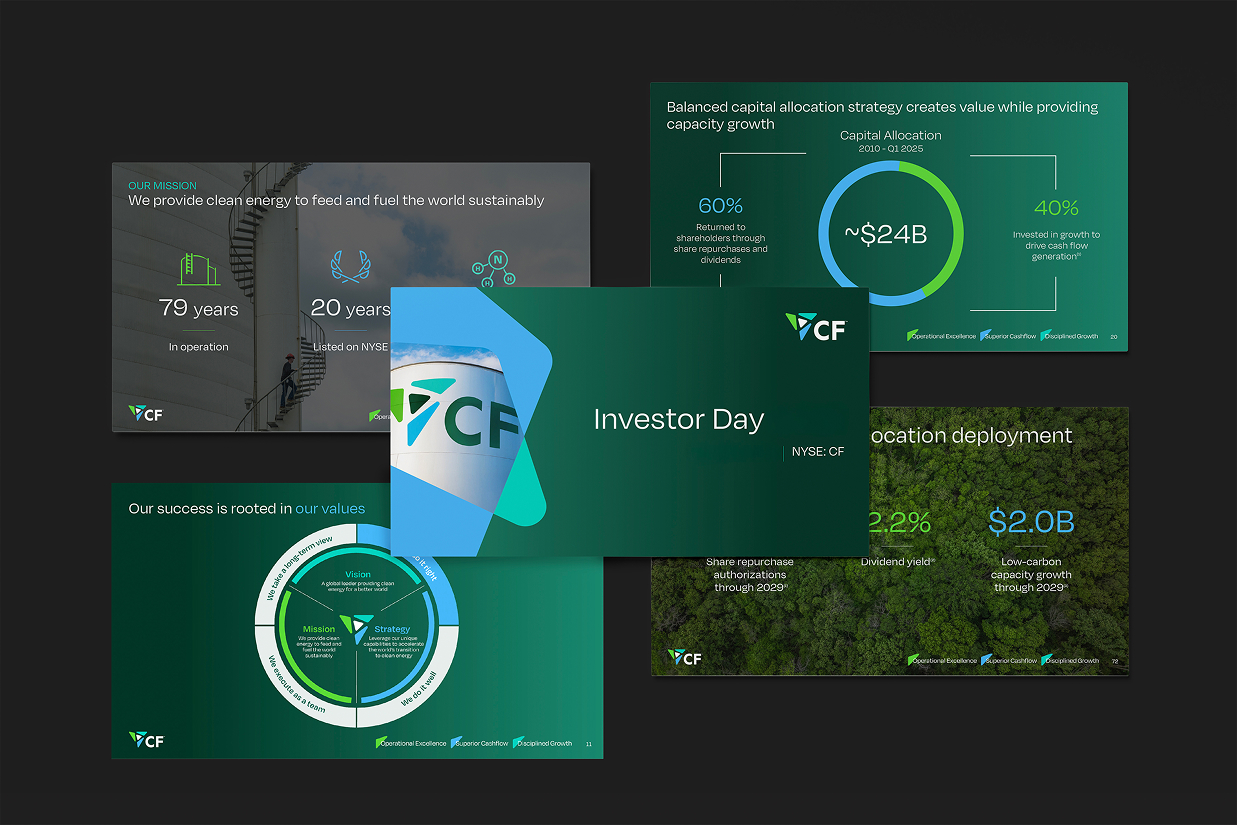
That’s where Investor Day production earns its place. A well-built Investor Day isn’t spectacle. It’s infrastructure for understanding. Presentation design, the sequencing of management segments, and the quality of the webcast and live and hybrid event experience all shape how investors absorb and retain the story. Done well, they cut cognitive friction, reinforce credibility, and make the narrative easier to believe and repeat. The same logic governs pre-IPO roadshows, strategic announcements, and M&A communications – any moment that asks capital markets to understand something complex, quickly, and with confidence.
The Cardboard Spaceship perspective
We work with public companies and their advisors on exactly these moments: the Investor Days, the roadshows, the strategic events that need more than a conference room and a slide template.
One pattern shows up again and again. The companies that communicate well in capital markets don’t run the biggest production budgets. They treat every piece of the program as connected. The presentation supports the video. The video supports the event. The event feeds the investor microsite. A single CEO video message on strategic priorities can serve the earnings moment, the Investor Day, the annual meeting, and the IR site at once – reusable, not redundant.
Here’s the part most teams underweight: investors don’t only judge what management says. They judge whether the company looks organized, coherent, and worth a multi-year commitment. Sloppy materials and a disjointed digital presence answer that question before a word of guidance lands. Performance will always outweigh production value. But on the right stage, production is what makes performance legible.
Start with the system
Heading into a major earnings period, an Investor Day, or a capital markets transaction? The question worth asking isn’t how do we make the earnings call more interesting. It’s whether the whole program hangs together – the materials, the distribution, the design of the supporting assets, and the quality of the event experience.
Wherever those pieces work against each other, that’s the opportunity. We’re glad to think it through with you. Talk to the team at Cardboard Spaceship.
Frequently Asked Questions
For most public companies, no. The call’s primary audience – institutional investors and sell-side analysts – values clarity, direct management access, and live Q&A over production. A heavily produced format can suggest that management prioritizes spectacle over substance. Produced investor storytelling belongs at the Investor Day, the roadshow, or a strategic announcement, not the quarterly call.
Focus on what surrounds the call. Invest in cleaner, better-designed earnings presentations and supporting materials, build a distribution plan that carries key messages to owned channels and IR microsites after the call, and treat the earnings moment as one part of a continuous program rather than a one-off event.
Video serves different jobs at different moments. For quarterly earnings, its value stays limited – investors prioritize direct access and live Q&A. For Investor Days, strategic announcements, pre-IPO roadshows, and CEO communications, professionally produced video becomes a durable, reusable asset that extends the story’s reach and reinforces management credibility.
Effective Investor Days combine a clear narrative structure, well-designed presentation materials, a strong webcast and event experience, and a supporting microsite that gives investors easy access to the full story. Each piece reinforces the others. Investors judge not only what management says, but whether the company looks organized, credible, and worth a long-term commitment.
IR microsites act as centralized digital homes for high-stakes communications – Investor Days, proxy contests, M&A announcements, and strategic transactions. They consolidate the webcast replay, the presentation deck, executive bios, FAQs, and a clear call to action in one place, which makes it easier for investors to find the story and stay engaged after the event ends.
