OpenAI and Anthropic haven’t filed for an IPO. But the production architecture of their eventual roadshows is already taking shape – in plain view, if you know what to look for.
DevDay 2025 looked like a developer conference. The 45-minute fireside chat between Sam Altman and Jony Ive, Apple’s former Chief Design Officer, looked like something else. To us, it played as a moment built for the institutional investors who would parse it on YouTube the next morning. Hardware ambition. Design pedigree. A three-year collaboration framed as a thesis paragraph for a future S-1.
From a production lens, that fireside reads less like a developer feature – and more like a cap-table signal.
The same pattern is playing out across the AI sector. Anthropic launched Code with Claude in May 2025 and expanded it across San Francisco, London, Tokyo, and Washington, D.C. The tour read as measured and technically rigorous, less like dev relations and more like the discipline of a public company running its narrative arc.
Audience composition appears to have shifted as well. The staging looks heavier. And the production decisions; line-of-sight blocking, fireside choreography, demo handoff timing, partner sequencing – increasingly resemble the staged moments a public company runs the year before it files.
We’re not predicting IPO timing. But we are saying the rehearsal is happening in plain view, and the production choices these labs are making now are the same ones every IPO candidate makes when they want institutional money to recognize them on sight.
The class of 2024–2026 – Reddit, CoreWeave, Klaviyo, Rippling – gave us a fresh dataset on which roadshow production decisions land and which don’t. Read that dataset alongside what’s happening at DevDay and Code with Claude, and the playbook for the next mega-IPO begins to write itself.
Here’s what we’re seeing.
Most coverage of DevDay 2025 focused on the announcements: GPT-5 Pro and Sora 2 in the API, ChatGPT Apps with Zillow, Booking.com, Target, Figma, Expedia, Uber, Instacart, OpenTable, DoorDash, and Peloton. AgentKit for autonomous workflows. Codex Slack integration.
The product news is the obvious headline. The interesting questions are about what the staging communicates.

At events of this scale, production choices rarely feel decorative. Instead, they tend to be directional. In our experience, every decision (who shares a stage, what experiences attendees walk through, which conversations linger in the memory) functions as a deliberate signal; first to the room, then to the much larger audience that catches clips, photos, and analyst recaps for weeks afterward. The question isn’t whether OpenAI staged DevDay 2025 carefully. It’s what the staging reveals about the story they want to tell.
Three production choices stand out.
When Altman sat down with Jony Ive, the staging seemed to communicate something specific to the financial world: this isn’t just a software company.
There’s hardware ambition, design pedigree, and a partner whose work shaped the iPhone, iMac, and Apple Watch. The chat felt unscripted enough to seem intimate, and structured enough to land its key points. Ive said his creative team’s purpose “became clear” with the launch of ChatGPT. Altman framed the collaboration as a three-year arc.
For developers, that’s a curiosity. For institutional investors evaluating whether OpenAI commands a hardware-software stack story, that plays as a thesis paragraph. Worth noting: the conversation wasn’t even livestreamed. It went up on YouTube hours later. To us, that distribution choice reads as confidence. The most consequential moment of the day didn’t need to compete for live attention.
A “cozy mini-theater with popcorn” featuring AI-generated short films sounds like a fun side-activation. Look closer. It’s a positioning argument. Sora moved from research preview to API offering at this event – a defining moment of value that extended far beyond a product demo.
The mini-theater turned attendees into an audience, not testers. Watching AI-generated film with popcorn in hand frames Sora as cinema. Watching it on a laptop frames it as a tool. The production choice tells the market which one OpenAI wants Sora to be.
That’s the same staging logic Reddit used in 2024 when it leaned into community as the equity story rather than DAU metrics. The product becomes the experience. The experience becomes the narrative.
The DevDay 2025 lineup looks deliberately chosen.
Each speaker delivered real content, and each one provided OpenAI with powerful, specific validation.
Stitched together, these three choices read as a single argument: this is a company with consumer scale, hardware ambition, and ecosystem depth. Whenever OpenAI eventually files, the components of the equity story are already on stage and evolving right in front of us.
Anthropic took a notably different production approach. Code with Claude launched in May 2025 as a single-day, hands-on conference at The Midway in San Francisco, then expanded into a multi-city series across San Francisco, London, Tokyo, and Washington, D.C. Where DevDay leans into spectacle, Code with Claude leans into rigor. Three choices stand out.

OpenAI sold $650 in-person tickets to anyone who clicked. Anthropic took applications and curated the room. To us, that’s a meaningful production decision.
Curating the audience signals to the financial world that the company controls who sees its developer relationship up close. It also implicitly positions Claude as a premium tool for serious builders rather than a consumer phenomenon.
For institutional investors evaluating where Anthropic sits in the AI stack, the application gate is exactly the kind of credibility signal that filters retail froth out of the room. That’s a strategic choice.
The decision to expand from a single SF event into a four-city tour mirrors how a public-company roadshow actually moves: deliberate geographic coverage, repeat performance discipline, the same narrative delivered to different markets.
To our eye, that’s not a developer marketing choice. That’s the rehearsal of an institutional travel pattern. Anthropic ran the SF, London, Tokyo, and DC sequence in 2025 and is following with additional cities in 2026.
The geography choice is itself a story. London for European enterprise. Tokyo for the kind of legitimacy that only comes from showing up in Asia’s most established tech and finance market. DC for policy and regulatory presence. Each city carries a specific part of the narrative to a specific audience.
AWS hosted official Code with Claude watch parties as satellite events. Most coverage treated this as a technical convenience. To us, it reads differently.
Look at it from a production standpoint: a major cloud hyperscaler is volunteering its physical and digital infrastructure to extend the reach of an Anthropic-branded event. AWS is Anthropic’s largest cloud distributor and a strategic investor with billions committed to the partnership. By hosting watch parties, AWS publicly performs that alliance – turning a developer event into a visible signal of institutional backing.
That’s the kind of credibility and distribution muscle most pre-IPO companies have to pay for. Anthropic has it built in.
Where OpenAI’s staging emphasizes scope and consumer reach, Anthropic’s emphasizes curatorial access, depth, and enterprise readiness. The cap-table signal differs accordingly. OpenAI seems to be telegraphing a story about scale, hardware, and platform breadth. Anthropic seems to be telegraphing a story about discipline, enterprise traction, and infrastructure partnerships. Both are legitimate pre-IPO postures. They simply imply different equity stories – and likely different institutional investor profiles when the filings eventually land.
To know what the AI labs are rehearsing, look at the recent IPO class. Four roadshows in particular produced distinct production case studies.


Reddit gave away 8% of its IPO to its users. 1.76 million shares allocated to 75,000 of its most active Redditors and moderators. Karma score decided who qualified. No lock-up period.
It was an unusual move and a deliberate one. Reddit’s equity story depended on community. A slide deck couldn’t tell that story; allocating real shares to real users could. Steve Huffman didn’t have to argue that Reddit had a unique relationship with its users. The directed share program was the argument.
The lesson: when your story depends on community, your investor day staging has to make the community visible, not just cite it in the deck. Reddit priced at $34 and opened at $47, a 38% first-day pop. The S-1 flagged real risk in the structure (no lock-up could amplify volatility, and some Redditors actively organized against the IPO), and the narrative architecture worked anyway. Users-as-shareholders is now an established roadshow technique that Uber, Airbnb, and Cava had used in lighter form.
CoreWeave downsized its IPO from $2.7 billion to $1.5 billion the day before launch. Institutional demand had softened. NVIDIA reportedly stepped in with a $250 million anchor purchase to get the deal across the line. CoreWeave priced at $40 on March 28, 2025, and the first day of trading closed flat.
The roadshow ran into a recognizable problem. The pitch was infrastructure-heavy and visually abstract: GPU capacity, liquid cooling, Kubernetes-native architecture, 250,000 GPUs across 32 data centers. All accurate. None of it tangible to a public-market investor who has never set foot in a data center.
The lesson: data center stories need physicality on stage. Slides and spreadsheets make “AI infrastructure” sound like a commodity. The tools that turn an abstract category into an investable thesis (data hall walkthroughs, rack density comparisons, heat-and-power math made visual) only work when the production team builds them in. CoreWeave eventually went on a 250%+ tear post-IPO once the market understood the story. The challenge wasn’t the company. It was the translation of the narrative – both visually and experientially.
Klaviyo was the first SaaS IPO in nearly two years. The market was frozen. Marketing automation isn’t a category that excites public-market investors. CEO Andrew Bialecki later called it an “IPO winter.”
So Klaviyo led with the founder. Bootstrapped origin. MIT-trained engineer. $100M strategic investment from Shopify. 119% net dollar retention. 51% YoY growth. GAAP profitability. Rule of 75 metrics. Bialecki himself became the narrative spine of the roadshow.
The lesson: when the product is unsexy, the founder narrative carries the staging, and that requires founder coaching, not slide design. Bialecki had to learn how to be the equity story in real time, in dozens of one-on-one institutional meetings, with no fireside chat to lean on. That’s a different production discipline than a celebrity CEO event. It’s intimate. It’s repetitive. It requires the founder to deliver the same emotional beats with freshness on the fortieth pitch. Klaviyo priced at $30, raised $576 million at a $9.2 billion valuation, and opened with a 23% first-day pop. The market recognized a credible operator, not just a magnetic personality.
In February 2026, Rippling aired a Super Bowl ad. Not because it was selling HR software to households. Because the company is making itself a household name before it asks public-market investors to recognize it.
Rippling hasn’t filed an S-1. CEO Parker Conrad has said publicly that an IPO isn’t imminent. Yet the production preparation is unmistakable. Rippling raised a $450 million Series G at a $16.8 billion valuation in May 2025. Annual revenue reached $570 million in February 2026, growing over 30% YoY with net revenue retention approaching 200%. The Super Bowl ad slot ran around $7 million.
Layer in the Deel lawsuit subplot. Rippling sued its largest competitor in March 2025 alleging corporate espionage; Deel countersued in April. The result is a roadshow narrative-in-waiting with built-in tension, competitive stakes, and a story arc the market is already following.
The lesson, even before the S-1 lands: the best roadshows aren’t built starting at the prospectus filing. They’re built years earlier, through brand investment, narrative seeding, and earned-media architecture. By the time Conrad walks into his first investor meeting, the story will already be partly told. Watch how the roadshow handles the Deel feud, whether it’s foregrounded as competitive moat or treated as backdrop noise. That choice will tell you everything about how Rippling has rehearsed its public-company identity.
Map the four cases onto OpenAI and Anthropic, and the patterns start to line up.
To us, the interesting observation isn’t that these labs will eventually IPO. It’s that the production preparation for that moment appears to be happening on the stages we’re already watching. DevDay and Code with Claude read as public dress rehearsals. The audience swap-out (developers in 2025, institutional investors in 202?) is mostly a matter of who’s in the room. The staging architecture is portable.
OpenAI’s ChatGPT has reached 800 million weekly active users (as Altman announced at DevDay 2025). The pre-IPO question is whether any of those users become shareholders. SpaceX just precedent-set the retail allocation question with its 30% retail target. DevDay’s Apps SDK announcement, which lets users chat directly with apps from Booking.com, Zillow, Target, Figma, and others, is the technical precondition for a community-visibility play at IPO. OpenAI is staging the infrastructure now.
Both labs face the data-center-economics problem. Both are spending tens of billions on compute. Both have the same risk: investors hearing “infrastructure” and pricing it as commodity capex. Sora Cinema was a small move in the opposite direction, making AI compute feel like a consumer experience rather than a balance-sheet item. Anthropic’s API-and-MCP focus at Code with Claude is the more enterprise-coded version of the same instinct. Whoever IPOs first will need a tangibility moment in their roadshow that CoreWeave didn’t quite execute.
Sam Altman is on stage all the time, but a roadshow is a different production challenge: dozens of intimate institutional meetings, repeated questions, no audience. Dario Amodei rarely takes that kind of stage. Both will need to develop the discipline of delivering the same narrative architecture, freshly, to room after room, for two weeks straight. That work happens long before the S-1.
This is where the AI labs appear most clearly to be rehearsing. The Sam Altman / Jony Ive partnership reads as brand seeding. Anthropic’s policy presence in Washington reads as brand seeding. Code with Claude’s multi-city expansion reads as brand seeding. None of it is sales activity. To our eye, much of it functions as roadshow preparation by other names.
The combined effect: the AI labs appear to be running all four production patterns at once, with bigger budgets and longer runway than any of their predecessors. By the time the S-1s eventually land, their production foundations will be deeper and more multi-dimensional than anything Reddit, CoreWeave, or Klaviyo had the runway to build.
If you’re a head of IR, head of corporate comms, or growth-stage CFO watching this rehearsal play out, here’s the framework outlined by these events:

Who’s in the room, and visibly in the room, is itself the equity story. The presence of an a16z partner on a developer stage doesn’t communicate the same thing as a developer relations engineer.
Every roadshow needs a single staged conversation that conveys narrative information no slide can. For OpenAI it’s Altman + Ive. For Reddit it was the moderator share program. For Klaviyo it was the founder’s bootstrapped credibility. Find yours.
If your story includes infrastructure, capacity, scale, or technical depth, design at least one production moment that translates the abstraction into an embodied experience. CoreWeave’s roadshow under-indexed on this. Sora Cinema was a low-stakes attempt to learn the lesson early.
Every speaker on your stage represents a category of validation: customer voices, partner voices, investor voices, civic voices. Choose the mix to match the equity story you’re telling, not just the agenda you’re filling.
Roadshows happen in conference rooms with twenty institutional investors at a time. The founder who’s brilliant on stage isn’t automatically brilliant in that room. Different muscle. Develop it years in advance.
Rippling’s Super Bowl ad. OpenAI’s Apps SDK partner announcements. Anthropic’s policy and developer presence. The roadshow doesn’t begin at the filing date. It begins the moment institutional investors first start hearing your name in unscripted contexts.
DevDay’s keynote streamed live. The Altman + Ive fireside didn’t, but went up on YouTube the same day. That sequencing is deliberate. Live serves urgency; on-demand serves reach. Design both.
When the AI labs eventually file, every staging choice they’re making now becomes part of the institutional case file investors use to evaluate them. The rehearsal is the record.
The bright line between “developer event” and “investor day” appears to be dissolving.
This isn’t unique to the AI sector. To us, it reads as an ongoing structural shift. Companies with consumer scale, enterprise depth, and platform ambition can’t run their pre-IPO communications through a single channel anymore. The audience for an IPO is now a constellation: institutional investors, retail allocations, developer ecosystems, enterprise buyers, regulators, partners, employee shareholders, and a financial press taking cues from social platforms. Every staged moment a company runs in the years before filing reaches some subset of all of them.
That makes production more strategic, not less. The companies that stage their developer events with the audience composition of an Investor Day in mind, that invest in their brand before the prospectus, and that coach their founders for both the keynote and the conference room, should have an enormous advantage over companies that wait until the S-1 to start thinking about narrative.
The rehearsal is the production. By the time the S-1 hits, the show is already running.
That’s the work worth investing in. It’s also the work Cardboard Spaceship builds for clients navigating the moments that matter.
The next generation of IPO roadshows won’t start at the S-1 filing. They’ll start years earlier, in the staged moments that quietly build institutional recognition. Whether you’re preparing for an Investor Day or the long lead-up to a future filing, the production decisions you’re making now will define how the market responds when the moment arrives. Let’s start a conversation →
Nine days from now, Greg Abel will walk onto a stage Warren Buffett owned for six decades.
It’s the Berkshire Hathaway 2026 annual meeting, and for 60 years, it’s unapologetically followed the same format. 40,000 people will file into the CHI Health Center in Omaha, Nebraska. They’ll take their seats in the same arena. They’ll hear CNBC’s Becky Quick introduce the Q&A session. They’ll see the Berkshire logo on the stage.
But this time, Buffett will be ten feet away. In the front row. Silent by his own public declaration.


The Berkshire Hathaway 2026 annual meeting would already be one of the most watched corporate events of the year on that fact alone. But something more interesting is already in motion. Abel has quietly restructured the format, and he hasn’t said a word yet.
For 60 years, this meeting had one production element worth analyzing: Warren Buffett in a chair for five hours. Everything else was deliberate absence. No slides. No teleprompter. No walk-on music. Just a microphone, a can of Cherry Coke, and the accumulated wisdom of the most successful investing career in history.
The anti-production was the production. The simplicity communicated respect for investor intelligence. The marathon length signaled nothing to hide. The solo performance said one person is accountable for everything. Those choices built the “Woodstock for Capitalists” – the only corporate event in the world that reliably draws 40,000 people to Omaha.


And Abel has redesigned all of it.
Two Q&A panels instead of one marathon. New voices on stage – Ajit Jain (insurance), Katie Farmer (BNSF), Adam Johnson (consumer products). The traditional open Q&A intact in spirit, restructured in execution.
That change isn’t cosmetic. It’s the succession narrative made physical. And it happened before Abel ever stepped up to the microphone.
The question is whether it works.
No CEO has ever inherited a corporate event this consequential. 40,000 shareholders. Global webcast in English and Mandarin. Buffett in the front row. A $380 billion cash position on the balance sheet.
When Buffett announced his retirement at last year’s meeting, the standing ovation lasted minutes. The question had already shifted from “when will Buffett step down?” to “what does Berkshire look like without him?”
May 2 is when the market gets its first real answer.
We’ve been in enough high-stakes investor rooms to know what’s at play. Here are five production and narrative challenges Abel’s team will need to navigate on May 2, and our predictions for how each one plays out.
This is the most loaded staging decision of the entire event.
Buffett sitting among the directors, visible but silent, is an extraordinarily powerful visual. It’s a living endorsement of the transition. It says: I trust this. I’m here. But it’s his turn now.
It also creates a gravitational pull the production team will need to manage carefully:
Our prediction: the webcast production will show Buffett briefly at the opening, then keep the focus firmly on the stage for the rest of the event.
The discipline is in resisting the reaction shot. Every time the camera cuts to Buffett instead of Abel, the narrative slides backward. The production team needs to treat the front row as context, not content.
There’s a subtler challenge too. Buffett’s physical presence in the room will hold an emotional weight no amount of production design can fully manage. Some shareholders will spend the entire meeting watching him, not the stage. That’s human nature, and the event can’t prevent it. But it can refuse to feed it.
The traditional Berkshire Hathaway annual meeting format was beautifully simple.
One person. One chair. Five hours.
Questions from the audience, answered in real time, with no filter and no limit. That simplicity wasn’t an accident. It was Berkshire’s brand made physical. Transparency. Directness. Trust.
Abel has restructured the format into two distinct Q&A panels:
The format change is, essentially, a narrative statement about where Berkshire’s value lives now. Buffett’s solo format said the value was in one chair – in one person’s judgment and ability to allocate capital. Abel’s panel format says something different. The value is in the operating leaders:
The quality of the people running the pieces, not just the person orchestrating the whole.
Our prediction: institutional investors will read this format change correctly; as a signal that Berkshire under Abel will be more operationally transparent, more team-driven, and less dependent on the mystique of a single decision-maker.
Some longtime retail shareholders may experience it as a loss. Both reactions are valid with a legacy of this magnitude.
There’s no polite way to say this: Warren Buffett was one of the great entertainers in corporate history.
His annual meeting performances were legendary not just for their financial insight, but for their warmth, their humor, their stories. He’d spend 10 minutes on a single question, reference a deal from 1967, make a joke about See’s Candies that somehow also explained capital allocation theory.
Abel won’t do that. And he shouldn’t try.
What Abel brings is different:
The production challenge is real. Forty thousand people in an arena that are accustomed to being entertained and educated simultaneously. Abel will educate, but education alone has to hold a room of that size for hours.
Our prediction: Abel’s answers will be tighter, more operational, less philosophical.
The Q&A sessions will feel shorter even if they run the same length, because the pacing will be steadier and the digressions fewer. Some attendees will call it “refreshing.” Others will call it “less fun.” Both are probably right.
The production team can help:
Berkshire is sitting on roughly $380 billion in cash and short-term investments. It’s the elephant in the room within every conversation about Abel’s leadership. And it will be the first hard question he faces on May 2.
Some version of “what are you going to do with the money?” will come early, probably from Becky Quick, who knows it’s the question on every shareholder’s mind. How Abel handles it will set the tone for his entire tenure.

The trap: over-promise.
Buffett spent decades preaching patience on capital allocation, and the market rewarded him for it. Abel needs to earn that same credibility, which means his first instinct on May 2 should be patience, not action.
Our prediction: Abel will acknowledge the cash position directly, reaffirm the discipline of waiting for the right opportunity at the right price, and resist the temptation to hint at anything specific.
The smartest answer is some version of “we have the capital to be decisive when the moment is right, and the discipline to wait until it is.” It’s not the answer that generates headlines. It’s the answer that builds trust.
This is the question nobody on stage will ask, but everyone in the room will be thinking about.
Forty thousand people came to Omaha because of Warren Buffett. The weekend around the meeting was built around his presence:
The “Woodstock for Capitalists” brand was inseparable from its headliner.
So what happens in 2027?
The 2026 meeting is the transition year. Attendance will likely hold. People want to see the first post-Buffett meeting, and many shareholders already have the trip booked.
But the real indicator isn’t 2026 attendance. It’s 2027.
If the numbers hold, the event has successfully become bigger than its founder. If they drop significantly, the market learns that the “Woodstock for Capitalists” was always more about the capitalist than the Woodstock.
Our prediction: Abel’s team knows this.
The format changes (multiple panelists, operational depth, visible bench strength) are designed for 2027 just as much as 2026. They’re building a format that doesn’t rely on one person’s magnetism to draw a crowd. Whether it works is the test that runs beyond May 2.

There’s a reason Buffett’s performances became legendary beyond the financial world.
He was one of the great entertainers in corporate history. His annual meeting set piece: spend 10 minutes on a single question, reference a deal from 1967, make a joke about See’s Candies that somehow also explained capital allocation theory. The audience stayed because he was teaching them something AND because he was fun to listen to.
Abel can’t replicate that. He also shouldn’t.
Buffett traded in folksy wisdom from the Oracle of Omaha. Abel trades in operational rigor – a CEO who has actually run the businesses he’s discussing. Different brand of credibility, not a diminished one.
The production team can amplify what Abel brings naturally:
Abel’s job on May 2 isn’t to answer any single question brilliantly. It’s to establish that the meeting still feels like Berkshire in his voice – honest, direct, unhurried – without requiring Buffett’s ghost in the room to make it work.
Katie Farmer runs BNSF Railway, one of the largest freight operators in North America and one of Berkshire’s most important businesses.
Most retail shareholders wouldn’t recognize her name. She’s never been a featured speaker at the annual meeting. In the Buffett era, she didn’t need to be.
Now she’s on stage. So is Adam Johnson from NetJets and consumer products. So is Ajit Jain from insurance.
The meeting does something it has never done before: puts operating leaders in front of the audience, answering real-time questions about what they actually run:


Shareholders spend every year reading about BNSF in the annual letter. Having Farmer field questions live is a different kind of signal – the business has a visible leader who can speak to operations at the level of detail institutional investors want.
Add Johnson and Jain to that picture, and the company presents itself as what it actually is: a collection of well-run businesses with deep bench strength, not a portfolio that only makes sense in one person’s head.
For any company navigating a leadership transition, there’s a production principle worth studying here. Don’t announce that you have great leaders. Put them on stage and let the audience see for themselves.
Berkshire’s 2026 meeting is the most visible example of a challenge every company eventually faces.

The founder steps back. The iconic CEO retires. The person who is the brand moves off the stage. And the event that was built around them has to keep working.
Here’s what we’d tell any company in that position.
Abel isn’t trying to be Buffett, and the format isn’t trying to recreate the solo marathon. The worst thing a successor can do is imitate the predecessor’s style.
The audience will spot it instantly, and it reads as insecurity, not continuity. Find the new leader’s authentic strengths and design the format around those.
Bringing operating leaders on stage communicates depth, reduces key-person risk perception, and gives the audience multiple points of connection with the company. If your event previously depended on one magnetic speaker, widening the stage is how you build a format that outlasts any individual.
The audience needs a moment to honor what came before. Then they need the event to move forward with confidence.
Lingering on the transition (spending too long on tributes, too many backward-looking references) signals that the company is more attached to its past than its future. A brief, genuine acknowledgment followed by decisive forward motion is the right balance.
Abel kept the Q&A. He didn’t add slides. He didn’t add video. He kept the thing that makes Berkshire’s meeting fundamentally different from every other shareholder meeting on Earth: the willingness to answer whatever shareholders want to ask, in real time, with no filter.
That format choice is the message. It says: we’re still Berkshire.
The 2026 meeting will get great attendance because of the transition itself. Everyone wants to see the first post-Buffett meeting.
The real test is Berkshire Hathaway 2027. Whether the format, the new voices, and the new identity can sustain the event on their own merit. Plan for the second year, not just the first.

On May 2, the most important signals won’t come from the stage.
They’ll come from the room:
And the question that hovers over all of it: does the room still feel like Berkshire?
That feeling (the sense of belonging to something, the connection between a company and its owners, the trust that what you’re hearing is the unvarnished truth) is what made the “Woodstock for Capitalists” something more than a shareholder meeting.
That quality was Buffett’s greatest production achievement. Not the jokes or the stories or the Cherry Coke.
The trust. The sense that this company respects you enough to sit in a chair and answer your questions for five hours.
Abel can’t inherit that trust. He has to earn it.
And May 2 is when the earning starts.
The format is set. The panels are announced. Becky Quick has the questions. Buffett has his seat in the front row. Forty thousand people have their tickets.
The rest is live.
We’ll be watching. For the production choices, the narrative architecture, and the moments that tell us whether the most iconic corporate event in history just found its second act.
Every analyst walks in with questions. The most effective events answer them before they’re asked, through narrative architecture, experiential production, and financial precision that earns the room’s conviction. Let’s start a conversation →
Somewhere in the next eight weeks, Elon Musk will walk into a room and ask investors for $75 billion.
Not a fundraising round. Not a tender offer. A full initial public offering targeting a valuation of up to $1.75 trillion, nearly triple the current IPO record set by Saudi Aramco in 2019. SpaceX filed its confidential S-1 with the SEC on April 1, 2026. The prospectus goes public in late May. The roadshow launches the week of June 8.
And on June 11, something happens that has never happened before in the history of capital markets: 1,500 retail investors will be invited to a dedicated event as part of the IPO process, with participants from the U.S., UK, EU, Australia, Canada, Japan, and South Korea.
This isn’t a standard roadshow with a retail twist. It’s a fundamentally different approach to SpaceX IPO roadshow design, one that splits the investor communication into two parallel tracks, asks two audiences with radically different needs to buy into the same story, and puts the world’s most unpredictable CEO at the center of the most financially sensitive week of his company’s 25-year history.

SpaceX generated roughly $15-16 billion in revenue in 2025, with Starlink alone contributing over $10 billion from more than 9 million subscribers worldwide.
The company merged with Musk’s AI venture xAI in February 2026. Morgan Stanley, Bank of America, Citigroup, JPMorgan, and Goldman Sachs are leading the deal, with 16 additional banks in supporting roles. According to reporting from multiple outlets, this single offering could exceed the total proceeds of all U.S. IPOs in 2024 and 2025 combined.
But here’s the thing. None of that guarantees the roadshow works.
We’ve produced enough high-stakes investor events to know. We’ve been in the rooms where CEOs make their pitch, where the production design either builds conviction or lets it slip away, where the difference between a good event and a great one lives in the details most people never notice. And looking at what SpaceX has announced, we see five production and narrative challenges that have never been solved at this scale.
Here’s what we’re watching — and what we think it’ll take to get each one right.

The week of June 8 will feature a traditional institutional roadshow with SpaceX executives and bankers pitching the offering to fund managers and institutional investors in private meetings. Three days later, on June 11, 1,500 retail investors will attend what the banking syndicate has described as a “major investor event.”
These are two fundamentally different productions.
The institutional roadshow is a controlled, small-room format. Twenty people around a conference table. Dense financial content. Detailed Q&A. The presentation is designed for sophisticated investors who’ve already read the S-1 and want to pressure-test the numbers. The tone is precision. The goal is analytical conviction.
The retail event is something else entirely. Fifteen hundred people don’t sit quietly through a slide deck. They need energy. They need vision. They need a reason to feel something about the company, not just a financial model. CFO Bret Johnsen has already signaled the intent: retail investors will represent “a bigger part than any IPO in history.”
Our prediction: the June 11 event will look and feel closer to an Apple keynote or an NVIDIA GTC than a traditional roadshow stop.
Production value will be high. Visual storytelling will carry more weight than financial tables. And the room will need to feel like the future, because 1,500 retail investors aren’t buying a DCF model. They’re buying a future they want to be part of.
The production challenge is keeping the narrative consistent across both formats while adapting the tone, pacing, and persuasion mechanics for each audience. Same story. Completely different rooms.


There’s no way around it: Elon Musk is simultaneously SpaceX’s greatest asset and its greatest production risk.
He’s the most famous CEO on the planet. His presence fills rooms and dominates headlines. For retail investors, he is the brand, the reason many of them want to own SpaceX shares in the first place. Removing him from the roadshow isn’t an option. Nor should it be.
But this is the most financially sensitive week in SpaceX’s history. Every word spoken during the roadshow is subject to SEC quiet period rules. Every unscripted comment carries headline risk. Every social media post gets parsed by regulators, reporters, and short sellers.
Our prediction: the production team will structure Musk’s participation carefully, probably in one of two ways:
Musk going fully unscripted for two hours in front of 1,500 retail investors during an active IPO process. The legal and regulatory exposure would be extraordinary. The production discipline here will be in giving Musk enough room to be magnetic without letting unscripted moments create problems that overshadow the offering.
And behind the scenes, CFO Bret Johnsen will likely carry the financial credibility. He’s already emerged as the pragmatic voice of the IPO process.
Our bet: The institutional roadshow features Johnsen as the primary financial presenter, with Musk in a more curated, vision-and-conviction role. The 125-analyst pre-briefing the day before the roadshow launches may feature Johnsen and other executives more prominently than Musk.
The calculus is clear. Musk brings the room to life. Johnsen brings the numbers to life. The roadshow needs both, in the right sequence, with the right boundaries.

This might be the single hardest narrative architecture problem in the entire roadshow.
SpaceX isn’t one company. It’s at least four:
Each of these has a different financial profile, a different time horizon, and a different type of investor who cares about it. Starlink is a recurring revenue growth story. Launch services is a margin-and-moat story. xAI is an AI-optionality story. Mars is a vision-and-mission story.
The roadshow has to weave all four into a single thesis that holds together. If the narrative fragments, if investors feel like they’re being asked to value four separate companies stapled together, the valuation argument weakens. Conglomerates get discounts. Platforms get premiums.
Our prediction: The team will anchor on a single connective phrase.
Something like “infrastructure for the next century” or “the platform that connects Earth and beyond.” Starlink carries the financial argument. Launch services carries the competitive moat argument. xAI becomes the intelligence layer that enhances both. And Mars becomes the vision closer – the aspirational endnote that makes people want to own a piece of the story.
That’s an architecture we’ve seen work in multi-business Investor Day presentations. The businesses that can be modeled go first. The businesses that require belief go last. Trust before imagination.

Here’s the uncomfortable truth about the June 11 event: nobody has done this before.
Retail investor events at IPOs typically involve a webcast, maybe a streamed presentation. They don’t involve flying 1,500 people to a venue and producing a live experience designed to generate buying conviction from an audience that doesn’t read prospectuses.
This event will need to accomplish several things simultaneously:
Our prediction: The production will borrow heavily from the tech keynote playbook.
High-quality video packages showing Starlink coverage expanding across the globe. Starship footage that puts you inside the experience. Live demos or visual presentations that make the technology tangible. Possibly a Starlink terminal in every attendee’s hands. The room needs to feel like you’re stepping into the company’s future, not sitting through its pitch.
And the post-event follow-through matters as much as the event itself. How does SpaceX convert 1,500 enthusiastic attendees into shareholders when the allocation process spans six countries and multiple regulatory frameworks? That’s a communications and logistics challenge that extends well beyond the room.
The day before the roadshow launches, approximately 125 financial analysts from the 21 banks on the deal will meet with SpaceX executives. This is the most under-discussed element of the entire process, and potentially the most consequential.
If those 125 analysts walk out of the room confident, they’ll pitch the IPO to their institutional clients with conviction. Their tone shapes the narrative for every subsequent institutional meeting. Their questions reveal what concerns are percolating in the market. Their body language in the first roadshow meetings tells fund managers whether the smart money is leaning in or holding back.
Our prediction: this session will be the most traditional, most financially dense element of the entire roadshow.
S-1 walkthrough. Revenue decomposition by business line. Margin trajectory modeling. xAI integration accounting. Risk factor discussion. Dual-class share structure explanation. Management credibility assessment.
It needs to feel like the most rigorous, most serious room in the process. Because it is. The contrast between this room and the June 11 retail event will be stark, and that contrast is the point. The two-track design only works if each track is optimized for its audience. The analyst room should feel like a boardroom. The retail room should feel like the future.

The narrative architecture of this roadshow will determine whether SpaceX gets valued as a platform or as a conglomerate. The difference could be hundreds of billions of dollars in market cap.
Here’s the core tension: Starlink is the financial story. It’s where the revenue is, where the margins are, where the subscriber growth is. Analysts can model it. Institutional investors can compare it to telecom and broadband peers. If SpaceX were just Starlink, the valuation conversation would be complex but tractable.
But SpaceX isn’t just Starlink. And the other businesses create both upside and confusion.
At $1.75 trillion, the valuation demands that institutional investors see SpaceX as infrastructure: a global broadband utility, a logistics backbone for orbit, a compute platform. Not as a speculative space exploration venture. We expect the word “infrastructure” to appear more than any other framing term in the S-1 and the roadshow materials.
The narrative needs to reposition “space company” as “infrastructure company that happens to operate in space.” That reframe is the difference between a utility multiple and a story stock multiple. And for a $75 billion raise, the team needs the utility multiple.
The S-1 will need to disclose xAI’s financials for the first time: Grok’s monetization, compute costs, capital expenditure commitments. Investors will want to know whether xAI is accretive or dilutive. Whether it strengthens the core businesses or just adds complexity.
Our prediction: the roadshow will frame xAI as the “intelligence layer” across the SpaceX ecosystem — AI-driven Starlink network optimization, autonomous flight systems, predictive maintenance for launch vehicles, and AI compute infrastructure in orbit. If the team can make xAI feel like an enabler of the core businesses rather than a separate bet, it adds to the story. If they can’t connect it, it becomes the section where institutional investors start shifting in their chairs.
Mars is the origin story. It’s why Musk founded SpaceX. It’s why many retail investors care about the company. But it’s also, from an institutional perspective, the part of the story that’s hardest to value and the easiest to dismiss.
The roadshow probably can’t avoid Mars entirely. But it also can’t lead with it.
Our prediction: Mars appears in the closing minutes, framed not as a near-term investment thesis but as the long-term vision that motivates the company’s engineering culture, its willingness to take risks, and its ability to attract world-class talent. It’s the “why” behind the company, not the “what” the market is buying. That distinction matters enormously in how institutional investors receive it.


The June 11 event is the one that will be studied for years.
If SpaceX pulls this off, with 1,500 retail investors leaving a room so convicted that they drive meaningful share purchases, in a format that complies with SEC requirements and generates positive media coverage, it becomes the template for every major IPO going forward. If it stumbles, it becomes a cautionary tale about the limits of retail participation in high-stakes capital formation.
The production stakes are that binary.
Here’s what we think the event needs to get right:
The retail audience is there because they believe in SpaceX. They follow the launches. They’ve watched Starship test flights. They might be Starlink subscribers. The event needs to honor that relationship before it asks for money. Start with the story of what SpaceX has built and why it matters. Let the financial case emerge from the mission, not the other way around.
Retail investors don’t think in revenue multiples. They think in experiences. Starlink’s 10 million subscribers becomes meaningful when you show the fishing village in Indonesia that got internet for the first time. The launch business becomes real when you show the cost curve that makes it all possible. The production should prioritize visual storytelling over slides and charts: maps, footage, real-world impact.
This is where the production discipline matters most. Musk needs to be present, engaged, and compelling. But the format should contain his participation within a designed arc – probably a moderated conversation or a keynote with a clear narrative structure. The goal is conviction, not controversy. Let him be the visionary. Don’t let the format invite the kind of unscripted tangent that becomes the next day’s headline.
The final moments of the event should make attendees feel like partners, not customers. “You’ve believed in this company for years. Now you can own a piece of it.” That emotional frame – investment as participation, not transaction – is what converts attendance into allocation.
Only 1,500 people will attend on June 11. Millions more will see the photos, clips, and posts that come out of it. Every production element – the staging, the visual design, the swag, the moments – should be designed to generate content that carries the narrative beyond the venue. The 1,500 attendees are the amplification channel. The event should give them something worth sharing.

This roadshow will set precedents that reshape how companies communicate with investors for years. Whether you’re planning an IPO, an Investor Day, or a shareholder meeting, three elements are worth tracking closely.
The institutional roadshow and the retail event are designed as parallel tracks serving the same equity story to different audiences. If both land, it proves that companies can design investor communication systems that serve multiple audiences without choosing between them. That has direct implications for Investor Days, earnings presentations, and any corporate event where the audience includes both institutional and retail shareholders.
The production discipline around a celebrity CEO during an active offering will be the most closely watched element of this roadshow. Every IR team with a high-profile CEO – and every production team that supports one – should study how SpaceX balances Musk’s magnetism with the guardrails required by the moment. The answer will reveal the state of the art in managing executive presentation risk at maximum stakes.
Rockets plus broadband plus AI plus Mars is a lot to ask any audience to absorb. Whether SpaceX finds the single connective thread – and whether the narrative architecture holds from the analyst pre-brief through the retail event – will determine whether the equity story feels like a platform or a conglomerate. The difference directly impacts valuation. Every company with multiple business lines can learn from how this plays out.
Even before anyone takes the stage, SpaceX’s IPO roadshow has already changed the conversation about how companies talk to investors.
The 30% retail allocation isn’t just a capital markets innovation. It’s a statement about who matters in the ownership structure of a public company. For decades, IPO design has prioritized institutional investors – the pension funds, hedge funds, and mutual funds that write the biggest checks. Retail investors got the leftovers, buying shares on the open market at whatever price the first day of trading produced.
SpaceX is inverting that hierarchy. And the June 11 event is the physical manifestation of that inversion – a produced experience designed specifically for individual investors, treated with the same production seriousness as the institutional roadshow.
If it works, every major IPO in the next five years will face a question they didn’t have to answer before: What are you doing for retail? How are you bringing individual investors into the process? What does your retail event look like?
That question will ripple beyond IPOs. Investor Days will need to consider retail audiences more deliberately. Earnings presentations will face pressure to be more accessible. The wall between “institutional communication” and “retail communication” will continue to erode.
For production teams, that convergence creates both a challenge and an opportunity.
The challenge: designing events that serve audiences with fundamentally different levels of financial sophistication.
The opportunity: the companies that figure this out first will build deeper, more loyal shareholder bases – and they’ll need production partners who understand how to build for both rooms at once.
That’s the production challenge SpaceX is about to face. It’s also the challenge we build for every day, from planning to playback.
We’ll be watching. And when the roadshow wraps, we’ll be back with what they got right – and what surprised us.
Every analyst walks in with questions. The most effective events answer them before they’re asked, through narrative architecture, experiential production, and financial precision that earns the room’s conviction. Let’s start a conversation →
Two hours. One stage. One man in a leather jacket. And approximately $4.4 trillion in market capitalization riding on what he said next.
On March 16, 2026, Jensen Huang walked onto the floor of the SAP Center in San Jose – a 17,000-seat hockey arena repurposed as a keynote stage – and delivered the NVIDIA GTC 2026 keynote that Wall Street, Silicon Valley, and the global AI community had been anticipating for months.
More than 30,000 attendees from over 190 countries had converged on San Jose for the four-day GPU Technology Conference. Over 450 sponsors had signed on. One thousand sessions with 2,000 speakers were scheduled across the convention center down the street. But everyone knew: the event that mattered most was happening right here, right now, with one man and a clicker.

The surface situation was extraordinary. NVIDIA had just closed fiscal year 2026 (ending January 2026) with $215.9 billion in revenue – up 65% year-over-year. Data center revenue alone hit $62.3 billion in the final quarter. The company had reported eleven consecutive quarters of revenue growth above 55%. By every financial measure, NVIDIA was delivering.
But GTC 2026 carried a deeper challenge. The AI spending narrative faced pressure from multiple directions:
Huang’s task wasn’t to present good numbers. The numbers spoke for themselves. His task was to prove that the AI infrastructure buildout is a multi-year industrial phenomenon, not a cyclical spike – and that NVIDIA sits at the center of it.
He had two hours to do it, in a hockey arena, alone, with the entire financial world watching.
What he built on that stage, and how his production team designed the experience around him, is worth a closer look.

The narrative architecture of NVIDIA’s GTC 2026 keynote solved a problem most corporate events never face: how to make a single presentation land simultaneously with three audiences – whose needs differ fundamentally.
Huang addressed all three in a single, continuous two-hour presentation. And he did it by layering the keynote so that each audience heard what they needed at different segments of the same content.
The opening set the demand thesis immediately. Huang projected that combined Blackwell and Vera Rubin purchase orders would reach $1 trillion through 2027, doubling the $500 billion figure he cited just a year earlier. This number targeted investors directly, arriving in the first minutes before any product announcement.
By establishing demand visibility first, Huang gave the financial audience permission to listen to the next 110 minutes of product announcements not as speculative R&D, but as pre-sold infrastructure. Every chip, every platform, every software tool that followed carried the implicit backing of a trillion-dollar order book.


The technical middle of the keynote unspooled NVIDIA’s full product ecosystem:
Basically, each product carried enough technical specificity to satisfy developers (chip architecture details, performance benchmarks, shipping timelines) while also framed in business terms that enterprise buyers and investors could parse. Vera Rubin was not just a chip. It was “10x inference per watt,” a cost-efficiency metric that translates directly into customer ROI. The Groq LPU was not just a new processor. It was the answer to the inference economics question every hyperscaler CFO had been asking.
Huang then deployed a technique that separates masterful keynote architecture from competent product presentations: he seeded portable frameworks throughout the keynote, phrases designed to travel far beyond the room.
Each phrase gave media and analysts a ready-made framing device that shaped coverage for weeks. This is narrative seeding at scale, built on the understanding that the real impact of a keynote happens not in the room, but in the thousands of articles, analyst notes, and social posts that follow.

The closing act shifted from products to long-term vision: the Kyber rack architecture, the Feynman roadmap through 2028, partnerships with BYD, Hyundai, Nissan, and Geely representing 18 million cars per year, the Uber robotaxi collaboration, and Vera Rubin Space-1, a concept for the first space-based data center.
By ending with vision rather than financials, Huang left every audience with a different takeaway. Developers saw a decade-long platform to build on. Enterprise leaders saw a strategic partner with a roadmap through 2028. And investors saw a competitive moat measured in years, not quarters.

What Huang does on stage at GTC looks effortless. It isn’t. Making a single presenter command a 17,000-seat arena for two hours – while delivering broadcast-quality content to a global livestream – is one of the most complex corporate event productions in the world.
The SAP Center hosts hockey games and concert tours, not corporate keynotes. Markedly, turning that space into a presentation environment where one person feels present, commanding, and intimate, whether you’re in the front row, the upper deck, or watching on a laptop in Tokyo, takes solutions across multiple production dimensions:
Here’s where it gets interesting from a production standpoint. According to NVIDIA, Huang starts planning his keynote about two months before GTC, but speaks off-the-cuff on stage.
No script. No teleprompter. No rehearsal.
That changes everything about how the production team operates. There’s no confidence monitor feeding lines. No prompter to pace him. The control room adjusts camera cuts, slide cues, and demo triggers in real time, matching a presenter who’s improvising the connective tissue between planned announcements as he goes. That’s concert-level responsiveness applied to a corporate keynote.
If you watched GTC 2026 from the outside, you might’ve thought some of the spectacle moments were gimmicks. They weren’t.
Disney’s Olaf robot walked across the stage and held a conversation with Huang. It looked like a cute bit. In reality, it was a live demonstration of NVIDIA’s Isaac robotics platform, Jetson compute, and Newton physics simulation, presented as a character that an arena audience could emotionally connect with. The demo worked on three levels at once:
And the spectacle didn’t stop at the keynote stage. One hundred and ten robots populated the convention center floor throughout the week. Serve Robotics AMRs delivered food during the keynote pregame. Humanoids from AGIBOT, Agile Robots, and others demonstrated manipulation tasks. ABB Robotics brought a DJ robot. Every one of them functioned simultaneously as a spectacle (drawing attention, creating shareable moments) and as evidence (demonstrating ecosystem breadth and partner adoption).
The keynote’s finale pushed this even further: an AI-generated campfire song featuring robots and “Toy Jensen” (an AI avatar of Huang) that recapped every major announcement in musical form. NVIDIA’s creative team built it using generative AI tools, the very tools they’d just announced. Even the ending credits did strategic work.
That discipline, making sure every “wow” moment also proves the thesis, is what separates GTC from events that merely entertain. DIA’s creative team built it using generative AI tools, the very tools announced at the conference. The finale itself demonstrated the technology stack. Even the ending credits did strategic work.
The market’s response reflected the multi-audience complexity of the event itself.
NVIDIA shares climbed 2.2% in early trading on keynote day, sparking a broader rally among AI-adjacent companies. But the full-week picture was more nuanced. The stock finished roughly flat to slightly down over the four-day conference, as analysts noted that GTC announcements largely confirmed existing expectations rather than blowing past them. Macro headwinds, including geopolitical tensions and sector rotation out of high-multiple tech, muted what might otherwise have been a stronger move.
The analyst response, though, pointed overwhelmingly in one direction:
Here’s the nuance worth paying attention to: the stock moved modestly, but analyst conviction deepened. At $4.4 trillion, NVIDIA’s stock already prices in massive growth. An event like GTC doesn’t create new demand for the shares. What it does is extend the visibility of that demand and reinforce the competitive moat narrative that keeps downgrades off the table.
Media coverage framed GTC as a cultural and industrial moment, not just a product launch. The “Woodstock of AI” label persisted across outlets. The Disney Olaf moment also generated widespread social coverage. And Huang’s $1 trillion projection became the headline number in virtually every recap – confirming that leading with the demand thesis was the right call.

Huang opened with $1 trillion in orders through 2027 before announcing a single product. That one choice transformed every subsequent announcement from “here’s something new” to “here’s something already pre-sold.”
If your audience includes investors, leading with the demand signal gives every product announcement an economic context that amplifies its impact:
Products impress. Demand signals convince.
Every “wow” moment at GTC 2026 simultaneously entertained and proved the technology thesis. The Olaf robot. The 110 robots on the show floor. The AI-generated campfire finale. Each one drew attention AND demonstrated that the platform works.
Before adding any spectacle element to your event, run it through this test:
Entertainment without strategic function is filler. Demonstrations without entertainment are forgettable. The best moments do both at once.
“Tokens are the new commodity.” “The ChatGPT moment for autonomous driving.” “OpenClaw is the operating system for personal AI.”
Each phrase showed up in headlines, analyst notes, and social posts for weeks. That’s because the real reach of a keynote isn’t the people in the arena or on the livestream. It’s the coverage that follows. Hand media and analysts ready-made language, and one keynote becomes months of narrative.
Build your three-to-five quotable phrases before you build your slide deck.
Huang previewed three generations of architecture: Vera Rubin (2026), Rubin Ultra with Kyber (2027), and Feynman (2028). That turned a product roadmap into a competitive advantage argument. The message to investors: the gap between NVIDIA and every competitor isn’t one chip. It’s three generations of integrated systems, each building on the last.
If your company has a multi-year technology or product roadmap, presenting that trajectory in a single visual moment communicates durability in a way individual product announcements never can. The roadmap isn’t just a plan. It’s the moat, made visible.
GTC includes a dedicated financial analyst Q&A the morning after the keynote. That’s not an afterthought. It’s a deliberate two-event design:
This separation produces sharper questions and more meaningful dialogue than a rushed Q&A tacked onto the end of a two-hour keynote. So, if your flagship event serves both customers and investors, consider this structure: spectacle first, substance second, with breathing room in between.

Step back from the product announcements for a moment, and GTC 2026 reveals something bigger. It’s a preview of where corporate event production is heading.
GTC isn’t an Investor Day. It isn’t a product launch. It isn’t a developer conference. It’s all three at once, and the fact that it works tells us something important about the future of high-stakes corporate communication.
The old model, separate events for separate audiences, each with its own format and content, is giving way to something new. Unified events designed to serve multiple audiences at different altitudes of the same content. The developer hears the API documentation. The enterprise buyer hears the deployment timeline. The investor hears the demand signal. Same stage, same two hours, same presenter. Three different experiences, all valid.
That convergence creates production challenges most companies aren’t yet equipped to handle:
every company that faces a multi-audience communication challenge, and that includes every public company planning an Investor Day, can learn from the production principles that make GTC work.
The keynote isn’t the show. It’s the architecture. The spectacle isn’t the entertainment. It’s the evidence. And the event isn’t for one audience. It’s for every audience that matters, designed so each one leaves with exactly what they came for.
That’s the production challenge that will define the next generation of high-stakes corporate events. And it’s the challenge that shapes every production we build, from planning to playback.
NVIDIA’s GTC proves that the most powerful corporate events don’t choose between developers, customers, and investors. They serve all three through narrative architecture, production design, and spectacle that does strategic work. If your next event needs to reach multiple audiences from a single stage, that’s a production challenge we’ve built for.
No slides. No teleprompter. No walk-on music. No rehearsed opening. No cocktail reception. No video package. No panel of executives. No celebrity moderator.
Just one man, Warren Buffett, in a chair for five hours, answering whatever he’s asked.
By every modern standard of event production, the Berkshire Hathaway annual shareholder meeting should be a snoozer. It violates every rule of contemporary audience engagement, and it’s the exact opposite of what IR consultants typically recommend.
Yet, it draws 40,000 people to Omaha every May. It commands global media coverage. It moves markets. And it’s routinely cited by institutional investors as the single most valuable investor communication event in the world.
So what’s going on?
The short answer: the Berkshire meeting isn’t boring. It’s disciplined. And it works for the exact reasons most shareholder meetings don’t.
Here’s what 60 years of the “Woodstock for Capitalists” teaches about effective investor communication – and what any IR team can apply to their next event.
Most corporate events are built around a fundamental assumption: investors need to be entertained, impressed, or both.
So the production gets heavier every year. More video. More stagecraft. More choreographed executive walkons. More polished messaging. The implicit message: we don’t trust you to stay interested unless we keep the energy up.
Berkshire does something different, and it takes more production skill, not less, to pull off. The format assumes the audience is smart enough to stay engaged without decorative flourishes. Every production decision – staging, lighting, camera work, broadcast design – is built to disappear so the content can carry the room.
That’s the hardest thing to do in event production. Making the work invisible requires a team that understands exactly what to amplify and when to pull back .
The takeaway for your next event: production isn’t about adding spectacle. It’s about designing every element – visible or invisible – to serve the core moment. The most confident companies communicate through production that feels effortless and intentional, which is almost always the product of the most thoughtful production design.
Every production decision at a Berkshire meeting communicates something:
None of those are obvious production choices. Each one was deliberate. Each one required significant production planning and infrastructure to execute consistently year after year.
Together, they communicate Berkshire’s values more effectively than any mission statement could.
The takeaway for your next event: every production choice – length, format, staging, Q&A structure, broadcast design – is saying something about your company. The best production partners don’t just execute the format. They help you understand what each decision communicates and design every element to reinforce the narrative you’re trying to build.
Most shareholder meetings are a mosaic of competing elements: opening remarks, CEO presentation, CFO deep-dive, divisional updates, video segments, panel discussions, Q&A, networking reception. Each element is designed to serve a different audience need. The result is often a meeting that does many things adequately and nothing exceptionally.
Berkshire picked one element – the open-question Q&A – and made it the entire event.
That single format decision is what built the brand. It’s also what makes the event irreplaceable. There’s nowhere else an institutional investor can ask a man like Warren Buffett – the CEO of a $1.1 trillion company – any question they want and get a real answer in real time for five hours straight.
The takeaway for your next event: identify the one element of your investor communication that genuinely differentiates you. Then ask whether the rest of your format is supporting that element or diluting it. If you’re doing ten things to satisfy different stakeholders, none of them will be memorable.
There’s a reason Berkshire’s meeting generates so much media coverage. Reporters and analysts know Buffett will answer hard questions directly – about the economy, about politics, about specific holdings, about mistakes. The format makes it impossible to dodge.
Compare that to a typical investor meeting where executives deliver scripted remarks, take three pre-screened questions, and exit stage right. The contrast isn’t subtle. Shareholders notice. So do journalists. So do short sellers.
Transparency at Berkshire isn’t a corporate value statement. It’s a production structure. The format doesn’t allow evasion. And because the format doesn’t allow evasion, the company has spent 60 years demonstrating that it has nothing to evade.
The takeaway for your next event: if your IR format includes a lot of guardrails; pre-screened questions, heavily rehearsed executives, short Q&A windows, vague forward-looking statements – those guardrails are communicating something. Ask whether what they’re communicating is actually what you want.
The “Woodstock for Capitalists” works because its core identity is unmistakable.
Same weekend. Same city. Same open Q&A format.
But here’s what’s easy to miss. Berkshire has evolved the event substantially over 60 years. The webcast expanded from audio-only to video to global streaming in English and Mandarin. The question-submission system evolved. The microphone lottery was introduced. The broadcast production grew from bare-bones to one of the most sophisticated corporate livestreams in the world.
What Buffett and his team understood is the difference between identity and execution. The identity stayed fixed. The execution kept getting better.
That’s the formula most IR teams get wrong in one direction or the other. Some reinvent everything every year and lose the continuity that builds audience loyalty. Others freeze their format and miss opportunities to elevate the experience as technology, audience expectations, and stakes evolve.
The best IR events have clear identity and constant elevation. What stays the same is the core: the narrative, the intentionality, the relationship. What gets better every year is the craft that delivers it.
The takeaway for your next event: separate what should never change from what should always improve. Your core identity, your voice, your relationship with investors – protect those fiercely. Your production value, your storytelling sophistication, your technical execution – those should get better every single year. Great production partners help you identify which is which and elevate the execution without disturbing the foundation.
Every IR team is making the same tradeoff, whether they realize it or not.
Most shareholder meetings are designed around this year’s messaging. The best ones invest in a relationship with investors that lasts decades.
There’s a reason Berkshire’s annual meeting has outlasted recessions, leadership questions, and Warren Buffett’s own transition off the stage. The event was built to carry weight, not to win a single news cycle. The format, the venue, the open Q&A, the trust between the company and its shareholders – none of it happened by accident. It was built, refined, and protected, year after year, by a team that understood what the event needed to carry. The result is the most respected, most attended, most covered corporate event in the world.
That’s not boring. That’s the highest form of the craft.
Great IR communication isn’t built one event at a time. It’s built as a long-term asset – a production foundation strong enough to hold the company’s relationship with investors through every cycle, every leadership change, every market condition.
That’s the work worth investing in. And that’s the quality Cardboard Spaceship delivers.
Rethinking your next investor event?
The best IR communication isn’t about stripping production down or piling it on. It’s about making sure that every production decision, visible or invisible, earns its place. That’s the discipline we bring to every high-stakes investor event we build.
Brian Niccol opened Starbucks’ 2026 Investor Day a way most corporate events never begin: with a coffee tasting.
Standing on stage at a venue on Manhattan’s West Side on January 29, 2026, the chairman and CEO invited master coffee developer Sergio Alvarez to join him. Together, they walked a room full of sell-side analysts and financial media through a tasting of 1971 Roast; a new dark roast named for the year Starbucks was founded.
Before a single slide appeared, the audience had cups in their hands. That wasn’t casual hospitality. That was a production decision – and it set the tone for an Investor Day designed to be experienced, not just watched.

The stakes weren’t theoretical. This was Starbucks’ first Investor Day since 2023, its first under Niccol, and the highest-stakes communication moment in the company’s turnaround campaign. As of late January 2026, SBUX had declined roughly 13% over the trailing twelve months.
The “Back to Starbucks” initiative – Niccol’s signature strategy since arriving from Chipotle in September 2024 – had just delivered its first proof point: Q1 FY2026 earnings showed 4% U.S. same-store sales growth, the first positive traffic reading in eight quarters.
The event needed to accomplish two things simultaneously:
It nailed the first. The second is where the seams showed.

Opening with a coffee tasting operated on multiple levels:
The tasting required physical participation, activating sensory engagement that a keynote alone cannot. By the time Niccol began his formal remarks, the audience was already part of the brand experience, not just observing it.
Starbucks made a production choice that few public companies attempt at this scale: they built the turnaround into the event space itself. Beyond the stage, the venue housed a floor model of Starbucks’ redesigned coffeehouse: leather seating, teak-colored display cabinets, warmer lighting, plants.
Analysts didn’t hear about the store renovation strategy through a slide. They walked through it. Upcoming menu items: a new matcha line, an ube beverage slated for spring – all available to taste. New espresso equipment and an AI-powered barista assistant were on display for hands-on interaction.
This is the experience-as-evidence production model.


When your turnaround story is about introducing and restoring a physical space (the coffeehouse), a considered, immersive experience in a controlled environment is more persuasive than any deck. The physical model gave analysts sensory proof that the capital investment in store renovations was producing something tangible, relevant, and compelling – not just a line item. That distinction matters.
The venue itself, on Manhattan’s West Side with a hybrid webcast, positioned the Investor Day as a destination event. After three years without one, the return to an in-person format signaled confidence.
The implication for any company investing in physical transformation is straightforward: if you’re spending significant capital to change what a customer experiences in your space, the most convincing production choice may be building that experience into the event itself.
The event ran approximately four hours, structured around five executive presentations with Niccol bookending the program. The speaker order followed a deliberate progression:
Tressie Lieberman, Global Chief Brand Officer, went first, establishing the emotional and cultural thesis before a single financial target appeared. The “Back to Starbucks” framing positioned the turnaround as a return to core identity – coffee, craft, connection – rather than a reinvention. That framing matters for analyst modeling: return-to-core stories anchor the growth thesis in proven economics. It’s a lower bar for conviction than an unproven pivot.
Mike Grams, Chief Operating Officer, followed with execution proof – operational improvements, staffing investments, the mechanics of how coffeehouses were actually changing on the ground.
Brady Brewer, CEO of Starbucks International, expanded the growth canvas: more than 2,000 net new international stores by 2028, a goal of reaching approximately 40,000 locations outside the U.S., and a China licensing partnership with Boyu Capital projecting international operating margins past 20%.
“The world wants more Starbucks,” Brewer told the room.
Cathy Smith, Chief Financial Officer, anchored the arc in the financial framework: 13.5–15% operating margin target by fiscal 2028, $3.35 to $4.00 earnings per share, and consolidated revenue growth of 5% or more.
The stakes weren’t theoretical. As of late January 2026, SBUX shares had declined approximately 13% over the trailing twelve months. Analysts were watching to see whether Niccol’s turnaround rhetoric would translate into a credible financial framework.
The event needed to accomplish two things simultaneously:
Niccol returned to close, synthesizing four hours into a single thesis: “‘Back to Starbucks’ is the strategic currency of our turnaround.”
This approach is effective because each speaker builds on the previous, moving from “what we believe” to “what we’re doing” to “how big this gets” to “what the numbers say.” When executed well, this structure creates a compounding sense of inevitability, so financial targets feel like natural conclusions rather than aspirational claims.
By the time Smith presented margin targets, they landed as an expression of a brand strategy, an operational overhaul, and a growth opportunity that had been layered throughout the entire event.
Where it worked: The return-to-core framing, the evidence-first timing (positive earnings the day before), and the speaker sequencing created a narrative arc that was structurally sound.
Where it strained: The connective tissue between speakers could have done more to build momentum. The gap between “solid plan” and “this is a momentum story” is often a production and editorial challenge, not a strategy problem. The individual presentations delivered. The sum didn’t quite exceed the parts.
One underappreciated, key element: The timing. By scheduling the Investor Day one day after reporting the first positive U.S. same-store sales in two years, Starbucks let Niccol open with evidence instead of promises. Proof first, plan second. It’s one of the most effective sequencing techniques available to any company hosting an Investor Day.
Despite strong production, the market response was flat.
Three specific gaps contributed to that disconnect.
Starbucks targeted a 13.5-15% operating margin and $3.35-$4 EPS range by FY2028. The $3.35 to $4.00 EPS range spans nearly 20% of the midpoint.
In an event where every other signal – the tasting, the store model, Niccol’s conviction – pointed toward precision and control, that width introduced a completely different register. Deutsche Bank analyst Lauren Silberman called the range “too wide” during Q&A. Brian Jacobsen of Annex Wealth Management was more blunt: “Turning the ship around may be taking longer than originally hoped.”
The core problem? The experiential production built genuine conviction in the brand turnaround, but the financial framework didn’t match that confidence. When the room says “we’re back” and the guidance says “somewhere between here and there,” the audience has to choose which version to believe. The Street will always choose the conservative one.
For IR teams, this is the most directly actionable takeaway from the event. If your guidance range is genuinely uncertain, the presentation needs explicit bridging logic – walking analysts through the scenarios, the levers, and the specific conditions that determine where within the range the company lands. Transparency about the range is more credible than precision you can’t support. But the range alone, without that context, just reads as uncertainty.
Post-event coverage and subsequent analyst actions consistently flagged the same concerns:
None of this was a surprise. These were the predictable questions any informed analyst would raise about a turnaround predicated on spending more to earn more. The event addressed those concerns – within Smith’s broader financial framework. But there’s a meaningful difference between addressing a concern and confronting it.
Addressing it means the data exists somewhere in the deck. Confronting it means building a dedicated moment with its own narrative structure, its own evidence, its own emphasis that tells the room: we know this is a question you have, and here is exactly how we’re thinking about it.
For example, the walkthrough of Starbucks’ loyalty program revamp included a specific, clear, relevant data point: if half of Starbucks’ loyalty members buy one additional time per year, it adds $150 million in annual revenue.
That single sentence converted a brand initiative into something an analyst could put in a spreadsheet. The cost narrative needed (but didn’t quite get) the same treatment.
Starbucks ran this as a hybrid event with a live webcast. However, the experiential elements that made the in-person event distinctive – the tasting, the store model, the product previews – were precisely the elements that couldn’t translate through a stream.
This matters because the webcast audience is typically the larger audience – and often the one most directly trading the stock. If the live experience builds conviction through immersive details while the webcast delivers standard presentations, those two audiences leave with fundamentally different experiences and levels of belief.
The production solution here is editorial, not technological. Handheld camera work following analysts through the experiential space. Close-up footage of product interactions. Cinematic moments of storytelling. Reaction shots that capture what the room actually feels like. Narrated segments that translate live moments into visual story. Given that the entire thesis of this event was about the power of physical experience, ensuring every audience – not just the on onsite – received that message was critical.
Regardless of any outcome, Starbucks approached this event asking the right question: what does it take to make an analyst really feel the revitalizing power of a turnaround, not just hear about it?
Starbucks’ 2026 Investor Day represents a genuine evolution in how consumer brands approach investor communications. The experiential format; building the brand experience into the event space, opening with sensory engagement, integrating product and technology demonstrations alongside formal presentations – is a model that will influence how companies think about these events going forward.
Starbucks proved you can immerse analysts in a brand story and generate real enthusiasm. But it also highlights a challenge that any IR team navigating a turnaround will face. The stock’s subsequent decline proved that enthusiasm without financial precision isn’t enough for the institutional audience. The most effective Investor Days will increasingly live at this intersection – experiential enough to build belief, financially precise enough to convert it. Where every immersive moment makes the financial story more specific – not more ambitious..
And to be clear, that’s not a Starbucks problem. The outcome of every Investor Day production lives at this intersection. Companies that master both will achieve the most valuable outcome in corporate communications: complete ownership of the narrative.
Starbucks timed their Investor Day one day after reporting the first positive U.S. same-store sales growth in two years. This allowed Niccol to open with proof (“4% same-store sales growth demonstrates the momentum we have”) rather than projections.
This evidence-first sequencing is immediately replicable for any company timing their Investor Day relative to a positive earnings cycle. If you have proof, let it precede the plan.
The coffee tasting reset audience expectations in the first five minutes. Most Investor Days open with forward-looking disclaimers and a CEO keynote. Starbucks opened with a sensory experience that was brand-aligned and participatory.
The question for IR teams: what’s the equivalent of a coffee tasting for your brand? What production choice in the first five minutes forces your audience out of autopilot and into active engagement?
When your turnaround story involves a physical experience (a store redesign, a product improvement, a service model change), showing is exponentially more convincing than telling. Starbucks’ floor model of the redesigned coffeehouse gave analysts tactile evidence.
The investment in building that environment inside the event space is a production cost that pays back in conviction. For any company investing in physical transformation, consider building the proof into the event.
When your experiential production says “we’re confident,” your financial guidance must match that confidence. Wide EPS ranges undermine the precision of everything else.
If a range is genuinely uncertain, the production should include explicit bridging logic that walks analysts through the scenarios. Not to eliminate uncertainty, but to demonstrate that leadership understands the range as clearly as the Street does.
Every turnaround involves investment. Every analyst audience will ask “at what cost?”
If the answer is embedded in a broader financial overview, it’ll get lost. Dedicate a segment, with its own narrative structure and its own data, to directly address:
Pre-empt the narrative the Street will write if you don’t.
If your Investor Day includes experiential or immersive elements, your webcast production must translate them. In most hybrid events, the remote audience is the larger audience.
Build a broadcast strategy specifically for the elements that can’t be physically shared:
The remote audience should feel the room, not just watch the stage.
Starbucks held its 2026 Investor Day on January 29 in Manhattan. It was the company’s first in three years and the first under CEO Brian Niccol. The event featured a five-speaker presentation structure, an experiential floor model of Starbucks’ redesigned coffeehouse, product tastings, technology demonstrations, and a financial framework targeting 13.5–15% operating margins and $3.35–$4.00 EPS by FY2028. SBUX shares fell approximately 1.5% on the day.
The immediate market reaction was tepid. SBUX declined approximately 1.5% on January 29 and continued falling over subsequent sessions. Analyst reactions were mixed: TD Cowen raised its price target but maintained a Hold, Deutsche Bank flagged the wide guidance range, and RBC Capital downgraded Starbucks to Sector Perform in March 2026. In-room reception, however, was described as “enthusiastic” by attending reporters.
“Back to Starbucks” is CEO Brian Niccol’s turnaround strategy focused on restoring the coffeehouse experience around three pillars: coffee, craft, and connection. Introduced after Niccol joined from Chipotle in September 2024, the strategy emphasizes store redesigns, improved staffing, menu simplification, and a renewed focus on in-store experience. Q1 FY2026 results showed its first proof point: 4% U.S. same-store sales growth.
Effective Investor Day production combines narrative architecture, experiential design, and financial precision. Key elements include evidence-first timing (reporting positive results before the event), experiential proof that supports strategic claims, clear speaker sequencing that builds a compounding narrative, dedicated cost-and-margin segments, and hybrid broadcast strategies that translate in-room experiences for remote audiences.
Check out more about our process, here.
The biggest challenge in hybrid Investor Day production is the asymmetry between in-room and webcast experiences. Companies should invest in dedicated broadcast storytelling for remote audiences: handheld camera work through experiential spaces, reaction shots, narrated B-roll packages, close-up product footage, and post-segment recaps. The goal is ensuring remote viewers feel the room, not just watch the stage./
Every analyst walks in with questions. The most effective events answer them before they’re asked, through narrative architecture, experiential production, and financial precision that earns the room’s conviction. Let’s start a conversation →
Investor Days are, without a doubt, the most important communication platforms for publicly traded companies. However, the experience looks very different today than it did 10 years ago. Companies now take a Virtual / Hybrid Event approach. These events merge a live presentation with a virtual or hybrid audience. Furthermore, teams can stream them live across the world for potential investors to watch. Quality investor relations video production is key to making these events impactful and memorable.
Here’s is an example of a virtual Investor Day with a live broadcast we did for Wex, Inc.:
Companies should adapt these events to their unique needs, logistics, and budget. In the example above, Wex found that adding video production to their event was tremendously helpful. It allowed them to show the new products and services they were launching in the market. Without the visual presentation, their investors and analysts might not have grasped the concept so easily. As a result, video helped them tell their story with greater impact and much greater control.
You can find it in commercials, social media posts, and event presentations. It is no secret why video production is so impactful. Our behaviors have changed over the last 10 years. We now consume massive amounts of video content every day. Video has become the primary way we learn about the world around us. This is not the future of storytelling. It is what is happening right now.
With video production and other creative services added to your event, you gain the ability to tell your story in a far more engaging way than traditional slideshows allow.
The story is key. Storytelling is how we all best connect with each other. Each company and each executive has their own important story. That story informs the trajectory of the business. Companies work hard to write their stories through innovation and strategic decision-making. However, those stories still need crafting and distilling to truly show investors what matters most. They need to present that story in the most efficient and memorable way possible.
For example, imagine showing the complex designs of a new suite of products through a compelling animated film. Indiscernible diagrams and technical language instantly become accessible. They reach not only niche investors but also a broader base of potential investors. Take a look at how we animated one of Wex’s new products:
You can also go out into the world and capture the spaces and people that make your company great. This gives your audience a cinematic film about your company. You can then weave these narratives and films into the presentation, creating an engaging and entertaining final product.
Your event does not have to be a live, unpredictable keynote experience anymore. With a pre-recorded approach, you leave nothing up to chance. You can use multiple cameras to capture cinematic compositions of key leadership.
Executives can do as many takes as they need. Teams can then edit the final result for a flawless performance. Leadership can also collaborate with a director or performance coach to execute their scripts perfectly and confidently.
Additionally, you can use this same setup to stream a live Q&A session. The same cameras, directing team, and on-set experience make executives feel comfortable and in control. This relieves pressure on the leadership team and allows everyone to successfully tell the story they have worked so hard to write.
Take a look at Brink’s Investor Day Live Broadcast Q&A:
With investor relations video production, you control every aspect of the Investor Day experience. It can be high quality, consistent, and natural.
Instead of crafting a narrative to suit a large auditorium or conference room, you can tell the story one on one. It makes leadership feel like they are talking directly to each audience member watching on their computer or phone. They can truly connect with the audience and reach them on a more emotional level. In turn, this builds an additional layer of familiarity and trust, which is key for a successful presentation.
Scriptwriting matters because you tell the story of the company’s past and progress through the script. That foundation is crucial for creating messaging that connects with investors.
The script also becomes the plan for the entire event:
Start early, write the script, and collaborate with your IR team. Plan the event as early as possible. Ideally, start the process 9 to 12 months out from launch day. Lock scripts 4 to 5 months ahead of time.
If anything changes in the months leading up to the event, you can edit and adapt content in the videos and performances. The earlier you start the process, the more creative, detailed, and thoughtful your Hybrid Investor Day can be.
Helpful hint: Hold off on setting your Investor Day event date until you consult with your IR Advisor and your production partner. Both have lead times you must consider.
One of the most valuable things about all the assets and pieces of content you create for the presentation is that they live on forever. Moreover, you can repurpose them across every channel of communication.
Video production is a powerful tool for investor communication. It helps you tell your story in a way that investors will connect with. The best way to speak effectively to a passionate group of investors is to harness the same methods they use to consume information and entertainment. Video production is by no means a new art form. However, integrating it effectively into Investor Day presentations is absolutely the future. Your competitors are already creating cinematic and memorable video content. Therefore, you should be too. Investing in professional investor relations video production is a strategic move that will differentiate your Investor Day and strengthen your brand.
Investor days are the most important platform a company can use to tell its annual story and video production can be an incredibly useful tool in telling that story. Investor days are undoubtedly the day analysts pay the most attention to because it is typically when companies announce their financial wins, forward guidance, big changes, new products, strategies, or services. As we move into a post-Covid world, more and more companies are adapting their strategies to include some sort of a video production whether it be virtual, hybrid and other intro sizzle videos to accomplish their investor days.
Videos can be a great way to communicate with your investors. The main benefit of using video production for investor day is that it helps you to tell your story, which will help you make your investor day more memorable and promote confidence in your company.
Investor days are a great opportunity to show investors your vision for the future and how you plan to achieve it. That’s where investor day video production comes in — helping you deliver a clear, compelling presentation. They can be a little overwhelming though, especially if you’re not used to presenting in front of an audience.
Video production is a great way to achieve consistent messaging for your investor day across all touchpoints. It allows you to highlight key messages and show your company in action.
A great way to supplement your investor day is with a series of short intro (or sizzle) videos that highlight the most important aspects of your presentation:
Video production is a great way to supplement an investor day. There are many types of videos you can use, including:
You can also use the video as a resource for internal training and education. This way you can show your team how to be more effective at investor days, analyst days, investor communications and investor relations.
This is a great way to share what you’ve learned with your team about investor day video production and for them to see first-hand how it’s done.
If you’re looking for a way to supplement your investor day, video production may be the perfect solution. Not only will it give you a professional presentation that looks great online, but it can also help ensure that no one misses any of your important information.
When a company steps in front of the Street for its Investor Day presentation, it’s not just about charts, bullet points, or executive talking heads—it’s about trust. It’s about clarity. And it’s about whether investors walk away believing in the path forward.
In June 2025, CF Industries held its first Investor Day in more than a decade. Expectations were high. Pressure was higher. And yet, what followed was one of the more positively received strategic presentations we’ve seen this year.
Here’s why it worked—and what companies can learn from CF’s approach.
Analysts didn’t leave the event hyped on headline numbers—they left with a clearer understanding of where CF is going, how it plans to get there, and why it has the operational foundation to pull it off.
Wall Street commentary following the event consistently highlighted CF’s transparency and strategic direction. From its pivot into low-carbon ammonia and carbon capture, to its continued cost leadership in a notoriously cyclical industry, the messaging was crisp, direct, and confident without drifting into overpromise.
This wasn’t investor storytelling for the sake of optics. It was strategic communication for the sake of credibility.
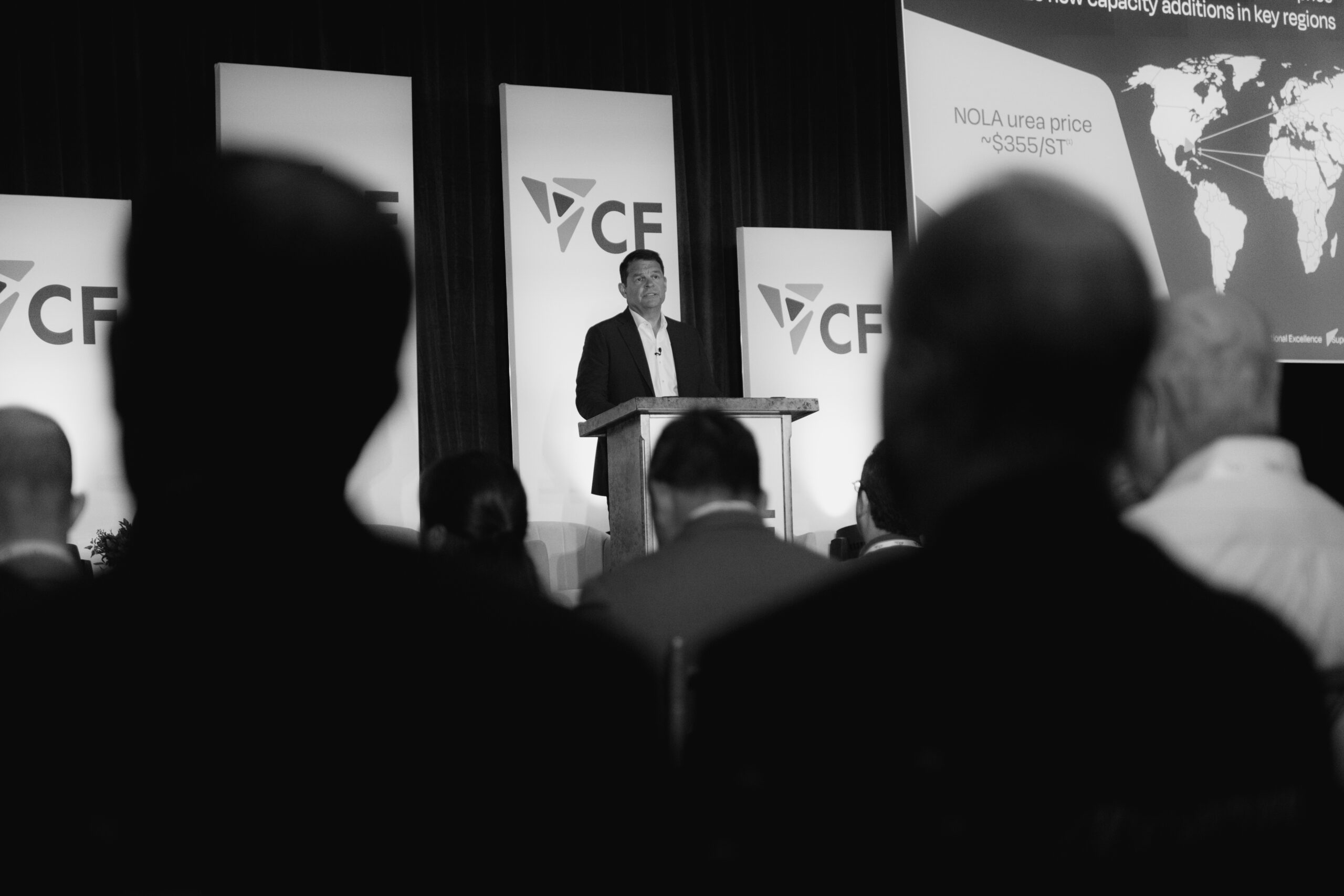
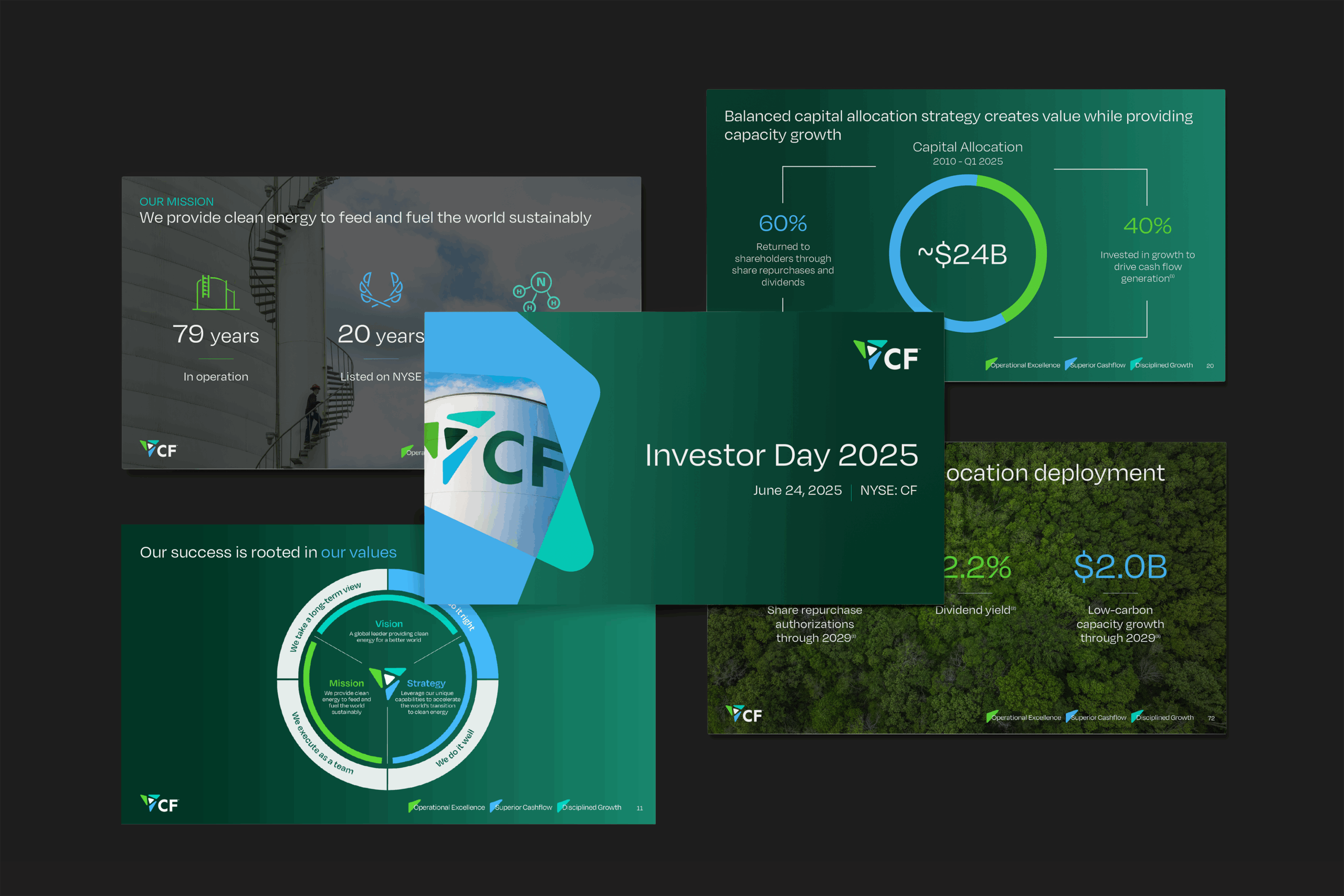
CF’s Investor Day wasn’t a one-day scramble—it was months in the making. That kind of clarity doesn’t happen by accident. It happens through planning, structure, and partnership.
At Cardboard Spaceship, we worked behind the scenes with CF to handle the entire production lifecycle:
The goal was simple: make the process seamless, make the content excellent, and let CF focus on what mattered most—getting their message right.
There’s a tendency to want to go big for big events. But for Investor Day presentation, polish means nothing if it gets in the way of the message.
We worked with CF to translate complexity into clarity—from data visualizations and facility footage to keynote messaging and content design. Each asset served a purpose. Every slide earned its place. The result was a presentation that felt coherent, sophisticated, and deeply intentional.
And it paid off.
Multiple analysts revised their outlook on CF following the event—not by issuing sweeping buy recommendations, but by doing something just as meaningful: expressing renewed confidence in CF’s leadership, strategy, and positioning in an evolving industry.


Investor Day isn’t just about presenting information. It’s about controlling your narrative. It’s about reducing friction and making your story land with the audiences who matter most—analysts, investors, and the financial media.
When the stakes are high, it’s not about doing everything yourself. It’s about choosing the right partner to carry the load so you can lead from the front.
CF Industries delivered — and the market took notice. Dive into our full case study to see how CF Industries made it happen!”
Want to talk about how we can help your Investor Day shine?
We’re here to elevate the message—not take the spotlight. Let’s start the conversation.
As an IR professional, your company’s Investor Day is the single-most important event of the year. It’s an immense opportunity for your leadership team to garner shareholder trust and share the company’s long-term vision and forward guidance. These events are pivotal for companies to boost transparency, educate the investment community, and display the humanity (and expertise) of the c-suite.
Our shared experience and insights from the buy-side show that well-run investor days educate the market on a company’s strategic path. They also correct any misconceptions, making the leadership and investment stand out. It’s crucial to leverage these events fully to enhance returns and influence the investment community.
Investor Days are pivotal for companies to deeply engage with the financial community and stakeholders. These events are a platform for companies to demonstrate their commitment to investor transparency. They allow investors to delve into the company’s strategies, goals, and future plans.
Investor Days are crucial as they offer companies a unique opportunity for strategic communication. With 94% of financial professionals finding them valuable, it’s essential to organize these events effectively. They should highlight investment differentiators to gain investor interest and trust.
Investor Days benefit both companies and investors. For companies, they offer a platform to educate the financial community about their strategies and operations. This enhances investor relations excellence and can boost investor confidence and market performance. Investors gain valuable insights into leadership, vision, and risk management strategies.
Companies like Disney use Investor Days to showcase their strong brands and diverse portfolios. This approach aligns with long-term growth and strengthens investor understanding of the company’s operational blueprint and market advantages.
Understanding the significance of these events and the thorough preparation required highlights a company’s commitment to transparency. This includes showcasing achievements in technology and operational efficiency, as seen with JPMorgan Chase, to bolster investor trust and confidence. For more information on maximizing your Investor Day potential, visit Cardboard Spaceship.
Strategic planning for an Investor Day is essential to meet its goals and add value for all stakeholders. It’s vital to set clear goals that show the company’s strategic path and its dedication to Strategic Investor Relations.
Well-defined objectives are key to a successful Investor Day plan. These objectives should match your investment thesis and strengthen it with clear financial communication and transparent reporting. For example, Edelman excels by leading discussions on thought leadership and climate change, boosting its reputation and offering insights into its strategy.
Finding a skilled production partner is crucial. Their expertise ensures the Investor Day goes off without a hitch, covering logistics and content. The ideal partner helps manage the various teams and ensures the technical experience needed for the execution of a successful event.
To craft a compelling message for an investor day, a strategic balance is essential. It must blend long-term plans with short-term goals. This requires thorough pre-production planning, a deep understanding of the audience, and high-quality production to leave a lasting impact.
Effective communication with investors demands presenting both strategic and tactical content smoothly. Our strategy emphasizes detailed pre-production planning. This includes scriptwriting, storyboarding, and scouting for top-notch video content. These steps are designed to engage our target audience and ensure our message hits home. By doing so, we not only reveal our long-term vision but also outline our immediate goals, shedding light on our tactical moves.
To effectively showcase leadership, we must go beyond the usual C-Suite presentation. It’s vital to feature insights from various management levels. Leaders like Patrick Dempsey of Barnes Group and Barry Hytinen of Hanesbrands have leveraged investor days to share their corporate stories. They’ve shown how the company’s strategies and leadership span across different levels. This strategy builds trust with investors and highlights the executive team’s depth and capability, making our message more compelling.
By focusing on these elements and maintaining a consistent corporate strategy, we can greatly influence how investors view our tactical information and our overall corporate narrative.
Premier video production is key to the success of investor days, especially in a hybrid format. By using high-quality video production, companies can keep both remote and live audiences engaged. This approach significantly boosts the event’s overall impact.

High-quality video content is vital for boosting investor engagement. It ensures a smooth video experience, connecting management with investors deeply. Engaging visuals and clear audio make every part of the presentation impactful and unforgettable.
For management visibility, streaming executive presentations effectively is crucial. Corporate event streaming helps businesses reach a broader audience and keep everyone engaged. From live events to hybrid and fully-remote events, it’s critical to lean into the experience of a trusted production partner. A public company may do a virtual event once or twice a year, whereas a trusted video production company should have a proven process in place for handling the platform integrations, managing remote audiences, and the various layers of technical expertise that are required for each.
Strategic video production, combining live management streams with dynamic slides, greatly increases engagement. Training and expert coaching help bridge knowledge gaps and achieve goals efficiently. This ensures a professional and streamlined broadcast experience.
Achieving Investor Presentation Excellence requires a strategic blend of thorough preparation and substantial content. A critical aspect is a meticulously designed presentation, often left to the last minute but deserving focused attention. Optimal presentation design ensures your visual aids effectively communicate your strategic investment communication goals.
To enhance delivery, engaging with specialized agencies can significantly elevate your presentation’s quality. Exceptional Speech Delivery is achieved through clear and compelling visuals, effectively capturing the audience’s attention and conveying the desired message. Leveraging visual means such as videos is a versatile tactic; they can be embedded on websites, shared through emails, and utilized in live events, directly enhancing the overall impact of your investor day presentation. We’re seeing the strategic use of AI across various processes within the IR landscape – like facial recognition to determine the authenticity of the speakers on-screen. These tools are showcasing the importance of proper script development, speaker-readiness and executive coaching.
Consider the success of companies such as Disney, which has leveraged its direct-to-consumer strategy to build a robust portfolio of content and services, helping to maintain a strong brand presence in the increasingly crowded market. They leverage their consumer marketing and strategically utilize content to enhance their investor day presentations, ensuring clear and impactful Strategic Investment Communication.
Lastly, examining companies like JPMorgan Chase & Co provides valuable insights into effective investor day strategies. Having a proven operational model and significant market share growth, they exemplify how solid financial narratives and operational achievements can enhance an investor day presentation. Their focus on innovation and technology investments showcases an Effective Presentation Technique that underscores client relationships and global expansion.
Conducting a comprehensive Investor Presentation Rehearsalis crucial for a flawless Investor Day. Rehearsing all parts of the event, from presentations to Q&A, significantly improves the final product. It’s key to focus on Strategic Message Alignment during rehearsals. This ensures the message matches the company’s strategic goals, enhancing investor understanding and engagement.
Simulating real conditions during rehearsals is beneficial. This includes setting up technology and understanding venue logistics. Such preparation is vital for delivering the company’s strategic messages and handling unexpected issues with ease.
Dry Runs are also essential. They cover all possible scenarios to ensure readiness. Dry runs enhance presentation flow, increase speaker confidence, and identify technical issues early, allowing for their resolution.
Virtual events offer numerous advantages, including cost savings, wider reach, data on participant engagement, and environmental benefits. By incorporating these aspects into our Investor Day through structured rehearsals, we can amplify our communication’s impact and reach.
By rehearsing for every scenario, we can effectively use modern communication tools. This shift to virtual and hybrid Investor Days underlines the importance of thorough rehearsals and preparation to improve storytelling and engagement.
Building a robust Long-Term Investor Relations strategy requires consistent, strategic messaging over time. Ensuring all Strategic Company Updates align with Investor Day messages is vital. This alignment lays the groundwork for effective communication and enhances investor confidence.
It’s crucial to keep our company updates in harmony with Investor Day themes and messages. Companies like Brink’s have benefited from platforms that facilitate compelling content for investor presentations. These platforms help drive home key points and make information impactful through engaging video content. By maintaining Messaging Consistency, we craft a narrative that resonates deeply with investors.
In today’s investment world, Trust and Transparency in Investing are essential. Investors seek clear, honest communication about the company’s performance and strategic plans. Effective storytelling and consistent updates inform investors and build trust. Regular updates on financial health, performance metrics, and strategic decisions demonstrate our commitment to transparency and long-term shareholder value.
Strategic Investor Day Optimization is key to boosting our corporate investment appeal and building stronger ties with our investment community. These events, when well-planned and executed, are vital for engaging with investors.
Keeping up with ongoing communication and building relationships with stakeholders is vital for long-term success. Experts stress the importance of leadership confidence and strategic planning for these events. This helps keep investors’ trust and boosts Corporate Investment Appeal.
In the end, it’s about ensuring the success of your most important event of the year. Make it count.