I have sat in two chairs during my career, and they face each other.
For years I sat on the client side of investor relations for the largest hospitality asset management firm publicly traded at that time. I lived the quarters, the investor days, the announcements that could not slip, and the moments when shareholder activism turned a normal week into a war room. Then I crossed the table. I co-founded an investor relations creative production agency built specifically for those moments. Earlier this year I presented this dual perspective to one of the leading strategic communications firms in the country, and the conversation that followed convinced me it was worth writing down.
This piece is for agency leaders. Not because agencies are the problem. Because agencies are closest to the fix.
Every public company has a short list of moments where trust is gained or lost based on execution. Investor Days. IPO roadshows. Management transitions. Activist situations. Transaction announcements. The strategy behind these moments can be months in the making. The judgment of them happens in hours.
Here is what I did not fully appreciate until I had worked both sides. The client and the agency are experiencing the same moment through different fears.
The client is worried about their audience. Investors, analysts, employees, the board. Trust with those audiences is gained or lost in real time, and there is no replay.
The agency is worried about the client. Their trust is gained or lost based on how the moment executes. A brilliant strategy that stumbles on stage does not get graded as a brilliant strategy.
Both sides face the same unforgiving math: high complexity, hard deadlines, no second chances. Which means both sides need the same thing. Strategic intelligence, creative excellence, and flawless execution, together, from the start. Not one or two of the three. All three.
In all my years on both sides of the table, I can count on one hand the failures I attribute to a bad strategy. Almost none of the breakdowns I witnessed came from weak thinking. The strategists were smart. The teams were competent. Everyone was well-intentioned.
The breakdowns came from fragmentation.
Too many vendors. Too many handoffs. A video team that never spoke to the presentation designer. A webcast provider who saw the run of show for the first time the night before. An event crew executing a stage design that contradicted the narrative the strategy team had spent months refining. Each vendor doing their fragment competently, and nobody accountable for the whole.
Investor relations and communications teams are still piecing together vendors and tools, each handling a fragment of what should be one unified, controlled experience. When the stakes are low, the seams don’t show. When the stakes go up, the seams are the first thing to tear.
When I moved from the client chair to the agency chair, three things became obvious quickly.
Most agencies outsource the services their clients judge them on. Very few firms have the internal resources to be an all-in-one solution, so production gets subcontracted to third parties. That is a rational business decision. It is also a quiet transfer of risk. The agency’s reputation now rests on vendors the client never chose and the agency may barely know.
Most production vendors don’t understand the IR landscape. They can execute. They can light a stage and cut a film. But they don’t know why a disclosure review changes an edit, why the sequencing of a guidance slide matters, or why an activist situation changes the tone of everything. They execute. They don’t develop strategy. In high-stakes capital markets moments, that gap is where mistakes live.
The integration gap is the opportunity. What the market lacks is a partner with a foundational understanding of the IR space and the creative acumen to produce work that holds up on the biggest stage. Not a strategy firm that dabbles in production. Not a production shop that skims a press release. A partner fluent in both.
Integration is not a philosophy. It shows up in specific moments. Three patterns come up constantly.
Management changes, major announcements, shareholder activism. These are the moments when a narrative needs visual components fast: explainer and narrative films, launch videos, and microsites built to hold and control the story. Speed and message control matter equally, which is why full-service video production and web need to run as one workstream, not two.
Pre-IPO roadshows and Investor Days. There are no second chances at a first impression. These moments demand live, hybrid, or virtual event production, executive films, animation, presentation design, and end-to-end project oversight, all pulling in the same direction. This is Investor Day production as a discipline, not a checklist of deliverables.
Sometimes the client already has the pieces. What they lack is orchestration. The internal point of contact is overwhelmed, and the agency needs someone acting as executive producer: managing vendors, owning timelines, overseeing logistics, and reducing risk for the agency and the client at once. This is the least glamorous version of the work and often the most valuable.
Earlier than you think. The pattern I saw repeatedly on the client side, and see now from the agency side, is simple: earlier involvement leads to broader impact and less risk.
When production joins at the end, it inherits decisions it cannot fix. The venue is booked, the deck is locked, the timeline is fixed, and the production partner is reduced to damage control. When production joins at the start, staging informs the narrative, the film supports the presentation, the microsite extends the event, and the whole moment reads as one coherent experience.
And to be clear about what this is not. A production partner should never replace an agency’s strategy. The right model enables the agency team to perform at its best and protects the long-term trust the agency has built with its client. The strategy firm owns the thinking. The production partner makes the thinking undeniable in the room.
If you lead a strategic communications or IR advisory firm, here is the honest audit I would run.
Look at your last three high-stakes client moments. Count the vendors. Map the handoffs. Ask who was accountable for the whole experience rather than a fragment of it. If the answer is “our account lead, on top of everything else,” you have found your exposure.
Your clients do not separate your strategy from its execution. Investors in the room do not either. They evaluate confidence, coherence, and credibility as a single impression. The firms that win the next decade of this work will be the ones that close the gap between what they recommend and what actually happens on stage, on screen, and online.
I have sat in both chairs. The view is better when they are on the same side of the table.
Jeremy Robinson is the co-founder and CEO of Cardboard Spaceship, a production partner for investor relations and high-stakes corporate communications. If a moment that matters is on your calendar, the best conversation is the one that happens early. Reach out at [email protected].
What is an investor relations production partner? A production partner for IR is a firm that executes the visual and experiential components of investor communications, including video, live events, presentation design, and microsites, with working fluency in capital markets context. It complements a strategy or communications firm rather than replacing it.
Why do Investor Days break down even with strong strategy? Most breakdowns come from fragmentation rather than weak ideas. When multiple disconnected vendors each handle a piece of one investor experience, accountability gaps appear at exactly the moments when deadlines are least forgiving.
Should agencies outsource production for high-stakes client moments? Outsourcing itself is not the problem. Outsourcing to vendors who lack IR fluency, without a single point of accountability for the full experience, is. Agencies protect their client relationships by choosing integrated partners who understand the stakes.
When should a production partner join an engagement? As early as possible. Early involvement lets production decisions inform strategy, broadens the partner’s impact, and reduces execution risk. Late involvement limits the partner to damage control.
Every IR team plans for the expected: earnings, guidance, investor meetings, and board updates. Then an executive departure, market rumor, activist approach, or unexpected miss changes the agenda in hours.
Q4’s August 2026 recap of Confessions of an IRO: Episode 3 brings together Jamie Stanton, Irina Zhurba, Isabel Vilela, and Geoff Callow to examine those moments. Their discussion offers practical lessons for investor relations teams. It also exposes a production reality: teams can move only as fast as the communication system they built before pressure arrived.
Investor communication infrastructure combines a current equity narrative, trusted executive voices, established digital channels, practiced response workflows, and consistent content production. Companies maintain these assets before a crisis so they can verify facts, respond quickly, and protect credibility under pressure.
When unexpected news breaks, analysts call, investors ask questions, and leadership feels pressure to respond immediately. The IR team should first confirm what happened, determine any disclosure obligations, and align legal, finance, corporate communications, and leadership around the facts.
The Q4 panelists urged teams to distinguish among market rumors, reporting errors, executive departures, and material events before they speak. Geoff Callow cautioned against a reflexive response without complete information. A short acknowledgment can protect credibility while the team verifies the details.
Standing infrastructure gives teams the confidence to wait for accurate information. A prepared team already knows who approves the message, which channel will carry it, who will speak, and how production will support the response. That clarity prevents silence from turning into panic.
Activist pressure rarely starts with a public letter. In the Q4 discussion, Callow described an activist who engaged privately for 12 to 18 months before going public. Zhurba noted that a public campaign can continue for two to three years.
IR teams should monitor the share register, study changes in investor tone, and listen for the question behind each repeated concern. An activist gains leverage when existing shareholders stop trusting management’s explanation and start considering a competing story.
That long runway creates an opportunity. Teams can document investor concerns, update the equity narrative, and strengthen shareholder relationships before a campaign starts. Our guide to why activist defense starts before the first letter explains how companies can use that time.
Once a contest reaches the public, the company needs a sustained content operation rather than a single press release. Purpose-built microsites and proxy fight sites give shareholders one source for the company’s argument, evidence, materials, and answers.

Management may focus on the five-year opportunity while investors focus on the next few quarters. Strong IR teams hold both views at once and identify the evidence that separates them.
Zhurba recommended bringing investors’ exact words into leadership conversations. Verbatim perception feedback gives executives evidence instead of opinion. She also warned that one miss can erase a year of credible calls, so teams should set expectations they can meet.
When investors misunderstand the business, a capital markets day can reset the narrative. A dense deck and conference line cannot carry a complex repositioning. The market needs clear sequencing, strong presentation design, confident speakers, and disciplined Investor Day production.
Format performs strategic work. Investors judge the plan and the team’s command of it at the same time. Our guide, Your Investor Day Is a Broadcast. Treat It Like One., explains how production quality supports the investment narrative.
A CEO who first appears online during an activist campaign can look defensive. An executive who communicates consistently through video, interviews, articles, and social channels enters the same moment with an audience and a record of credibility.
Corporate communications and IR should define the subjects each executive can credibly own, create a regular publishing cadence, and let formal disclosure lead every market-sensitive message. Practice also matters. Executives who rehearse on camera communicate with greater clarity when the stakes rise.
A full-service video production program helps leadership maintain that presence. No team can create trust in a week. Teams must earn and reinforce it over time.
Cardboard Spaceship helps corporate communications teams turn executive expertise into consistent, credible video content.
Prepared companies maintain five connected assets:
Prepared companies keep the narrative current, maintain a digital home for the story, rehearse leaders during calm periods, and treat major events as strategic resets. When a crisis changes the plan, those companies respond with the calm of a team that trusts its delivery system.
Preparation cannot prevent every surprise. It changes the quality and speed of the response. In capital markets, investors remember both.
Audit your communication infrastructure before you need it. Does leadership maintain an established voice? Do investors have a digital source of truth? Can your team publish a credible response within a day? If any answer gives you pause, start the work now.
If your calendar includes a high-stakes moment, or your team wants one less system to build under pressure, talk with Cardboard Spaceship.
The IR team should verify the facts, identify any disclosure obligations, and align legal, finance, corporate communications, and leadership before it responds. A short acknowledgment can give the team time to confirm the details without creating speculation.
Companies protect credibility when they communicate through established channels, match every claim with evidence, set expectations they can meet, and update investors consistently. Preparation gives teams the confidence to prioritize accuracy over speed.
An activist may engage privately for 12 to 18 months before going public, and a public campaign can continue for two to three years. Companies need a sustained communication program for the full period.
A capital markets day helps a company explain its strategy, operating model, leadership, and long-term value drivers in greater depth. Companies often use the event to address a valuation gap that stems from market misunderstanding.
Executives who communicate consistently build familiarity and trust before pressure arrives. During a crisis, those leaders can extend formal disclosure through channels that investors already recognize.
A microsite gives shareholders one controlled source for the company’s argument, evidence, presentations, video, and FAQs. That clarity helps companies maintain a consistent reference point during proxy contests and other high-stakes situations.
A public company uses a dedicated proxy fight website that it controls during a contested shareholder vote to explain the board’s case, show the evidence behind it, publish updates that counsel has approved, and tell shareholders how to vote. Unlike a standard investor relations site, the company designs it around one decision and one deadline.
That sounds straightforward until the contest starts moving.
An activist publishes a new letter, a reporter calls for comment, a proxy advisor asks a question that exposes a weak point in the narrative. Counsel revises language that has already made its way into a layout. Meanwhile, the shareholder arriving on the site may have ten minutes, little context, and two competing versions of the same company in front of them.
This is why the best proxy fight sites do not look like document libraries with campaign headlines. They make structured arguments. They help a reader understand what the board believes, why it believes it, what supports the claim, and what the reader should do next. Also, they give every team working on the contest one source that everyone has approved.
When other people are interpreting your story in public, that source matters.
A proxy contest rarely reaches shareholders as one clean, uninterrupted argument. It arrives in pieces: proxy statements, shareholder letters, activist presentations, earnings commentary, news coverage, proxy advisor reports, social posts, and conversations with investors. By the time someone forms an opinion, they may be reacting to a summary of a summary.
The company’s proxy contest website gives that fragmented conversation a center. It does not replace the proxy statement, SEC filings, direct shareholder outreach, or the work of the proxy solicitor. It gives those materials a clear public structure.
That structure should clearly answer four answer for shareholders:
Internally, a site also forces IR, communications, legal, the proxy solicitor, outside advisors, and the production team to work from the same narrative spine. In a contest, small inconsistencies can become large distractions. A well-run site gives the campaign a current source of truth.
Every contest is different, but the strongest sites tend to contain six working parts. The important word is working. Each part should help a shareholder evaluate the decision, not simply prove that the company has published a lot of material.
The site should open with what the board is for, not only what it opposes. That usually means a concise account of the company’s strategy, the progress already made, the work still underway, and the reason continuity or change is in shareholders’ best interests.
This is where many defense sites lose their balance. If the activist sets the agenda and the company spends the first screen rebutting it, the site feels reactive before the reader reaches the evidence. Lead with the company’s case. Put the dispute in that context.
The long version can live in the filings. The website needs the version a smart, skeptical person can follow between meetings.
In a contested vote, adjectives are liabilities. “Strong performance” invites an argument. A figure with a date, a comparison period that the team states clearly, and a visible source give the reader something to evaluate.
Present performance data, strategic milestones, capital allocation, governance changes, and the history of shareholder engagement as exhibits rather than decoration. Place source notes near each claim. Make dates and definitions easy to find. If a chart uses a selected peer group or time period, say so plainly.
The practical rule is simple: if a claim matters enough to influence the vote, make its support easy to inspect
Standard corporate bios answer, “Who is this person?” A proxy fight site has to answer a harder question: “Why is this director right for the company now?”
That may require drawing out experience relevant to the strategy under debate, the board’s refreshment and succession work, committee leadership, operating expertise, or direct accountability for the next phase of the business. The goal is not to inflate a résumé. It is to connect qualifications to the choice on the ballot.
Short director videos can help when they add something a bio cannot: judgment, command of the issues, and a sense that the people asking for the vote are willing to address shareholders directly. A three-minute answer with a point will usually do more work than a ten-minute statement that a committee has polished into submission.
The initial launch is only the first version of the site. New letters, presentations, recommendations, press releases, and responses may need to appear as the campaign develops. A useful proxy defense site anticipates that from the beginning.
That means a news and resources area with dates, descriptive titles, and a clear distinction between the company’s argument and the underlying materials. It also means reusable page modules that can absorb a new rebuttal or evidence point without turning the homepage into a running transcript of the fight.
The tone matters here. A strong rebuttal stays specific, cites its sources, and matches the scale of the claim. Not every accusation deserves the largest headline on the page.
The site should tell shareholders exactly what action to take, how to take it, and when to act. Legal counsel and the proxy solicitor should control the exact language and mechanics.
Clarity is particularly important under the SEC’s universal proxy rules, which generally require proxy cards in non-exempt contested director elections to list nominees from both sides. The rules give shareholders more flexibility, but a ballot with every nominee also makes precise, situation-specific instructions essential. The website should reinforce the instructions that counsel and the proxy solicitor approved, not paraphrase them creatively.
A proxy fight website is not a normal campaign page. Treat it as part of a regulated shareholder communication from the first working session. Counsel should decide which language to review, which materials the company must file or disclose, and when the team can publish them.
That changes the production process. Teams cannot leave sources and footnotes until the end. They need version control once counsel approves the copy. Design must accommodate legal language without burying it. The publishing team must track every change and record which version counsel cleared.
Compliance is not the final gate after the creative work. It is one of the conditions the creative work has to solve.
The obvious answer is shareholders. The more useful answer is that several audiences use the same site in very different ways.
Institutional governance teams and proxy advisory analysts tend to follow claims back to their sources. They care whether numbers reconcile, whether the board’s case addresses the actual criticism, and whether the evidence is current.
Retail shareholders need more orientation. Many will not have followed every filing or understand why two parties are asking for their vote. Plain-language context and visible voting instructions are not a simplification of the case. They are part of making the case usable.
Reporters and market commentators work at speed. When the company makes its position difficult to summarize, others often summarize it poorly. Clear headings, dated facts, and concise statements make the site a more reliable reference.
Then there is the discovery layer between the site and all three groups: search engines, news aggregators, and AI assistants. These systems are not voters, but they increasingly shape the first explanation someone sees. The answer is not to write robotic copy for a machine. Write important facts so they stay accurate when search tools and AI assistants extract them: state the conclusion early, keep its evidence close, use descriptive headings, and avoid leaving essential context three paragraphs away.
The rule is the same whether a person reads the full page or first encounters a summary: the point should survive the excerpt.
The exact group varies, but a live proxy contest site often brings together investor relations, corporate communications, internal and outside counsel, the proxy solicitor, financial communications advisors, executives, and the board. The web and production team works inside that group rather than beside it.
The kickoff call presents the easy part. The team still has to design an approval path that can move when the contest does.
One team may own the narrative. Another validates financial claims. Counsel reviews language and determines filing treatment. The proxy solicitor shapes voting instructions and shareholder support details. Directors and executives have limited windows for interviews. Developers may hold an update that counsel has approved while another team continues to revise a related paragraph.
That work cannot wait for a tidy weekly handoff. Teams need parallel tracks, clear decision-makers, strong version control, and a fast route from material change to publication. Ask any prospective production partner how it would handle a substantive activist letter on Tuesday and publish a response by Thursday. The answer will tell you more than a portfolio reel.
After counsel approves the material, a focused launch can move to a live site in days. A fuller build may take two weeks or longer, depending on the content, video, technical requirements, and review process. Development rarely creates the bottleneck. The readiness of the narrative, the evidence, the directors, and the people who must approve all three usually sets the timeline.
This is why “How fast can you build it?” is not quite the right question. A better one is, “How much of the case is already ready to use?”
If the team still needs to settle the narrative, source performance claims, schedule board members, and approve voting language, a fast web team cannot recover all of that time at the end. It can only compress the risk.
The site itself may remain dormant, but much of the work should happen before an activist campaign becomes public.
In practical terms, preparedness means having four things in usable condition:
Companies do not waste that work if a contest never arrives. The same narrative and evidence support investor days, earnings communications, governance engagement, leadership changes, and other moments when the company needs to explain itself under scrutiny.
Preparedness does not mean publishing a defense against an attack that has not happened. It means avoiding the more expensive mistake of deciding what the company stands for after someone else has defined it.
Credibility usually comes from restraint.
The site should feel like the company at its most composed, not like a special-situations template wearing the company’s logo. Brand matters because it signals continuity and confidence, but the design cannot compete with the evidence. Motion should guide attention, not manufacture urgency. Video should let accountable people speak, not turn directors into campaign talent.
Most of all, a skeptical reader should be able to test the argument by moving from a claim to the supporting number, source, filing, or timeline without losing the thread.
That was the central production challenge in Cardboard Spaceship’s proxy defense site for Victoria’s Secret & Co.. VS&Co had already documented a substantial public record across filings, earnings materials, letters, and releases. Working alongside Edelman Smithfield and the broader advisory group, the team brought the strategy, performance case, board qualifications, voting information, source materials, and director videos into one coherent experience. Content, design, development, video, and review moved in parallel because the calendar required it.
Shareholders ultimately re-elected every board nominee. That outcome belonged to the company, its board, its advisors, and its shareholders. The site made a narrower but still important contribution: when someone went looking for the board’s case, the site kept that case organized and ready for scrutiny.
These sites may use some of the same content, but they do different jobs.
The corporate IR site is the permanent record. It serves many audiences over time and houses filings, results, governance information, events, and company news.
An Investor Day microsite centers on an event. It gives the strategy a stage, organizes the agenda and speakers, and carries presentations, webcast access, and replay content.
A proxy fight website centers on a decision. It makes an argument, answers a competing argument, maintains a live record of campaign materials, and directs a shareholder toward a vote.
The strongest companies keep all three consistent. The numbers should reconcile. The strategy should sound like the same strategy. The experience changes because the audience’s task changes.
No. A dedicated proxy fight site is a strategic communications asset, not a standard filing requirement. However, companies may need to file or disclose content that solicits votes under SEC rules. Counsel should determine the requirements for the specific contest.
Companies and their advisors use several names for it: proxy contest website, proxy defense site, activist defense website, shareholder communications site, campaign site, or contested-situation microsite.
Yes. A company can give it a distinct section within the corporate or IR site, or launch it as a standalone site on its own domain. The right setup depends on the company’s infrastructure, security, approval process, desired speed, and plans to archive or retire the site after the vote.
Whenever a material development changes what shareholders need to understand or access and the advisory team approves an update. The team should name a site owner and establish a publishing process so new letters, filings, recommendations, responses, or voting information can go live quickly without creating conflicting versions.
Many companies retire or archive the campaign site after the meeting. The useful parts should return to the ongoing IR program: the narrative structure, evidence with clear sources, director content, and a publishing process that can handle scrutiny.
No. It supports the broader solicitation and communications effort. Direct engagement, SEC filings, advisor outreach, and voting support still do their respective jobs. The site gives those efforts a clear, accessible public home.
Facing a contested vote, or getting the underlying case in order while the register is quiet? Explore our proxy fight site and microsite capabilities or see how the Victoria’s Secret & Co. proxy defense site came together.
When SpaceX went public earlier this year, Elon Musk retained more than 82% of the voting power. On paper, that settles every argument before it starts. No proxy contest can touch the board. No activist can win a vote. The textbook levers of shareholder accountability simply do not apply.
So why are controlled companies now among the most active targets for shareholder campaigns?
A recent analysis from FTI Consulting, published on the Harvard Law School Forum on Corporate Governance, works through five fallacies that controlled companies tell themselves. The pattrn behind all five is the same. Voting control settles the ballot. It does not settle the story. And in modern capital markets, the story is where the fight actually happens.
We would push the argument one step further. Knowing you need to communicate is not the same as being built to do it. The controlled companies that protect their valuations treat investor communication as a system, with the same discipline they apply to operations.
The FTI authors make a point that every founder-led and family-controlled company should sit with. Activists targeting controlled companies are not trying to win votes. They are trying to win the narrative.
The recent campaigns at Snap and Zoom illustrate it. In both cases, activists had almost no path to victory at any shareholder meeting. They published anyway. Letters, presentations, public arguments about strategy and capital. The pressure worked the way public pressure always works, through reputation, media coverage, and the psychology of executives who do not enjoy being called out for underperformance.
For a controlled company, this changes the threat model completely. Your defense is not your share structure. Your defense is whether the market already understands and believes your story before someone else offers a competing version of it.
Controlled companies often assume the numbers will speak for themselves. The market disagrees.
Dual-class companies frequently trade at a discount to what an identical single-class business would command. Some investors are barred from the stock by mandate. Others simply price in the governance risk of decisions made without shareholder input. Research cited in the FTI piece, drawing on MSCI data, notes that controlled companies have underperformed widely held peers on both five-year and ten-year total shareholder return.
That discount is not fixed. It varies company by company, and it responds to communication. Investors penalize opacity and reward companies that explain their capital decisions in terms of value creation for all shareholders. Meta’s very public pivot away from metaverse spending, made under investor pressure despite founder control, shows that even the most insulated companies answer to sentiment when the cost of capital is on the line.
The lesson is uncomfortable but useful. Valuation is partly a communications outcome. Companies that treat it that way have an advantage over companies that treat it as a math problem.
The most common failure is treating investor communication as compliance. The 10-K gets filed. The earnings call gets scripted. The proxy statement goes out. Everything required happens, and nothing persuasive does.
Compliance-grade communication has three predictable weaknesses:
The companies that get this right run investor communication as an operating system, not a filing calendar. In practice, that looks like a sequence.
Commission the blinded study. Learn where the market’s version of your story diverges from yours. This is the raw material for everything that follows.
Not a refresh of last year’s deck. A genuine narrative architecture that answers the questions investors are actually asking, especially about capital allocation and the logic of the control structure itself.
Major strategic shifts should never debut in a press release. They should be seeded at conferences, developed on earnings calls, and given a full airing at an Investor Day where management can walk the market through the reasoning. Predictability is not boring. Predictability is what the market pays for.
A well-built IR microsite turns the narrative into infrastructure. When a challenge comes, whether from an activist, a skeptical analyst, or a surprised press cycle, the company’s complete argument is already published, organized, and easy to cite.
Here is what two decades of high-stakes investor communication has taught us. Investors do not just evaluate numbers. They evaluate confidence, coherence, and credibility. Production quality either reinforces those signals or quietly undermines them.
For controlled companies, this matters more, not less. The market is already discounting you for governance. A muddled presentation, a poorly staged Investor Day, or a CEO video that reads as defensive confirms the market’s worst assumption, that decisions inside the company are as unclear as the communication coming out of it.
The inverse is also true. A disciplined Investor Day, built on clean presentation design and supported by full-service video production, tells investors something no filing can. It says this management team can organize complexity, sequence an argument, and stand behind it in public. For companies bracing for a contested moment, investor microsites and proxy fight sites extend that same discipline into a permanent, controllable channel.
A strong narrative is not decoration. It is infrastructure for understanding. Controlled companies that build that infrastructure early rarely have to build it under fire.
If you lead communications at a controlled company, the question is not whether you can lose a vote. You cannot. The question is whether the market would recognize your story if someone else told a different one tomorrow.
Run the perception study. Close the gaps it reveals. Stage your strategy in public before your strategy surprises anyone. And treat the production of your investor communication, the events, the video, the presentations, the digital home, as seriously as you treat the strategy itself.
Control is a structure. Confidence is earned. If your next Investor Day, roadshow, or contested moment needs to earn it, that is the work we do.
Yes. Activists increasingly target controlled companies through public letters, presentations, and media pressure rather than proxy votes. The goal is to shape the narrative and force strategic debate, not to win a ballot.
A blinded perception study is a third-party survey of investors and analysts conducted without attribution, so respondents can speak candidly. It reveals how the market perceives the company, its strategy, and its story without the filtering that often happens in direct conversations.
Sequence it. Signal the evolution at conferences and on earnings calls before any announcement, then use a dedicated forum such as an Investor Day to walk investors through the full reasoning. Surprises get punished. Journeys get funded.
Arguably more than anyone. An Investor Day is the one moment a controlled company can address the governance discount directly, demonstrate management depth beyond the controlling shareholder, and present the complete equity story in a format built to persuade.
Nobody holds a meeting about where footage comes from. A launch needs shots, the timeline is tight, somebody charges a subscription or a generation credit, and the work ships. Then it happens again, and again, and the pattern hardens into a habit. In our experience that’s how footage sourcing actually works: not a decision, an accumulation. Two years of it and a brand is running a visual identity assembled from material other people made, none of it owned, some of it live in a competitor’s ad that same week.
There are three ways to get footage: generate it, license it, or commission it. Teams choose poorly because they compare the cost of a clip today – instead of what the material has to do over the next two years. They price the clip instead of the asset – the one that pays back the longest: footage shot for them, that only they can use. That single substitution is what leaves brands paying repeatedly for footage they never come to own.
Here’s a short breakdown:
We’re on the supply side of this market. We shoot footage, we clear it, we manage the rights, and we license it. Our existing collections live on Filmsupply, which licenses cinematic work from established production companies rather than aggregating clips from anywhere, and we build custom libraries for brands that need material nobody else can access.
So, this is not a neutral comparison, and we’d rather say that plainly than pretend otherwise. Read it the way you’d read a seller’s disclosure: written by the seller, yes, but the seller is the one who knows which floorboards creak.



You’re buying three things, and the clip is only the one you can see: a set of rights, an exclusivity position, and a shelf life.
AI-generated video is weak or unsettled on all three. Commodity marketplace stock is usually fine on rights and poor on the other two: thousands of buyers hold the same clips, the sources are unrelated to each other, and no continuity from one clip to the next – which is why footage assembled that way rarely cuts together into anything that feels like one brand. Curated licensed footage, the kind that comes from real productions rather than a submissions pipeline, is strong on rights and genuinely strong creatively, and it’s shared by design. Custom footage is the only option where you set all three variables yourself.
So the real question isn’t licensing or custom. The question is whether your brand’s look is something you own or something you rent. Most brands never notice they’ve made the choice.
Licensed footage is material someone shot, someone appeared in, and someone cleared. A professional license from a reputable source should give you three protections:
The word “stock” hides an enormous range of products. At one end sit open marketplaces aggregating footage from thousands of contributors, sometimes with limited visibility into how any individual clip was produced. At the other sit curated libraries built from real commercial productions, where the material came off a real set with a crew, a director, a producer, cleared talent, and an established clearance process behind it. Both get called stock footage. They are not the same product, they don’t deliver the same result, and only one of them enters a premium brand film without immediately announcing itself as a stock shot.
Our collections sit on Filmsupply for exactly that reason. The platform licenses work from production companies rather than running an open submission marketplace, so what you’re licensing came from professional sets and established production teams.
What licensing doesn’t give you, by design, is exclusivity. Other brands can license the same material. That’s a fair trade while the footage supports your story. It gets harder to justify once the footage starts to define it.
Generation gives you speed, volume, and creative flexibility, and for some projects those benefits genuinely outweigh the limitations. What it cannot give you is a record. For public-facing brand work, the ownership and rights record still has four specific gaps:
Custom stock footage is material shot to your brief and licensed to you. Sometimes that’s a commissioned shoot built around a single campaign. More often the stronger investment is a purpose-built library designed to feed everything the brand expects to produce over the next several years.
It uses the same crews, cameras, production standards, and clearance processes as premium licensed work. The difference is that every decision gets made around your brand: your people, your products, your facilities, your locations, your visual language, your content calendar. The production record is clean because you commissioned the work. Releases get collected on the day and attached to the assets. Usage terms are written for what you actually need. Exclusivity is available.
Rights coverage is the foundation, not the reason. The business case is what a library does to your cost, your speed, your consistency, and your competitive position.




Four things worth the money, and only the first one is about risk.
Generated video reflects the patterns in its training data. Marketplace stock gravitates toward its bestsellers. Both roads arrive at the same visual shorthand: the sunlit open-plan office, the slow push toward a laptop, the hand reaching for the product, the drone pulling back over the coastline. That’s how two competing brands end up speaking in nearly identical pictures, and occasionally running the identical clip.
Custom footage changes the structure of that problem rather than treating its symptoms. Instead of trying to make shared material feel distinctive in the edit, the distinction starts at production: your environments, your product, your people, your framing, your grade, your movement. The work looks like your brand because it could not have been made for anyone else, and nobody can license it out from under you because it exists nowhere else.
Most comparisons put a shoot day next to a clip price and stop there. The metric that matters is cost per deployed asset over the useful life of the footage. One well-planned library shoot can support the campaign it was commissioned for, the paid social cutdowns, the organic social calendar, the site refresh, product launches, sales presentations, recruiting content, trade-show loops, executive communications, investor updates, and next year’s brand work.
After production, the cost of those assets becomes an edit rather than another shoot. The investment looks expensive exactly once, on the day. The footage keeps working long after that.
This is the benefit brands underrate going in and the one they notice first once they have it. It’s Thursday, something moves in your category, and the window to say anything is about four days wide. Without a library, that starts with a scheduling call: crew availability, a location, talent, maybe a permit, and by the time everything is booked the moment has closed.
With a library, it starts in the edit bay. Same idea, same brand, entirely different outcome, decided months earlier by whether the shelf was stocked.
A media buy ends. A well-built library doesn’t. Years after the original shoot, the material is still generating new edits, new campaigns, new presentations, and new brand moments – at zero marginal production cost. It also does something quieter and more valuable: it establishes a consistent visual language that you fully own. That’s the difference between an expense and an asset, and it’s the whole argument in one line.
Most custom shoots underdeliver for a boring reason: the team scoped a campaign and got campaign footage. Beautiful, on-brief, and useless three months later. A library shoot is a different animal, and the differences are consistent enough that we can list them.
None of that requires a larger production budget. It requires deciding, before the truck rolls, that this footage has a job after this campaign.
We do both, so here’s the honest distinction.
The pattern we see most often goes like this. A brand licenses campaign by campaign for a year or more. Somebody eventually adds up the invoices and finds real money spent on material the company still doesn’t own or control. They commission a library, and it costs less than the eighteen months of piecemeal licensing that preceded it. Nobody planned that spend. It just accumulated, the way these things do.
The failure mode isn’t usually a lawsuit. It’s an ordinary Tuesday.
The hero spot gets pulled two weeks into flight while somebody hunts for a release. The agency has to recut around a clip it can’t clear, at your cost, against your launch date. The founder video for the funding announcement gets quietly shelved because nobody can say where the b-roll came from. A launch date slides while legal, procurement, the agency, and the footage provider work out whose problem it is. The brand pays for the new edit, the delayed media, the missed window, and all the internal hours in between.
Companies in regulated industries or speaking to investors carry legal and reputational exposure on top of all that. Most brands never face the legal version. The operational one is expensive enough: a pulled campaign and a rebuilt edit can cost a marketing team most of a quarter it had already spent.
The reason it keeps happening is that footage sits in a blind spot in how work gets approved. Ask a review team to read a script and every sentence gets scrutiny: claims challenged, disclosures revised, individual words through several rounds. Ask who holds the release for the person appearing underneath those words, and the room goes quiet. We’ve watched this play out inside global financial institutions, where the review process is as rigorous as it gets anywhere, and the pattern holds even there. Legal reads every line. Nobody asks the same questions about the pictures. If the gap exists there, it exists on brand teams working with lighter review and faster turnarounds.
Generation is genuinely useful whenever the footage isn’t being treated as a final, defensible brand asset. Internal previsualization, mood boards, early concept exploration, pitch materials, storyboards, animatics, rough cuts that unlock production approval, testing creative directions before committing budget – the low-stakes surfaces where speed beats the paper trail. (What the flood of generated content is doing to audiences’ appetite for the real thing is a separate argument, and we’ve made it here.)
The distinction isn’t whether the technology works. It’s how much exposure the finished material will face. A private concept presentation carries one level of risk. A paid social flight, a homepage film, a national spot, an investor presentation, or a product launch carries another. The line is exposure, and it arrives earlier than most teams assume.
Four questions, at the decision level:
Clear answers, delivered in writing, usually mean a serious source. Vague answers usually reveal what the lower price was actually buying. The full plain-language walk through licensing terms deserves its own piece, and it’s coming, but these four will keep you out of most of the trouble.
The loudest voices in the AI-versus-stock debate mostly sell generation tools, and even they concede that authentic footage with a real paper trail is what survives high-stakes commercial work. The industry identified the category that holds up under scrutiny, but hasn’t explained why that category is valuable from the perspective of the people who actually produce it. That’s the part we can speak to.
So price the decision properly. A generated clip solves a creative problem quickly and leaves you owning nothing. A licensed clip solves an immediate production need with cinematic quality and a documented record, shared with whoever else licenses it. A custom library becomes something different in kind: an exclusive content asset that lowers future production costs, keeps the brand cohesive across departments, and lets your team move at the speed of the moment for years.
We license our collections through Filmsupply, and we build custom libraries for brands that need footage nobody else can access. When a company is weighing the two, we start with what it expects to produce over the next several quarters. Sometimes the library obviously earns its keep. Sometimes the smarter answer is to license the six shots the campaign actually needs, and we’ll say so. Either way, the point is to decide deliberately, before another year of footage spend quietly accumulates. Our Licensed Stock Footage page covers how purpose-built collections come together.
Four: exclusivity, since nobody else can license material shot for you; lower cost per deployed asset, since one library shoot feeds campaigns, social, sales, and recruiting for years; faster turnaround, since reactive content starts in the edit bay instead of a production cycle; and a complete rights record, since releases get collected on the day.
Scope from your content calendar rather than a clip count. List what the brand will produce over the next eight quarters across campaign, social, sales, recruiting, and executive needs, then build the shot list from the gaps. Most libraries underdeliver because the team scoped a single campaign and got campaign footage.
For low-scrutiny surfaces like internal previews and concept tests, generally yes. For public-facing work the risk remains unresolved: no talent releases exist, the courts are still fighting over the data the models trained on, and while some enterprise tiers now indemnify against copyright claims, consumer plans typically pass the legal exposure to the user, and no tier covers likeness.
Under current U.S. law, nobody. The Copyright Office holds that purely AI-generated content cannot receive copyright, and the Supreme Court left that rule intact in March 2026 by declining Thaler v. Perlmutter. You can use the clip commercially, but so can anyone else, because no one owns it.
Indemnification is the licensor’s contractual promise to defend you and cover losses if the footage triggers a claim, for example from someone who appears in it. Note that AI-platform indemnification, where offered, covers copyright claims only; a footage licensor’s indemnification stands behind the talent releases too.
Licensed stock footage is existing material you license under defined terms, shared with other licensees by design. Custom stock footage is shot to your brief, with releases collected for your exact use and exclusivity available: a library your brand controls rather than shares. Licensing solves an immediate need; a custom library becomes an asset that produces content for years.
When you’ll produce content continuously rather than campaign to campaign, when your people, product, or facilities are the story, when exclusivity matters competitively, or when your annual licensing spend has quietly grown past the cost of a shoot day. Many brands license for a year, then commission a library that costs less than the licensing did.
In June, Heidrick & Struggles published a board effectiveness insight built on Benjamin Franklin’s old line about an ounce of prevention. Their argument: shareholder activism has become too frequent, too sophisticated, and too board-focused to treat as a crisis you respond to. It’s a condition you prepare for.
The numbers behind that argument are hard to ignore. Heidrick reports that activists launched a record 255 campaigns globally in 2025, with the US accounting for 141. That’s a 23% year-over-year increase. Nearly a third of campaigners were first-timers, and more than a third of all campaigns explicitly targeted board change: refreshment, governance reform, leadership credibility. The contest is no longer just about strategy. It’s about the people overseeing it.
The cost of getting caught flat is equally concrete. Citing Deal Point Data, Skadden reported that the eight US proxy contests that went to a vote in the first half of 2025 cost target companies $69.1 million in aggregate, roughly $8.6 million per company, before you count management distraction, delayed execution, and the internal erosion that follows a public fight.
Heidrick’s prescription is a four-part preventive discipline: stress-test your own vulnerabilities the way an activist would, run a forward-looking diagnostic of board composition and performance, insist on decision-grade data rather than reassuring dashboards, and build a credible value creation narrative.
It’s a strong framework. We’d push on one point: the fourth step is where most companies stop one move short. Because a narrative that exists only in the boardroom isn’t a defense. It’s a draft.
Here’s the short version, for boards and IROs who want the takeaway up front: activist preparedness has two layers. The first is governance — the self-assessment and refreshment work Heidrick describes. The second is communications infrastructure — the proxy site, the Investor Day record, the executive video library, and the presentation system that make your value creation story visible, consistent, and verifiable to shareholders before anyone forces the question. Companies that build both layers early control their own story. Companies that build only the first end up arguing from a position of credibility they never made public.
For a broader crisis-readiness framework, see our guide to investor communication strategy. It connects narrative management, executive visibility, digital channels, and rapid-response workflows before pressure arrives.
One of the sharpest observations in the Heidrick piece is that activists rarely win by uncovering something new. They win by taking familiar, public facts from filings, TSR comparisons, segment economics, board tenure and assembling them into a story that’s more pointed than the company’s own.
Read that from a communications perspective and the implication is uncomfortable: an activist campaign is, at its core, a competing content operation. The activist arrives with a thesis, a deck, a website, and a media plan. If the company’s answer is a hastily assembled press release and a proxy statement written for compliance rather than persuasion, the activist doesn’t need better facts. They just need a better-built argument.
This is also why one of the blind spots Heidrick flags is inconsistent messaging across earnings calls, proxies, and investor decks and matters more than it looks. Inconsistency isn’t just sloppy. It’s raw material. Every gap between what the CEO said in March and what the deck showed in September is a slide in someone else’s presentation.
In our experience producing contested-situation and investor communications, the pattern is consistent. Companies don’t lose the narrative fight because they lack a story. They lose it because they try to build the delivery system for that story in the middle of the fight.
That looks like: standing up a shareholder site in days under legal review pressure. Recording executive video for the first time when the executives are already defensive. Rebuilding the investor deck mid-contest because the standing version was written for a friendlier audience. Discovering that the company’s last visible, produced statement of its own strategy is three years old.
None of this is a strategy failure. It’s an infrastructure failure. And it’s preventable in exactly the sense Franklin meant.
So what does activist-ready communications actually look like? Four assets, built or maintained before you need them.
A digital center of gravity. In a contested situation, shareholders, proxy advisors, and journalists all ask the same question: where is the company’s case? A proxy fight site answers it in one controlled destination for the board’s recommendation, materials, governance messaging, video, FAQs, and voting information.
When we built the proxy defense site for Victoria’s Secret & Co., We built the site alongside executive video interviews across three locations because stakeholders based the contested vote on both the supporting documents and whether leadership looked and sounded like a team worth backing. Companies that map their information architecture, messaging, and approval processes before a contest begins are best positioned to launch a site like this quickly.
A public record of the value creation story. Heidrick argues that the strongest narratives have coherence, credibility, and continuity. Investor Days are where all three get tested in public. The board’s answer to “why this strategy, why this team, why now,” delivered on the record is why Investor Day production belongs in an activist-preparedness conversation, not just a marketing calendar. It’s also why the connection runs both directions: often times we’ll create a proxy fight site and the produce a full Investor Day shortly thereafter, turning a complex multi-business story into one coherent investor experience. The site holds the line; the event proves the case.
An executive presence that already exists. The first time investors see your CEO on camera should not be during a contest. Year-round investor relations content such as strategy explainers, leadership interviews, segment stories builds the familiarity and credibility that a defense campaign can draw on instead of manufacture.
A presentation system, not a deck. The proxy, the earnings deck, the Investor Day materials, and the contested-situation presentation should read as chapters of one book. Heidrick notes that leading boards now treat the proxy as a strategic narrative rather than a compliance document. We’d extend that to every investor-facing asset: same story, same structure, same visual logic. Consistency is the cheapest credibility you can buy.
Investor audiences don’t only evaluate the numbers. They evaluate confidence, coherence, and control — and they read those qualities partly through the quality of what a company puts in front of them. A defense that arrives late, looks improvised, or contradicts itself does damage no set of facts can fully repair.
That’s why we think of activist preparedness the way Heidrick thinks of board effectiveness: as ongoing discipline, not episodic response. The board does the governance work. Someone has to build the system that carries it — and the time to build it is when nothing is on fire.
If a campaign never comes, none of this is wasted. A strong proxy-ready microsite becomes an IR content hub. Investor Day materials compound into a public strategy record. Executive video keeps working across recruiting, media, and shareholder engagement. Prevention, done well, is just good investor communications with a harder edge.
If your board is doing the self-assessment work Heidrick recommends, it’s worth asking one more question in the same session: if the letter arrived Monday, what would shareholders find when they went looking for our side of the story? If the honest answer is “not much yet,” that’s the gap to close — and we’re glad to talk through what closing it looks like.
A proxy fight website is a dedicated digital destination used during a contested shareholder situation to present the company’s position, board recommendations, key materials, voting information, and supporting content in one controlled place. It may also be called a proxy contest website, activist defense website, or shareholder communications site.
Ideally before it needs one. Mapping the information architecture, messaging, and approval process in advance means a site can launch in days rather than weeks when a situation turns contested — and the same foundation can serve as an IR content hub in the meantime.
An Investor Day puts the board’s value creation narrative on the public record — strategy, leadership, capital allocation, and targets, delivered in the company’s own voice. That record makes it materially harder for an outside party to reframe familiar facts into a competing story.
According to Skadden, citing Deal Point Data, the eight US proxy contests that went to a vote in the first half of 2025 cost target companies $69.1 million in aggregate — about $8.6 million per company — before accounting for management distraction and reputational drag.
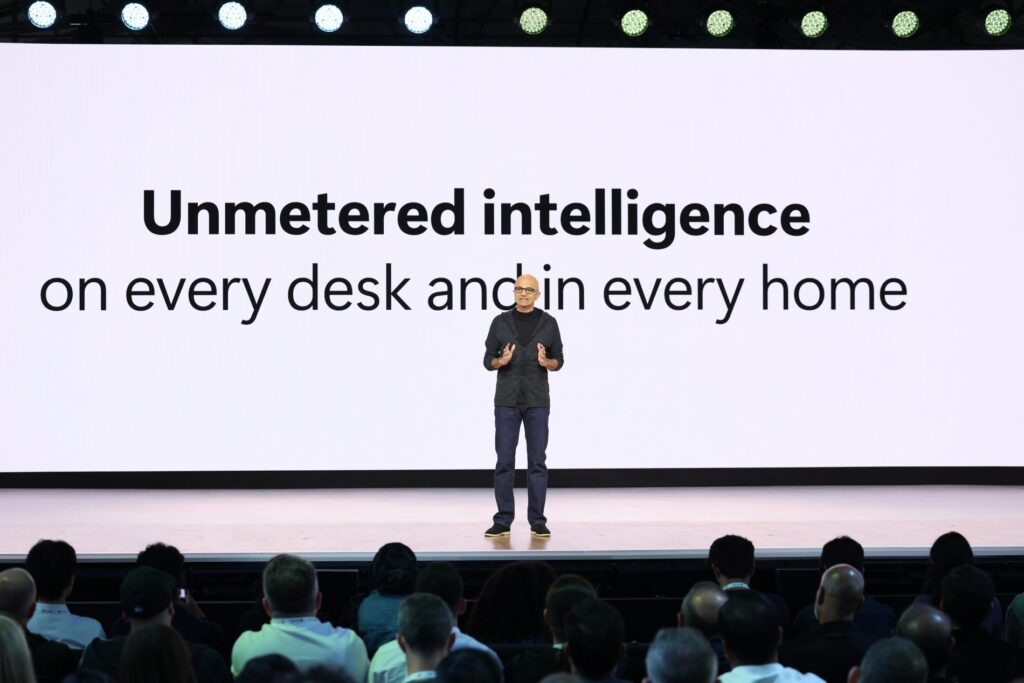
The afternoon before Satya Nadella walked onto a stage at Fort Mason, Microsoft Copilot went dark. More than 2,600 enterprise users reported outages on Downdetector before noon on June 1, 2026. The failure locked people out of workflows their companies had rebuilt around the assistant. Twenty-four hours later, Nadella opened Microsoft Build 2026 by promising autonomous agents that would run those workflows on their own.
That gap – between the failure and the promise – is where this story starts. But it is not what the story is about. For three years, the question facing every public company with an AI story was simple: do you have it? Build 2026 is where that question quietly died. Nobody in the room doubted Microsoft has AI.
The sharper shift wasn’t the question. It was who is now asking it.
The first reader of your earnings call is increasingly not a person but a machine. It is an AI agent that summarizes and scores you for the analyst before a human looks. At Build, Microsoft spent two days building exactly that kind of system. This piece is about the audience it creates: what we call the agentic audience. And what every team working in investor relations in the agentic era must do to earn an accurate read.
Here is the uncomfortable part. An investor moment built only for the people attending (live or virtually) is now half-built. The other half of your audience never shows up, never applauds, never forgets. And it is already grading you. The investor moment used to be a pitch. It is becoming an audit, one you volunteer for the moment you publish.

The agentic audience is the growing layer of AI systems that read, summarize, and score a company’s communications before any human does. It is the model an analyst runs across your earnings transcript to extract guidance. The tool that sentiment-scores management’s tone on the call. The agent that reconciles your slide deck against your filings and flags what does not match. By the time a human analyst forms a view, a machine has often already shaped it.
Build 2026 turned that abstraction into something you can point at, because Microsoft spent the keynote building the very class of system that does this work. It unveiled seven in-house MAI models, among them the reasoning model MAI-Thinking-1 and MAI-Transcribe-1.5, which handles 43 languages. They are summarizers, sentiment-scorers, and reasoning engines. In other words, they are the exact tools that now sit between a company and its investors. The company that demonstrated the agentic audience most vividly is also one of the companies building it. Microsoft did not invent this reader, and it is not building it alone. Google, OpenAI, and Anthropic are racing on the same class of system. What Build offered was the clearest view of it: the whole stack on one stage, in public – models, agents, web-grounding, governance.
Web IQ is the Bing-built service Microsoft unveiled to pull live web information into AI answers. And it already feeds both Microsoft Copilot and ChatGPT. Read that twice. The machine forming a view of your company is, increasingly, a handful of systems owned by the same companies whose clouds you publish on, whose models you depend on, and whose platforms you compete with. The agentic audience is not a neutral crowd assembling on its own. Someone is building it, and the supplier list is short.
Nothing announced at Build governs how an outside model reads or summarizes you. Microsoft’s governance story was real but pointed elsewhere: Agent 365 controls what your agents can touch and spend. The party being summarized has no equivalent protection. The reader is consolidating, and no one is accountable for the read.

A machine does not read the way a room does, and that single fact rewrites the job.
It cannot be charmed. Not by a confident founder, not by a clean slide, not by the conviction that carries a room. It does not attend a presentation; it parses one. It extracts the claims, checks them against the rest of your disclosures, and scores what reconciles. Charisma was always part of the IR toolkit. The agentic audience is immune to it. What it rewards instead is verifiability – a claim it can reconstruct, not one it has to trust.
This is why “do you have AI?” gave way to a harder set of questions. Can you govern it, can you reproduce the results you claim, and can you earn back what you spend. Each one is a question a machine can actually check.
Microsoft built its keynote to answer them in evidence rather than adjectives. It owned its reasoning model outright, trained without distillation. It unveiled an agent platform whose first Autopilot, Scout, runs on the open-source OpenClaw wrapped in enterprise governance. And Microsoft Foundry, a consumption-billing model, turned agent work into metered, countable usage.
Capability was the last decade’s contest. The next one is quieter and harder to fake: it rewards the company that AI can verify. A version of it has already played out in publishing. There, AI summaries answer for the source before readers ever click through. The businesses on the other end feel it, in their traffic and their revenue.
You cannot charm this reader. You can only hand it something to confirm. Numbers that reconcile across every document. Claims it can check on its own. Proof it can rebuild without taking your word for any of it. That is what reading you well now requires. The reader is here, and it is forming a view. The only question left is whether you have given it a story true enough to support.
You could watch this happen in real time at Build. Microsoft shares had run well off their late-March low going into the week, but the stock slipped during the event itself, sliding roughly 3 to 4% across June 2 and 3 to around $430.80. The pattern of that sell-off is the agentic audience caught in the act.
The market discounted the spectacle – a next-generation Majorana 2 quantum chip it could not yet price – and bore down on the one figure it could verify and model: performance per watt, where Microsoft claimed a 1.4x gain from running its own MAI models on its own Maia 200 chips. It rewarded what reconciled and marked down what it could not check. That is not how a crowd responds to a great show. It is how a system reads. The agentic audience was no forecast at Build; it was already in the tape, grading the most consequential AI company on earth in real time.
The bull case ran on the same currency. Morgan Stanley’s Keith Weiss argued Wall Street is underestimating the revenue Microsoft’s AI data-center spending will generate – by as much as 91% – and set a $650 price target against a roughly $557 “Strong Buy” consensus. Wedbush’s Daniel Ives, calling the recent OpenAI restructure a net positive, raised his to $575 and noted Microsoft will now collect roughly $6 billion from OpenAI in 2026. Notice what those targets rest on: not vision, but modeled, reconcilable numbers – revenue per megawatt, dollars per token, performance per watt. Even the human analysts are reading like the machines now.

None of this retires production. An investor moment is still a human performance. You are still building conviction, sequencing a story, earning a room’s trust in the span of a morning. The agentic audience does not replace that work. It adds a second, colder reading on top of it. A machine that was never in the room now parses everything you build for the people in it. The discipline is producing one event that lands both ways.
The two audiences reward different things, which is harder than it sounds. A few of the considerations that change how we build:
The agentic audience reads the transcript, the deck, and the filing. It does not read the lighting, the pause before the big number, or the certainty in a CEO’s voice. A point that landed only on its delivery will not survive the compression into text. The meaning has to live in the record, not only in the performance.
The agentic audience scores reconciliation a human eye forgives. Every figure has to tie across every document a system cross-references – deck, press release, 10-Q, transcript, call. The mismatch a person skims past is the exact thing the model flags. Consistency also runs across time. The reader holds your last several quarters and compares them in seconds. A quietly reclassified segment or redefined metric reads as drift. Flag the change before the model catches it.
It can’t hear conviction, but it reads the words that carry it. Hedging, heavy qualifiers, and a defensive Q&A answer register as uncertainty. One shaky line can color an otherwise strong quarter. Confident language is not only better for the room. It also scores better on the page.
A machine cannot infer the setup. The claims you most want understood have to be the easiest ones to extract and still be true. Say a number needs three slides of context to mean what you intend. The summary will keep the number and drop the context.
A machine can rebuild proof, so proof is what it rewards. Microsoft modeled this on stage. Its strongest demonstrations were the ones the audience could go run that same afternoon. The new coding model reached developers the day it launched, and the models rolled out live rather than “coming soon.” Our five Demo Modes for reading live AI demonstrations need a sixth: Verified Reproducible. Its credibility comes not from how it looked, but from how easily the audience can rebuild it. The IR translation is exact. An analyst – or the analyst’s AI – can rebuild a number from your filings. That number beats the one you ask anyone to take on faith.
Production craft is not exempt from this. If anything, it matters more. This year, Microsoft shrank Build into the workshop-scaled Fort Mason Center. It was a smaller, more exposed room than the stadium productions of years past. The choice traded spectacle for intimacy to rebuild developer trust. A smaller room is harder to produce, not easier – there is nowhere for thin material to hide. But the same instinct serves the AI analyst. A room built on substance rather than spectacle produces a clean record: proof-dense, claim-forward, easy to reconstruct. The production decisions that earn a skeptical room’s trust are, increasingly, the same ones that survive an agentic read.
A few overlooked materials become the load-bearing part of an investor moment. Each decides whether the story you told the room is the one that travels beyond it:
The last move is the one most teams skip.
After the event, query the major models and agents the way a covering analyst would. Read how they summarize you. Say they miss the thesis, mangle the guidance, or quote a number out of context. That is not a model problem. It maps exactly where your materials fell short, and you now know what to fix before the next one. The agentic read is no longer something to anticipate. It is something you can test, the same way you would rehearse a run-of-show. That is the difference between a team that talks about the agentic audience and one that produces for it.
None of these are particularly glamorous. They are what decides whether the story you told the room is the story that sticks.
This is what we consider when we approach any investor moment, live event, or public production. The room still gets the cinematic, human experience it came for: the narrative arc, the presence, the conviction that moves people. But we make sure that every asset that leaves the building will survive the second, thorough machine reading.
It echoes something we explored in Coinbase’s recent work: proving real human craft in a synthetic age. Build 2026 is the other side of the same coin. Coinbase had to prove provenance: that real people made the work. The agentic era asks for accountability: that the claim holds up to scrutiny. Both answer the one question that now defines high-stakes communication. When everyone assumes capability, and software can fake or automate almost anything, how do you generate trust?
The companies that own the agentic era will take the new reader seriously now. They will decide how the world understands them before a model decides for them. The ones that wait will not get a warning. They will simply find their story reaching the analyst pre-summarized. A model they never met will have framed it, in words they did not choose.
Your next investor isn’t only human. The audience now includes a machine that reads first, forgets nothing, and cannot be won over. At Build 2026, Microsoft showed everyone what it looks like by building it. You do not win that room with a better show. You win it with a story built from planning to playback. Both the people deciding and the machine briefing them have to read it the same way. That is the work, and it is worth starting before the reader starts deciding for you.
Microsoft Build 2026 centered on agentic AI. The headline announcements included seven in-house MAI models (led by the reasoning model MAI-Thinking-1), a new category of autonomous agents called Autopilots – the first, Scout, runs on the open-source framework OpenClaw – the Maia 200 AI chip, the Project Solara agent platform, and the Majorana 2 quantum chip.
Build 2026 marked the moment the investor question shifted from “do you have AI?” to whether a company can govern, reproduce, and monetize it. For IR teams, it signals that capability is now assumed and proof – of control and return – is the new mandate.
The Agentic Audience is the idea that the first reader of your earnings transcript, investor day deck, or keynote is increasingly an AI system that summarizes and sentiment-scores you for the analyst before a human reads a word. Companies now produce investor communication for both humans and the models that brief them.
Microsoft stock fell roughly 3–4% across June 2–3, 2026, to around $430.80. Investors treated the flashiest reveal, the Majorana 2 quantum chip, as a long-term catalyst, and kept pressing on AI capital spending, margins, an expanded FTC probe, and broader macro headwinds.
Beyond its core AI platform, Microsoft Build 2026 introduced Azure HorizonDB, a managed PostgreSQL service for agentic apps; a GPU-accelerated Fabric Data Warehouse for faster analytics; Project Rayfin, a managed backend-as-a-service on Microsoft Fabric that closes the prototype-to-production gap; the MAI-Voice-2 and MAI-Transcribe-1.5 models, the latter covering 43 languages; and Web IQ, a model-agnostic, MCP-native grounding layer that already powers both Microsoft Copilot and ChatGPT.
The agentic era is rewriting what proof looks like in front of investors, and the companies that adapt first will set the standard. If you are planning a high-stakes moment and want to build it to convince both the room and the models reading it, let’s start a conversation.
Investor day production, even in the simplest sense, is no small task. Your company will spend six to nine months and a budget that can run past a quarter of a million dollars to prepare for a single day. The leadership team will rehearse. Legal and finance will sign off on every number. The deck will move through draft after draft. Then, somewhere in the second Q&A session, an analyst three rows back – or half-watching the webcast from a desk in Boston – will form the quiet judgment that moves your stock.
That judgment rarely turns on the strategy itself. It turns on whether you made the strategy easy to understand, easy to believe, and easy to repeat.
The research bears this out. When Corbin Advisors surveyed 453 investors, analysts, and IR executives in 2020, 76% of the investors and analysts said strong investor day content pushed them to buy shares or upgrade a rating. In the same study, 53% said weak content – content that confused them or raised more questions than it answered – pushed them to sell or downgrade. Same room, same executives, same numbers on the slides. Execution flips the outcome.
That study dates to late 2020, and two forces have only sharpened its conclusion since. The room is now permanently hybrid, and your first reader is increasingly not human. More on both below. The throughline holds: the strongest companies stop planning the investor day like a meeting and start producing it like a broadcast. That is what it has become.
A best-in-class investor day educates the market on strategy, gives investors access to leadership beyond the C-suite, and presents content substantial enough to stand on its own. Investors reward that with buys and upgrades – and punish poorly delivered content with the opposite. Increasingly, the deciding factor is production: a broadcast-quality webcast, a deck designed to survive scrutiny, educational video, and a durable digital home for the content afterward.
Institutional shareholders, active and passive alike, want deeper transparency into strategy and a sharper case for competitive advantage. Investor bandwidth keeps shrinking while the competition for attention climbs. Investors still value the format when companies use it well: 94% call investor days a good use of their time, though about a third qualify that endorsement, crediting the events only when the company executes.
Most companies leave the opportunity on the table anyway. Corbin found that 68% have held an investor day, yet only 19% hold one annually and 17% biennially, even though investors say they want these events every year or two. Show up on a credible cadence, execute when you do, and you already stand apart.
An investor day is not a low-risk educational exercise. It is a high-leverage moment that either reinforces confidence or creates friction, and production quality usually decides which. The upside is just as concrete as the downside. When Starbucks held its investor day in New York in January 2026, it used the platform to put a multi-year financial outlook behind CEO Brian Niccol’s “Back to Starbucks” turnaround, and it put leaders beyond the CEO on stage to walk investors through the plan. That is the job an investor day exists to do: turn a story investors have already heard into a framework they can underwrite. A clear narrative, backed by numbers and delivered well, still shapes how the market models your future.
Strip away the logistics and three themes run through the research.
The single biggest draw is exposure to management investors don’t normally see: business unit presidents, segment leaders, the next layer beyond the C-suite. In Corbin’s survey, 83% name next-level leadership presenters among the most important elements of an investor day, just ahead of access to senior leadership at 75%.
Investors weigh depth and credibility, not just the headline strategy. When only the CEO and CFO field questions, the bench looks thin. When the whole leadership team answers with confidence, the company looks durable.
71% of investors prefer content-rich slides supported by voiceover over image-heavy slides that lean on narration. They want the presentation to stand on its own.
This is not a minor preference: 88% rank the investor presentation as the leading source of company-generated information – on par with meeting management directly – and 78% call it Important to Critical to their due diligence, returning to the deck and transcript long after the room has cleared.
Investors want a credible long-term view – targets or milestones, framed as ranges with stated assumptions. A clear 60% prefer a three-year horizon for financial targets over any other timeframe. Without that forward view, the strategy reads as aspiration rather than commitment.
Here is where a production lens changes the conversation. Most of the avoidable failures aren’t strategic. They’re executional.
When Corbin ran its survey in 2020, 85% of investors still preferred to attend in person, and a live video stream of management counted as the rarer, more expensive option – even though 72% of remote investors said they wanted exactly that. That world is gone.
Hybrid is now the default, not the exception: investors expect a broadcast-quality stream, live virtual Q&A, a quickly published replay, and increasingly a virtual facility tour, and they judge the virtual and hybrid side of the event by the same standard as the room. Seeing and hearing executives still builds the familiarity and trust that drive investment decisions, but most of that audience now watches through a screen. Audio-only with a static deck quietly tells your most time-constrained investors that they’re second-class attendees, and nothing erodes credibility faster than a feed that drops mid-presentation.
When a dozen contributors assemble a deck with no design discipline, it cannot stand on its own, which is exactly what investors need it to do, often for years. The deck is not a backdrop. It is infrastructure for understanding, and its shelf life runs in years, not days.
This is the most useful and most misread finding in the report. Investors rate video as one of the least important investor day elements – but only because most corporate video at these events is promotional.
The same audience welcomes educational video: a look at a technology or manufacturing process, an operational deep dive, a customer’s voice, a facility most investors will never visit in person. The problem was never video. It was the brief.
Many teams treat the investor day as the finish line. The research frames it as the starting line – the event that should anchor every subsequent quarter of communication.
None of this replaces the strategy work – the perception study, the message alignment, the months of dry runs and Q&A preparation, and the discipline of staying inside Regulation FD under live questioning. It makes the work land.
Corbin’s research predates a shift now reshaping how investors take in your investor day. A human still makes the call. But more and more often, a machine reads first. Institutional investors increasingly run financial disclosures and IR materials through AI tools that surface guidance, detect sentiment shifts, and even scrutinize tone and word choice in executive commentary. The practice isn’t universal, but the investment community is moving decisively from experimentation to adoption, and these agents routinely ingest earnings transcripts, investor presentations, and IR-site analytics.
That adds a second reader to the brief without removing the first. AI systems reward material they can parse cleanly and misread or skip the rest. An image-heavy slide that hides the substance in a voiceover, a chart with no underlying text, a video with no transcript, a PDF with broken structure: each one reads clearly to a person in the room and poorly to the model summarizing your story for a portfolio manager. Notice the irony. The content-rich, self-contained deck investors asked for in 2020 is the same deck the machines can read in 2026.
So the discipline that serves human investors now does double duty. Clear structure, substance on the slide, a transcript attached to every video, and a clean, durable content home all read as quality to a person and as signal to a machine. Your microsite, deck, and transcript are not just an archive. They are the training data for how your equity story gets summarized when no one from your company is in the room to correct it.

Investor audiences do not only evaluate numbers. They also read confidence, coherence, and credibility, and those come through as much in how you present a story as in what it contains. The more complex the business and the higher the stakes, the more discipline the communication system demands.
That’s why we don’t treat the deck, the stage, the webcast, the video, and the microsite as separate assets. They’re connected parts of one investor experience. A confident leader on a clean stage, a deck that reads as clearly on a laptop in Boston as it does in the room, an educational video that earns its place, and a microsite that keeps the story intact for years – those reinforce each other. And in 2026 they have to land twice: once for the people in the room and on the webcast, and once for the AI systems parsing the record afterward. When any one of them is weak, the friction shows up in the Q&A and, eventually, in the rating.
Good investor communications make the story easier to understand, easier to believe, and easier to repeat. An investor day is the rare moment when you control all three at once. It’s worth producing like it.
Before your next investor day, ask one question of every element: will this still hold up six months from now, on a screen, parsed by an analyst’s AI, with no one there to explain it? If the deck can’t stand alone, the webcast looks like an afterthought, or the content disappears the week after, that’s where the ROI leaks out. Fixing it is a production problem, and production problems are solvable.
If you’re mapping out an investor day, roadshow, or analyst day and want the experience to reinforce your thesis rather than undercut it, we’d be glad to talk through how to produce, stream, and archive it.
Investors point to three things: meaningful access to leadership beyond the CEO and CFO, content substantial enough to stand on its own, and a credible long-term view of the strategy. Disciplined planning and execution – including a well-produced webcast and a deck that survives scrutiny – separate best-in-class events from forgettable ones.
Yes. Many investors still value attending in person, but hybrid is now the default rather than the exception. Investors joining remotely expect a live video stream of management with the slides visible, live virtual Q&A, and a quickly published replay. Produce the webcast as a reliable, broadcast-quality experience, not an audio afterthought, because most of your audience now watches through a screen.
Very. In Corbin’s research, 88% of investors rank it as the leading source of company-generated information, and 78% call it Important to Critical to their due diligence – returning to the deck and transcript long after the event. Design it to stand on its own, because it stays relevant for years.
Promotional videos tend to fall flat with investors. Investors welcome educational video – showcasing technology, operations, a process, or a customer’s perspective – especially when it gives remote viewers access to something they couldn’t otherwise see. The format isn’t the issue; the purpose is.
Treat the event as the beginning, not the end. Archive the webcast, deck, and transcript on the IR website or a dedicated microsite – Corbin’s best-in-class benchmark is five years, not the minimum twelve months – and reference the content in ongoing communications so the story stays consistent and easy to repeat.
Two shifts stand out. Hybrid is now the default rather than the exception, so a broadcast-quality webcast with live virtual Q&A is table stakes, not a premium add-on. And investors increasingly run your deck, transcript, and IR page through AI tools as a first pass, which puts a premium on clear structure, substance on the slide, and transcripts attached to every video. The fundamentals investors wanted in 2020 still hold; the audience and the channels around them have widened.
About: Corbin Advisors’ 2020 report argues that investor days are one of the highest-return communication platforms a public company has – but the return only materializes when a company executes the event against a specific set of investor expectations: real transparency, access to leadership beyond the CEO and CFO, content-rich substance, ample Q&A, credible long-term targets, and disciplined planning. Corbin’s data shows a wide gap between what investors want and what most companies deliver, and frames the investor day as the beginning of a communication arc rather than a one-day event.
The Cardboard Spaceship angle: Corbin defines what investors want. We extend it into how you produce it – and we update that 2020 study for 2026. The distance between a “run-of-the-mill” and a best-in-class investor day is increasingly a production and orchestration gap, not just a content gap: the deck that has to stand on its own for five years, the broadcast-quality webcast that hybrid audiences now treat as table stakes, the difference between promotional and educational video, and the digital home where the whole event lives afterward.
Two 2026 realities sharpen the case – hybrid is now the default format, and AI tools read your deck, transcript, and IR page before a human does, rewarding clean structure and penalizing image-heavy, transcript-less content. High-stakes investor moments need a production system, not a vendor patchwork.
This article has been updated to include insight following the Google I/O 2026 event.
Live AI is the highest-risk recurring moment in any major company’s annual calendar today. And almost no one outside a handful of production teams has a clear framework for how to think about it.
Most of the conversation about AI demos focuses on what the AI does. The harder question is how the production around the demo reinforces its value. The old playbook was designed for deterministic software – scripted, rehearsed, locked down. And, simply put, agentic AI doesn’t work that way.
The product is unpredictable. The demo runs once – with the share price moving in real time. The production team can’t fully constrain the output. And the audience is watching with their finger on the share button. Get it right and you reset the equity narrative. Get it wrong and you become the case study in someone else’s analysis.
Google has been the case study before. In February 2023, a single live Bard demo answered one question incorrectly about the James Webb Space Telescope. By the next day’s close, Alphabet had lost roughly $100 billion in market capitalization.
In a few days, Sundar Pichai will walk back on stage at Shoreline Amphitheatre for Google I/O 2026. (The keynote begins at 10:00 AM PT on Tuesday, May 19.) Reports point to a major Gemini model update, a new agentic AI assistant called Gemini Spark, Android 17, and the unveiling of Aluminium OS. Some of these will demo well in a controlled environment. Others will require live, multi-step, agentic AI performance in front of a global audience. Fortunately, the production discipline that distinguishes a credibility-building demo from a market-moving disaster has been developed largely in public, by Google itself, over the past nine years.
And to interpret Google I/O 2026, you have to understand the framework Google has been building since 2018.
For decades, corporate live demos followed a simple production logic. You wrote the script, ran the rehearsals, and planned for what could go wrong. A Salesforce dashboard demo. An iPhone software walkthrough. An Adobe Creative Cloud feature reveal. The product behaved predictably because the demo was, in essence, a high-fidelity rehearsal performed live.
Live AI demos break that model in four specific ways.
Agentic AI works differently. You give the system a goal, and it decides how to get there. The production team can guide the prompt but not the path. How and what the model produces between input and output isn’t fully predictable. That’s both the promise of agentic AI – and the production risk.
Even with the same prompt, the model can produce a different response. Sometimes the difference is small. Sometimes it’s significant. Sometimes the answer is just wrong. Until the demo actually runs in front of the audience, the production team can’t know exactly what the model will say.
aA multi-step AI agent might take 45 to 90 seconds to finish a task. On a live stage, 45 seconds of an AI “thinking” is a production crisis. The audience disengages. The camera has nothing to cut to. The speaker has to fill the silence. A traditional software demo can choreograph every second. An AI demo can’t.
A traditional software demo failure is embarrassing. A live AI demo failure is a stock-moving event. The Bard incident wasn’t a fluke – it was the first clear signal of a new category of risk. Since 2023, more than one AI company has watched its share price move on the strength of a single live demo.
For us, these aren’t quirks to manage. They’re a structurally new production category. And they require a fresh approach.
No company has confronted the live AI demo problem longer or more publicly than Google. The framework isn’t written down anywhere, but it is present in the production decisions Google has made over the past nine years – including the ones it learned the hard way.
Six moments define that evolution.
At I/O 2018, Google played pre-recorded phone calls in which its Duplex AI assistant booked a hair appointment and called a restaurant. Sundar Pichai introduced the recordings as “the Google Assistant actually calling a real salon.” The AI sounded so human, complete with “um” and “uh” verbal tics, that the demo went viral within hours.
Then came the questions, first raised by Axios: why didn’t the businesses identify themselves when they picked up? Why was there no ambient noise? Were these genuine real-world interactions or carefully staged recordings? Google declined to provide the names of the businesses or confirm whether the calls had been edited. The credibility question presented a separate ethics issue: should an AI identify itself as AI when calling a human?
The lesson: When an audience can’t verify whether what they’re seeing is real, the demo creates more doubt than it resolves. Specificity, transparency, and verifiable detail are essential to earning trust and demo credibility.
Google held a small launch event for Bard featuring a promotional clip in which the AI gave a factually incorrect answer about the James Webb Space Telescope. Astronomers noticed within hours. Alphabet shares dropped about 7.7% the following day, erasing roughly $100 billion in market value.
The lesson: Every public AI output is a public statement. Fact-checking demo content isn’t a marketing task – it’s a risk management one.
Google released a six-minute video billed as “Hands-on with Gemini: Interacting with multimodal AI.” It appeared to show the model engaging with images, drawings, and a continuous spoken conversation in real time.
Within 24 hours, Bloomberg’s Parmy Olson reported that the demo had been constructed differently than the video implied: Gemini wasn’t responding to spoken voice or live video at all. Google’s team had fed the model still image frames and text prompts, then added the voice narration afterward in post.
Google’s disclaimer in the video description noted only that “latency has been reduced and outputs have been shortened.” The narrative shifted from “Gemini is remarkable” to “Google misrepresented Gemini.”
The lesson: The line between live demo and marketing video has to be transparent. The credibility hit when an edit gets exposed is worse than the lift from a polished demo.
At I/O 2024, Google unveiled Project Astra – its real-time multimodal assistant – with a deliberate production move that broke from prior patterns. The demo aired as two continuous takes, one on a Pixel phone and one on a prototype pair of smart glasses.
The signal to the audience was clear: Google hadn’t cherry-picked the responses. The model was handling a stream of inputs in real time, rough edges and all. Around that demo, Google also began explicitly labeling other AI segments as recorded or aspirational rather than implying everything was live. The change was subtle in execution but marked a significant milestone. Google had stopped trying to make everything feel live and had started telling the audience exactly what they were watching.
The lesson: Labeling the kind of demo you’re showing is the first rule of demo credibility. The audience will forgive almost any production choice if they know what choice you made.
At I/O 2025, Project Astra moved from research demo to shipping product, powering new experiences in Search Live, the Gemini app, and third-party developer tools. The production decision here was as significant as the engineering one.
Having spent 2024 carefully framing Astra as a live, unscripted experience, Google could now invite the audience to use the same capability themselves. The demo and the product had become indistinguishable, which is the highest form of credibility a live AI demo can earn.
The lesson: When the AI demo eventually becomes a product launch, the production discipline that surrounds it becomes the foundation for long-term trust.
At I/O 2026, Google staged the most agentic-AI-heavy keynote in the event’s history. Gemini Spark – a 24/7 personal AI agent designed to act autonomously across apps, emails, and calendars – was the headline product. Antigravity 2.0 was demoed by showing an operating system that the AI had built from scratch over 12 hours, then demonstrating it running Doom live on stage.
The Samsung XR glasses demos had real-time presenters using the eyewear to ask Gemini where to meet a friend, order coffee with a tip, and capture photos – rough edges visible, no edits. The doctrine held. No demo failures on the scale of Bard 2023. The framing across the keynote was unusually clean: live demos clearly labeled as live, aspirational segments clearly labeled as future-state.
The lesson: When a company builds the framework for nearly a decade, the production framework starts to feel native rather than imposed. But clean execution alone isn’t enough anymore – the audience now expects production to also resolve the strategic questions they walked in with.
That’s nine years of drafting the playbook, paid for in public embarrassment, market cap, and corrective communication. It distills into a single principle: the audience doesn’t need the demo to be perfect – but they need to know exactly what kind of demo they’re watching.
Which brings us to the framework.
Most companies treat a live AI demo as a binary – either it’s live or it isn’t. The actual production reality is a spectrum, and failure in almost every public AI demo controversy comes down to misalignment between which category the audience thought they were watching and which one was actually being staged.
There are five distinct ways to stage a live AI demo. We call them the Demo Modes – a five-category framework for live AI production
rThe AI runs in real time during the event. No pre-staging. No predetermined output. The speaker delivers an input, and the audience watches the response unfold in real time. Highest credibility, highest production risk. The two continuous-take Project Astra demos at I/O 2024 were the clearest recent example of Mode 1 done well.
The AI is running in real time, but inside a controlled environment. The prompts are curated, the use cases are scoped. The model is genuinely working, but the production team has narrowed what it might be asked to do. Mid-high credibility when the framing is transparent, mid risk. Most enterprise software AI demos today are Mode 2 whether the company says so or not.
The AI completed the task minutes or hours before the event. The audience watches the playback of an actual real run – including any imperfections – with the speaker explicitly framing it as such: “We ran this just before walking on stage. Here’s what it produced.” Mid credibility when disclosed, low risk. This mode is dramatically under-used. Done well, it captures most of the trust of a live demo while significantly lowering the risk of failing on stage.
A polished video of the AI performing a task, clearly labeled as recorded. Low credibility for capability claims but high credibility for visual production quality. The Gemini Hands-On video would have qualified as Mode 4 if Google had labeled it that way. The controversy emerged because it wasn’t.
Explicitly framed as “what’s possible,” “what we’re building toward,” or “where this is headed.” It’s a preview of where the product is going – not proof of what it can do today. Lowest credibility for capability claims, but useful for setting vision. Google should have framed the Duplex demo at I/O 2018 this way. Instead it was framed ambiguously enough to read as Mode 1.
The Demo Modes aren’t a ranking. They’re a set of choices. A keynote can deliberately mix categories – Verified Live for the headline demonstration, Constrained Live for the enterprise capability, Pre-flight Live for the agentic workflow, Pre-Recorded for the partner integration, Aspirational for the long-term roadmap.
The discipline isn’t picking the “best” mode. The discipline is making sure the audience knows which one they’re watching.
The framework becomes most useful as a real-time reading tool. Here’s how it applies on Tuesday, May 19.
Reports point to a major Gemini model update at the keynote – whether labeled Gemini 4 or a 3.x successor. The production question is which mode Google chooses for the headline demonstration. Verified Live (Mode 1) would be the most confident move – signaling that Google trusts the new model to perform outside of a controlled environment. Constrained Live (Mode 2) would be the more cautious choice. If Google frames the demo as anything other than Mode 1 or 2, that’s a signal worth noting.
Leaks point to a new agentic AI assistant called Gemini Spark – designed to work autonomously across apps, emails, calendars, and websites. Booking flights. Managing email. Filling out forms. This is the most production-risk kind of demo a company can stage today, because every action links to the next, and a single failure cascades across all points. The production decision is whether to demo Spark’s full workflow live (Mode 1 – high risk, high reward), to scope it tightly (Mode 2 – safer, less impressive), or to compress the experience via Pre-flight Live (Mode 3 – the team runs it just before the event and acknowledges it openly). Watch for the speaker’s framing language at the moment of the reveal. If they say “we ran this just before walking out,” that’s Mode 3 done well. If the demo cuts cleanly between steps without acknowledgment, the production team has chosen polish over transparency.
Every live AI demo at I/O 2026 will have some friction. Latency. A response that lands awkwardly. A model output that’s correct but visually unimpressive. The production decision is whether to absorb that friction visibly (the Astra 2024 approach) or to edit it out (pre-2024 approach). The Astra approach is the more mature move. Watch for it.
I/O 2024 introduced explicit labeling. I/O 2025 refined it. If I/O 2026 makes the live vs. recorded distinction even cleaner – graphics, lower-thirds, verbal framing – that’s Google institutionalizing their framework. If the line blurs again, that’s a regression worth flagging.
The most consequential audience at I/O 2026 isn’t the developers in Shoreline. It’s the institutional investors evaluating Google Cloud’s AI revenue trajectory. Pichai disclosed at Cloud Next 2026 that just over half of 2026 ML compute investment will go to the Cloud business. The Cloud demos at I/O have to translate that capex into a credible product story. Watch how those demos are categorized. Constrained Live with enterprise customer logos as visible validation carries weight. Aspirational framing doesn’t.
Anyone who watches I/O 2026 with the 5 Demo Modes framework in hand will likely walk away from the keynote with a deeper understanding of these products and features than the reader who watches for product news alone.
The 5-Mode framework names the demo categories, but the execution lives in the production decisions that distinguish one category from another. Four of them carry disproportionate weight.
Mode 1 (Verified Live) requires real-time agility. The speaker has to be ready to narrate whatever the model produces – including responses they’ve never seen before. That’s a different kind of prep than walking through a rehearsed click sequence. Pichai’s comfort with live AI moments is a production advantage Google has built over years. Most CEOs aren’t there yet.
Every live AI demo needs a written set of fallbacks: if the model produces a problematic response, what does the speaker say next? If latency drags on, where does the camera cut? If the demo fails entirely, how does the show move on without acknowledging it? The audience never sees the contingency. They only see the recovery. The Bard launch failure wasn’t a demo failure – it was a contingency-planning failure. The factual error was visible in promotional materials before the event. Better fact-checking should have caught it.
When a live AI demo is processing, the camera has to go somewhere. A cut to the speaker carries one signal. A cut to crowd reaction carries another. A cut to a product graphic carries a third. Each choice tells the home audience something different about whether to trust what’s happening. At I/O scale, this requires a director, multiple operators, and pre-planned camera blocking for every demo segment.
Mode 3 demos don’t happen by accident. They require the production team to actually run the demo backstage, capture the output, and have it ready to play back within minutes of the live moment. That’s a second production happening at the same time as the live event. Most companies don’t budget for it. The ones that do have a tool the others don’t.
These decisions aren’t decorative. They’re the difference between a demo that builds credibility and one that costs market cap.
Google I/O 2026 isn’t an isolated event. It’s the first in a three-week window that includes Microsoft Build (June 2–3) and Apple WWDC (June 8–12). All three companies will stage live AI demos. All three will face the same production decisions. And by the end of June, the industry will have its first complete data set for how the leading public AI companies are navigating the new production risk.
And others are watching them closely. Salesforce Dreamforce in September will stage Agentforce demos. Workday, ServiceNow, Adobe, and every major enterprise software company will demo agentic capabilities at investor moments over the next year. The companies that have a clear live AI demo framework will appear more credible than those with technically superior AI but worse production discipline.
That’s the broader implication. When every public company is staging live AI, the production discipline around the demo becomes part of the equity story itself. Not just for the AI labs – for any company whose narrative depends on showing product capability and evolution.
The 5 Demo Modes aren’t a prescription. Different companies, different audiences, different products will call for different combinations. What every company needs is the vocabulary to make those choices on purpose – not by accident.
Google has been learning that vocabulary in public for eight years. The lesson the rest of the industry has yet to fully absorb is that the question isn’t whether to demo live. It’s whether the production team is ready to handle what happens when you do.
The high-wire act is permanent. The model for walking it is still taking shape. Google I/O 2026 is the next big stage.
That’s the work worth investing in. It’s also the work Cardboard Spaceship builds for clients navigating the moments that matter.
Update: This section was added after Google I/O 2026 wrapped to validate our framework against the actual two-day event.
Google I/O 2026 ran from May 19 to May 20. Sundar Pichai walked off the Shoreline Amphitheatre stage having staged the most agentic-AI-heavy keynote in the event’s history – followed by a Developer Keynote that quietly proposed an architectural overhaul of how the web itself works. Here’s how it tracked against the framework, and what the broader industry should take from it.
Varun Mohan, head of Google’s Antigravity platform, demoed agentic coding by showing how Antigravity and Gemini 3.5 Flash together built a functioning operating system from scratch in 12 hours, using less than $1,000 of tokens. The OS was then demonstrated running Doom live on stage.
This was a textbook Mode 3 (Pre-flight Live): the AI did the actual work autonomously in the hours before the event, and the audience saw the genuine output. The catch: Google didn’t visually communicate the Pre-flight Live nature of the demo as clearly as the framework would prescribe. The 12-hour reality was disclosed verbally but compressed into a moment that read closer to Mode 1 in the audience’s mind. The most impressive demo of the keynote and the most under-framed production move – at the same time.
Josh Woodward took the stage to show Spark planning a block party – coordinating schedules, permits, and calendar integrations through tightly scoped prompts on an iPhone. The model worked in real time, the prompts were curated, the use case was defined. This was the right production decision for a brand-new product with broad cross-app permissions.
Spark is genuinely high-risk to demo because every action chains to the next. Constrained Live limits that chain to a deliberate set of steps without sacrificing the live energy.
Real presenters on stage using the glasses to ask Gemini where to meet a friend, order coffee, and capture photos – with rough edges left in. This was the production choice closest to the Astra 2024 approach. The friction wasn’t hidden. The audience saw the model working in real time, sometimes imperfectly, and trusted what they saw more for it.
Demis Hassabis’s “AGI is now on the horizon” framing was explicitly labeled as future-state – not current product. This is exactly how Mode 5 should work. The audience knows they’re being shown a vision, not a capability. No credibility cost. No expectation mismatch.
Day 1 afternoon brought the announcements with the longest-tail production implications: WebMCP, an open web standard for AI agents; Chrome DevTools for agents as a stable 1.0 release; HTML-in-Canvas; Modern Web Guidance; Android CLI; Android Bench. The framing in Google’s own keynote recap: “We’ve transitioned from AI that simply assists you, to agents that can independently navigate complex tasks across your entire workflow.” This is the bet that recasts every live AI demo from this point forward. Every demo is now also a demo of the agentic web thesis – and the production stakes have just compounded.
No demo failures on the scale of Bard 2023, no edited-video controversies, no credibility leaks. The framing across the keynote was unusually clean: live demos clearly labeled as live, aspirational segments clearly labeled as future-state. And yet Alphabet’s stock slid during the keynote. The next morning, BofA reaffirmed Alphabet at a $430 price target, Wells Fargo raised its target to $435, and Morgan Stanley called out the “agentic offerings across commerce, travel and daily life.”
So the picture is nuanced: the demos themselves didn’t fail, but the production didn’t sufficiently answer the question Wall Street walked in with – how AI Mode in Search will be monetized when 93% of those searches already end without an external click. The lesson is sharper than “live demos move markets.” It’s that production decisions are now responsible for resolving the audience’s open questions, not just demonstrating the product. The Bard-era risk was that a live demo could break the equity story. The new risk is that even a clean live demo isn’t enough.
Microsoft Build (June 2–3) and Apple WWDC (June 8–12) will stage their own live AI demos – and their own answers to the agentic web thesis Google just planted. Both companies have learned from Google’s nine-year public arc. By the end of June, the industry will have its first complete data set for how the leading public AI companies are handling not just the production risk of live demos, but the production responsibility of resolving institutional questions in real time.
Watch which Modes they choose. The framework still applies. The stakes just got higher.
That’s the work worth investing in. It’s also the work Cardboard Spaceship builds for clients navigating the moments that matter.
The most consequential moments in modern corporate communications now run on live AI. Whether you’re preparing for an Investor Day, a product launch, a developer event, or an investor moment that includes an agentic demonstration, the production decisions you make now will define how the market reads your capability when the moment arrives.
Let’s start a conversation →
CNN Business: Google shares lose $100 billion after AI chatbot makes error during demo — February 2023
NPR: Google’s AI chatbot, Bard, sparks a $100 billion loss in Alphabet shares — February 2023
TechCrunch: Google’s best Gemini demo was faked — December 2023
Engadget: Google admits that a Gemini AI demo video was staged — December 2023
TechCrunch: Duplex shows Google failing at ethical and creative AI design — May 2018
Axios: What Google isn’t telling us about its AI demo — May 2018
TechCrunch: Google’s Gemini updates: How Project Astra is powering some of I/O’s big reveals — May 2024
TechCrunch: Project Astra comes to Google Search, Gemini, and developers — May 2025
Google Blog: Alphabet Q1 2026 earnings remarks — April 2026
Google Blog: Sundar Pichai shares news from Google Cloud Next 2026 — April 2026
Google I/O 2026 Official Site
OpenAI and Anthropic haven’t filed for an IPO. But the production architecture of their eventual roadshows is already taking shape – in plain view, if you know what to look for.
DevDay 2025 looked like a developer conference. The 45-minute fireside chat between Sam Altman and Jony Ive, Apple’s former Chief Design Officer, looked like something else. To us, it played as a moment built for the institutional investors who would parse it on YouTube the next morning. Hardware ambition. Design pedigree. A three-year collaboration framed as a thesis paragraph for a future S-1.
From a production lens, that fireside reads less like a developer feature – and more like a cap-table signal.
The same pattern is playing out across the AI sector. Anthropic launched Code with Claude in May 2025 and expanded it across San Francisco, London, Tokyo, and Washington, D.C. The tour read as measured and technically rigorous, less like dev relations and more like the discipline of a public company running its narrative arc.
Audience composition appears to have shifted as well. The staging looks heavier. And the production decisions; line-of-sight blocking, fireside choreography, demo handoff timing, partner sequencing – increasingly resemble the staged moments a public company runs the year before it files.
We’re not predicting IPO timing. But we are saying the rehearsal is happening in plain view, and the production choices these labs are making now are the same ones every IPO candidate makes when they want institutional money to recognize them on sight.
The class of 2024–2026 – Reddit, CoreWeave, Klaviyo, Rippling – gave us a fresh dataset on which roadshow production decisions land and which don’t. Read that dataset alongside what’s happening at DevDay and Code with Claude, and the playbook for the next mega-IPO begins to write itself.
Here’s what we’re seeing.
Most coverage of DevDay 2025 focused on the announcements: GPT-5 Pro and Sora 2 in the API, ChatGPT Apps with Zillow, Booking.com, Target, Figma, Expedia, Uber, Instacart, OpenTable, DoorDash, and Peloton. AgentKit for autonomous workflows. Codex Slack integration.
The product news is the obvious headline. The interesting questions are about what the staging communicates.

At events of this scale, production choices rarely feel decorative. Instead, they tend to be directional. In our experience, every decision (who shares a stage, what experiences attendees walk through, which conversations linger in the memory) functions as a deliberate signal; first to the room, then to the much larger audience that catches clips, photos, and analyst recaps for weeks afterward. The question isn’t whether OpenAI staged DevDay 2025 carefully. It’s what the staging reveals about the story they want to tell.
Three production choices stand out.
When Altman sat down with Jony Ive, the staging seemed to communicate something specific to the financial world: this isn’t just a software company.
There’s hardware ambition, design pedigree, and a partner whose work shaped the iPhone, iMac, and Apple Watch. The chat felt unscripted enough to seem intimate, and structured enough to land its key points. Ive said his creative team’s purpose “became clear” with the launch of ChatGPT. Altman framed the collaboration as a three-year arc.
For developers, that’s a curiosity. For institutional investors evaluating whether OpenAI commands a hardware-software stack story, that plays as a thesis paragraph. Worth noting: the conversation wasn’t even livestreamed. It went up on YouTube hours later. To us, that distribution choice reads as confidence. The most consequential moment of the day didn’t need to compete for live attention.
A “cozy mini-theater with popcorn” featuring AI-generated short films sounds like a fun side-activation. Look closer. It’s a positioning argument. Sora moved from research preview to API offering at this event – a defining moment of value that extended far beyond a product demo.
The mini-theater turned attendees into an audience, not testers. Watching AI-generated film with popcorn in hand frames Sora as cinema. Watching it on a laptop frames it as a tool. The production choice tells the market which one OpenAI wants Sora to be.
That’s the same staging logic Reddit used in 2024 when it leaned into community as the equity story rather than DAU metrics. The product becomes the experience. The experience becomes the narrative.
The DevDay 2025 lineup looks deliberately chosen.
Each speaker delivered real content, and each one provided OpenAI with powerful, specific validation.
Stitched together, these three choices read as a single argument: this is a company with consumer scale, hardware ambition, and ecosystem depth. Whenever OpenAI eventually files, the components of the equity story are already on stage and evolving right in front of us.
Anthropic took a notably different production approach. Code with Claude launched in May 2025 as a single-day, hands-on conference at The Midway in San Francisco, then expanded into a multi-city series across San Francisco, London, Tokyo, and Washington, D.C. Where DevDay leans into spectacle, Code with Claude leans into rigor. Three choices stand out.

OpenAI sold $650 in-person tickets to anyone who clicked. Anthropic took applications and curated the room. To us, that’s a meaningful production decision.
Curating the audience signals to the financial world that the company controls who sees its developer relationship up close. It also implicitly positions Claude as a premium tool for serious builders rather than a consumer phenomenon.
For institutional investors evaluating where Anthropic sits in the AI stack, the application gate is exactly the kind of credibility signal that filters retail froth out of the room. That’s a strategic choice.
The decision to expand from a single SF event into a four-city tour mirrors how a public-company roadshow actually moves: deliberate geographic coverage, repeat performance discipline, the same narrative delivered to different markets.
To our eye, that’s not a developer marketing choice. That’s the rehearsal of an institutional travel pattern. Anthropic ran the SF, London, Tokyo, and DC sequence in 2025 and is following with additional cities in 2026.
The geography choice is itself a story. London for European enterprise. Tokyo for the kind of legitimacy that only comes from showing up in Asia’s most established tech and finance market. DC for policy and regulatory presence. Each city carries a specific part of the narrative to a specific audience.
AWS hosted official Code with Claude watch parties as satellite events. Most coverage treated this as a technical convenience. To us, it reads differently.
Look at it from a production standpoint: a major cloud hyperscaler is volunteering its physical and digital infrastructure to extend the reach of an Anthropic-branded event. AWS is Anthropic’s largest cloud distributor and a strategic investor with billions committed to the partnership. By hosting watch parties, AWS publicly performs that alliance – turning a developer event into a visible signal of institutional backing.
That’s the kind of credibility and distribution muscle most pre-IPO companies have to pay for. Anthropic has it built in.
Where OpenAI’s staging emphasizes scope and consumer reach, Anthropic’s emphasizes curatorial access, depth, and enterprise readiness. The cap-table signal differs accordingly. OpenAI seems to be telegraphing a story about scale, hardware, and platform breadth. Anthropic seems to be telegraphing a story about discipline, enterprise traction, and infrastructure partnerships. Both are legitimate pre-IPO postures. They simply imply different equity stories – and likely different institutional investor profiles when the filings eventually land.
To know what the AI labs are rehearsing, look at the recent IPO class. Four roadshows in particular produced distinct production case studies.
Reddit gave away 8% of its IPO to its users. 1.76 million shares allocated to 75,000 of its most active Redditors and moderators. Karma score decided who qualified. No lock-up period.
It was an unusual move and a deliberate one. Reddit’s equity story depended on community. A slide deck couldn’t tell that story; allocating real shares to real users could. Steve Huffman didn’t have to argue that Reddit had a unique relationship with its users. The directed share program was the argument.
The lesson: when your story depends on community, your investor day staging has to make the community visible, not just cite it in the deck. Reddit priced at $34 and opened at $47, a 38% first-day pop. The S-1 flagged real risk in the structure (no lock-up could amplify volatility, and some Redditors actively organized against the IPO), and the narrative architecture worked anyway. Users-as-shareholders is now an established roadshow technique that Uber, Airbnb, and Cava had used in lighter form.
CoreWeave downsized its IPO from $2.7 billion to $1.5 billion the day before launch. Institutional demand had softened. NVIDIA reportedly stepped in with a $250 million anchor purchase to get the deal across the line. CoreWeave priced at $40 on March 28, 2025, and the first day of trading closed flat.
The roadshow ran into a recognizable problem. The pitch was infrastructure-heavy and visually abstract: GPU capacity, liquid cooling, Kubernetes-native architecture, 250,000 GPUs across 32 data centers. All accurate. None of it tangible to a public-market investor who has never set foot in a data center.
The lesson: data center stories need physicality on stage. Slides and spreadsheets make “AI infrastructure” sound like a commodity. The tools that turn an abstract category into an investable thesis (data hall walkthroughs, rack density comparisons, heat-and-power math made visual) only work when the production team builds them in. CoreWeave eventually went on a 250%+ tear post-IPO once the market understood the story. The challenge wasn’t the company. It was the translation of the narrative – both visually and experientially.
Klaviyo was the first SaaS IPO in nearly two years. The market was frozen. Marketing automation isn’t a category that excites public-market investors. CEO Andrew Bialecki later called it an “IPO winter.”
So Klaviyo led with the founder. Bootstrapped origin. MIT-trained engineer. $100M strategic investment from Shopify. 119% net dollar retention. 51% YoY growth. GAAP profitability. Rule of 75 metrics. Bialecki himself became the narrative spine of the roadshow.
The lesson: when the product is unsexy, the founder narrative carries the staging, and that requires founder coaching, not slide design. Bialecki had to learn how to be the equity story in real time, in dozens of one-on-one institutional meetings, with no fireside chat to lean on. That’s a different production discipline than a celebrity CEO event. It’s intimate. It’s repetitive. It requires the founder to deliver the same emotional beats with freshness on the fortieth pitch. Klaviyo priced at $30, raised $576 million at a $9.2 billion valuation, and opened with a 23% first-day pop. The market recognized a credible operator, not just a magnetic personality.
In February 2026, Rippling aired a Super Bowl ad. Not because it was selling HR software to households. Because the company is making itself a household name before it asks public-market investors to recognize it.
Rippling hasn’t filed an S-1. CEO Parker Conrad has said publicly that an IPO isn’t imminent. Yet the production preparation is unmistakable. Rippling raised a $450 million Series G at a $16.8 billion valuation in May 2025. Annual revenue reached $570 million in February 2026, growing over 30% YoY with net revenue retention approaching 200%. The Super Bowl ad slot ran around $7 million.
Layer in the Deel lawsuit subplot. Rippling sued its largest competitor in March 2025 alleging corporate espionage; Deel countersued in April. The result is a roadshow narrative-in-waiting with built-in tension, competitive stakes, and a story arc the market is already following.
The lesson, even before the S-1 lands: the best roadshows aren’t built starting at the prospectus filing. They’re built years earlier, through brand investment, narrative seeding, and earned-media architecture. By the time Conrad walks into his first investor meeting, the story will already be partly told. Watch how the roadshow handles the Deel feud, whether it’s foregrounded as competitive moat or treated as backdrop noise. That choice will tell you everything about how Rippling has rehearsed its public-company identity.
Map the four cases onto OpenAI and Anthropic, and the patterns start to line up.
To us, the interesting observation isn’t that these labs will eventually IPO. It’s that the production preparation for that moment appears to be happening on the stages we’re already watching. DevDay and Code with Claude read as public dress rehearsals. The audience swap-out (developers in 2025, institutional investors in 202?) is mostly a matter of who’s in the room. The staging architecture is portable.
OpenAI’s ChatGPT has reached 800 million weekly active users (as Altman announced at DevDay 2025). The pre-IPO question is whether any of those users become shareholders. SpaceX just precedent-set the retail allocation question with its 30% retail target. DevDay’s Apps SDK announcement, which lets users chat directly with apps from Booking.com, Zillow, Target, Figma, and others, is the technical precondition for a community-visibility play at IPO. OpenAI is staging the infrastructure now.
Both labs face the data-center-economics problem. Both are spending tens of billions on compute. Both have the same risk: investors hearing “infrastructure” and pricing it as commodity capex. Sora Cinema was a small move in the opposite direction, making AI compute feel like a consumer experience rather than a balance-sheet item. Anthropic’s API-and-MCP focus at Code with Claude is the more enterprise-coded version of the same instinct. Whoever IPOs first will need a tangibility moment in their roadshow that CoreWeave didn’t quite execute.
Sam Altman is on stage all the time, but a roadshow is a different production challenge: dozens of intimate institutional meetings, repeated questions, no audience. Dario Amodei rarely takes that kind of stage. Both will need to develop the discipline of delivering the same narrative architecture, freshly, to room after room, for two weeks straight. That work happens long before the S-1.
This is where the AI labs appear most clearly to be rehearsing. The Sam Altman / Jony Ive partnership reads as brand seeding. Anthropic’s policy presence in Washington reads as brand seeding. Code with Claude’s multi-city expansion reads as brand seeding. None of it is sales activity. To our eye, much of it functions as roadshow preparation by other names.
The combined effect: the AI labs appear to be running all four production patterns at once, with bigger budgets and longer runway than any of their predecessors. By the time the S-1s eventually land, their production foundations will be deeper and more multi-dimensional than anything Reddit, CoreWeave, or Klaviyo had the runway to build.
If you’re a head of IR, head of corporate comms, or growth-stage CFO watching this rehearsal play out, here’s the framework outlined by these events:

Who’s in the room, and visibly in the room, is itself the equity story. The presence of an a16z partner on a developer stage doesn’t communicate the same thing as a developer relations engineer.
Every roadshow needs a single staged conversation that conveys narrative information no slide can. For OpenAI it’s Altman + Ive. For Reddit it was the moderator share program. For Klaviyo it was the founder’s bootstrapped credibility. Find yours.
If your story includes infrastructure, capacity, scale, or technical depth, design at least one production moment that translates the abstraction into an embodied experience. CoreWeave’s roadshow under-indexed on this. Sora Cinema was a low-stakes attempt to learn the lesson early.
Every speaker on your stage represents a category of validation: customer voices, partner voices, investor voices, civic voices. Choose the mix to match the equity story you’re telling, not just the agenda you’re filling.
Roadshows happen in conference rooms with twenty institutional investors at a time. The founder who’s brilliant on stage isn’t automatically brilliant in that room. Different muscle. Develop it years in advance.
Rippling’s Super Bowl ad. OpenAI’s Apps SDK partner announcements. Anthropic’s policy and developer presence. The roadshow doesn’t begin at the filing date. It begins the moment institutional investors first start hearing your name in unscripted contexts.
DevDay’s keynote streamed live. The Altman + Ive fireside didn’t, but went up on YouTube the same day. That sequencing is deliberate. Live serves urgency; on-demand serves reach. Design both.
When the AI labs eventually file, every staging choice they’re making now becomes part of the institutional case file investors use to evaluate them. The rehearsal is the record.
The bright line between “developer event” and “investor day” appears to be dissolving.
This isn’t unique to the AI sector. To us, it reads as an ongoing structural shift. Companies with consumer scale, enterprise depth, and platform ambition can’t run their pre-IPO communications through a single channel anymore. The audience for an IPO is now a constellation: institutional investors, retail allocations, developer ecosystems, enterprise buyers, regulators, partners, employee shareholders, and a financial press taking cues from social platforms. Every staged moment a company runs in the years before filing reaches some subset of all of them.
That makes production more strategic, not less. The companies that stage their developer events with the audience composition of an Investor Day in mind, that invest in their brand before the prospectus, and that coach their founders for both the keynote and the conference room, should have an enormous advantage over companies that wait until the S-1 to start thinking about narrative.
The rehearsal is the production. By the time the S-1 hits, the show is already running.
That’s the work worth investing in. It’s also the work Cardboard Spaceship builds for clients navigating the moments that matter.
The next generation of IPO roadshows won’t start at the S-1 filing. They’ll start years earlier, in the staged moments that quietly build institutional recognition. Whether you’re preparing for an Investor Day or the long lead-up to a future filing, the production decisions you’re making now will define how the market responds when the moment arrives. Let’s start a conversation →